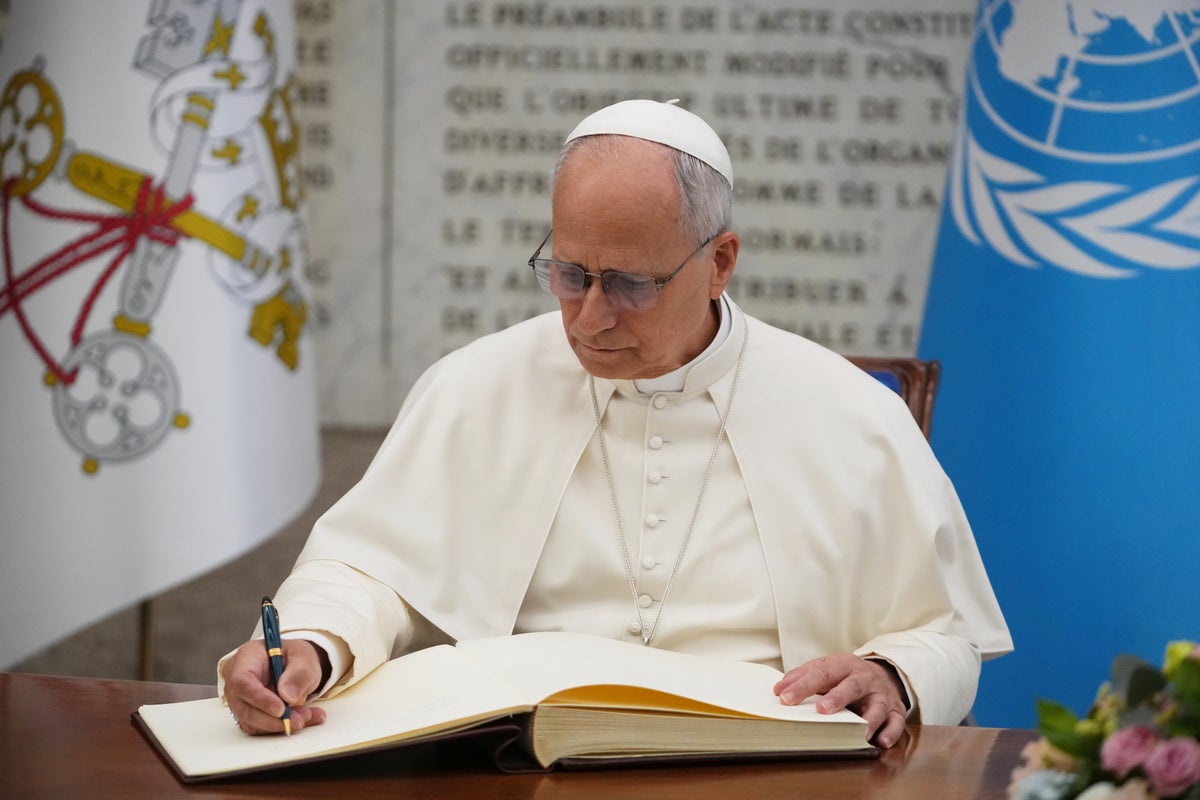
The media remains obsessed with the scorecard of the first year of Pope Leo XIV. They track his "to-do list" like he’s a mid-level project manager at a legacy tech firm. They measure success in synod attendance, diplomatic memos, and the frequency of his public gestures. This is a fundamental misunderstanding of the office and the man.
While commentators cheer for his supposed "modernization" efforts, they ignore the reality that the Vatican is currently overseeing the most sophisticated liquidation of spiritual capital in modern history. The "progress" being touted isn't growth; it's a controlled demolition designed to make the Church more palatable to a secular audience that has no intention of ever walking through its doors.
The Fallacy of the Strategic To-Do List
Standard reporting frames the Pope’s first year as a series of administrative hurdles: financial reform, Curia restructuring, and addressing the clergy crisis. This is a distraction. The Vatican isn't a corporation that can be "fixed" with better accounting software or a more inclusive HR policy.
The real story isn't what Leo XIV has done, but what he has successfully avoided. By focusing on bureaucratic shifting, he has sidestepped the massive, existential rot at the core of the institution. We are watching a masterclass in theatrical governance.
Take the much-vaunted financial transparency initiatives. Every few years, a new Pope arrives, hires a "Big Four" accounting firm, and promises to clean up the Institute for the Works of Religion (IOR). I’ve seen this cycle play out in legacy industries for decades—bringing in external consultants is usually the first sign that the leadership doesn't actually want to change the culture, they just want a clean audit report to show the board.
In this case, the "board" is the global media. Leo XIV has given them exactly what they want: the appearance of movement without the friction of actual change.
The Death of the Moral Absolute
The most dangerous misconception about this papacy is that "inclusion" equals "survival." The competitor press treats the Pope's softer rhetoric as a strategic masterstroke to win back the youth. This is mathematically illiterate.
In marketing, if you dilute your product to appeal to everyone, you end up appealing to no one. The Church’s "product" for two millennia was a distinct, often difficult, counter-cultural moral absolute. By pivoting toward a vague, socio-political "niceness," the Vatican is entering a marketplace already saturated by NGOs, secular charities, and lifestyle influencers.
Why would a 22-year-old seek spiritual guidance from an institution that sounds exactly like their university’s DEI department? They wouldn't. And they aren't.
Leo XIV’s "to-do list" focuses on making the Church less offensive. But an inoffensive Church is a redundant Church. If the Vatican becomes nothing more than a European NGO with better architecture, it has already failed.
The Curia as a Sunk Cost
Critics point to the reorganization of the Roman Curia as a major win. They call it "streamlining." In any other industry, we’d call it "rearranging the deck chairs on the Titanic."
The Curia is an ancient, self-preserving organism. You don't "reform" it by merging departments or changing their names from Congregations to Dicasteries. That’s a rebranding exercise, not a structural overhaul. Real reform would require a level of decentralization that no Pope—especially not one as aware of his image as Leo XIV—would ever truly permit.
The centralized power of the papacy is the very thing preventing the Church from adapting to the radically different needs of its growing congregations in the Global South versus its dying ones in the North. Leo XIV keeps the power firmly in Rome while talking about "synodality." It’s a classic bait-and-switch: give the provinces a "voice" while maintaining an absolute veto over the "vibe."
The Myth of the Great Diplomat
One year in, the press is enamored with Leo’s "quiet diplomacy" in global conflicts. This is perhaps the most egregious example of the "lazy consensus" in modern journalism.
Vatican diplomacy is currently characterized by a desperate need to remain "relevant" at the table, often at the cost of its moral authority. When the Church refuses to name aggressors in a conflict to maintain "neutrality," it isn't being diplomatic; it’s being cowardly.
True authority comes from saying the things that political leaders cannot say. Instead, Leo XIV’s first year has been defined by a desire to be the world’s chaplain—a comforting presence that offers platitudes but refuses to take a stand that might alienate a major geopolitical player.
The Missing Metric: Spiritual Retention
If we evaluated Leo XIV on the only metric that actually matters for a religious institution—spiritual retention and fervor—the first year would be a failure.
Look at the data. In every region where the Church has "modernized" its liturgy and softened its stance to match the local culture (Germany, for instance), the exodus is accelerating. In regions where the Church remains unapologetically traditional and rigorous (parts of Africa and Southeast Asia), it is booming.
Leo XIV’s to-do list is focused almost entirely on the concerns of the dying Northern Church. He is prioritizing the sensibilities of a demographic that is already halfway out the door while ignoring the requirements of the demographic that is actually showing up.
It’s the equivalent of a retail giant focusing all its R&D on its failing flagship store in a ghost mall while ignoring its thriving e-commerce and international branches.
The Price of Popularity
Being a "popular" Pope is the easiest job in the world. You just have to say things that make secular journalists feel good about themselves. You have to criticize the "right" people (unregulated capitalists, polluters) and support the "right" causes (environmentalism, vague solidarity).
But the Church was never meant to be a popular institution. It was meant to be a prophetic one.
The downside to Leo XIV’s approach—and I’ll be the first to admit this—is that it creates a temporary "halo effect" that masks the underlying decline. It buys time. But time is only valuable if you use it to build something durable.
Instead, the Vatican is using that time to burn its remaining credibility on the altar of contemporary relevance.
Stop Asking if He’s "Modernizing" the Church
The question is flawed. The real question is whether he is making the Church essential.
Modernization is a process of conforming to the present. Essentialization is the process of offering something the present lacks.
Leo XIV has spent twelve months conforming. He has checked the boxes of his secular admirers. He has streamlined the paperwork. He has smiled for the cameras. He has made the Church "approachable."
But in making the Church approachable, he has made it ignorable.
You don't need a Pope to tell you to be kind to your neighbor or to recycle your plastic. You can get that from a cereal box. You need a Pope to tell you why your life has infinite meaning in a universe that feels increasingly cold and mechanical.
On that front, the to-do list remains untouched.
The first year of this papacy wasn't a "breath of fresh air." It was the sound of a vacuum being filled by the spirit of the age. And as anyone in the industry knows, once you let the spirit of the age dictate your strategy, you’re already a legacy brand waiting for the lights to go out.
Stop looking at the press releases. Look at the pews. The math doesn't lie, even if the theologians do.