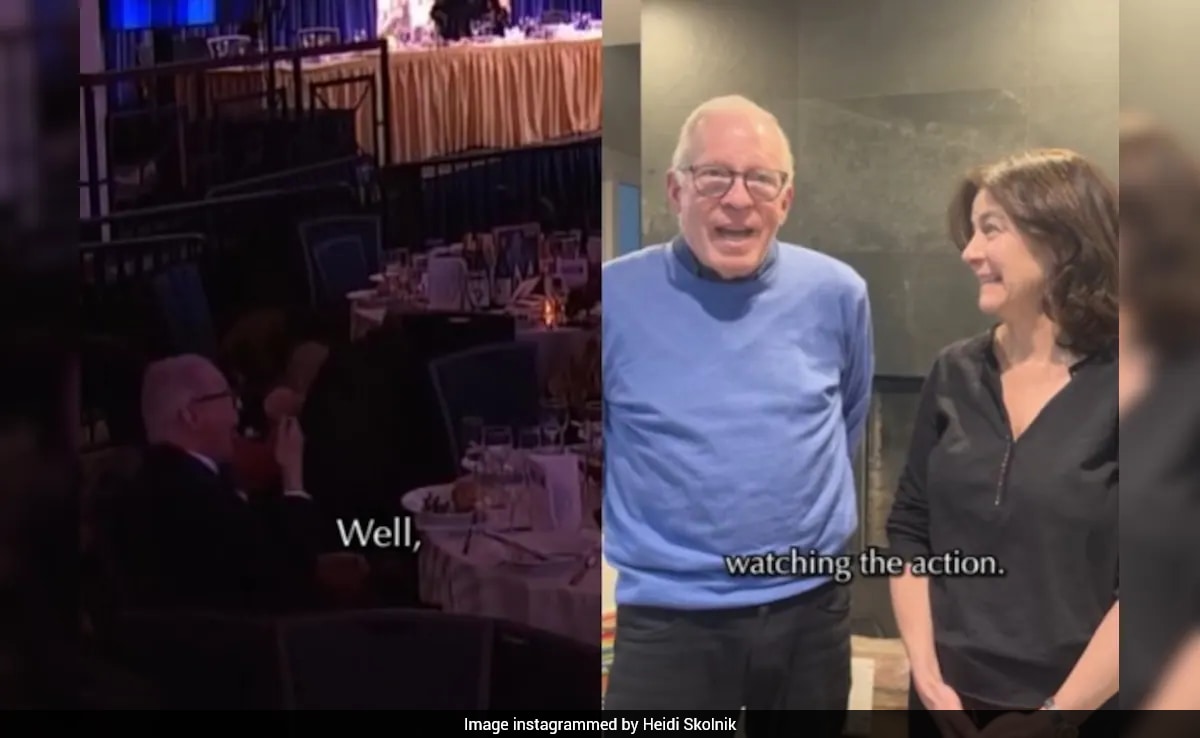
The human response to acute environmental stress—such as a high-level security breach during a formal state function—is typically governed by the sympathetic nervous system’s fight-flight-freeze triad. However, when an individual chooses to continue a mundane task like eating while peers are seeking cover, it signals a rare divergence in cognitive processing known as "low-threat-appraisal heuristic." This behavior suggests a specific psychological state where the observer prioritizes visual data acquisition over biological preservation, fundamentally decoupling the sensory input of "chaos" from the internal command of "evacuate."
The Mechanics of Threat Assessment Disparity
To understand why an individual remains seated during a White House security event while others duck, one must analyze the Information Processing Loop. Most attendees rely on social proof—the observation of others’ panic—to determine their own level of risk. The outlier, however, utilizes a direct observational model.
- Direct Visual Verification: The individual bypasses social cues. By "watching the action," they are gathering primary data to determine the trajectory and nature of the threat. If the threat is perceived as localized or already contained by security protocols, the brain assigns it a lower risk coefficient than the immediate social disruption would suggest.
- Professional or Temperamental Desensitization: Individuals with backgrounds in high-stress environments (journalism, military, or emergency services) often exhibit a higher threshold for "startle response." They categorize noise and movement faster than a civilian, allowing the prefrontal cortex to override the amygdala.
- The Sunk Cost of Social Presence: At a White House dinner, the social stakes are maximum. The psychological friction of "making a scene" by diving under a table is, for some, higher than the perceived risk of a nebulous threat.
The Cost Function of the Nonreactive Observer
The decision to remain upright and observant carries specific trade-offs. We can define this through the Observational Utility vs. Survival Probability framework.
Utility of Observation ($U_o$):
In a historic or high-stakes environment, the value of witnessing an event firsthand is immense. For a witness, the information gathered has social, historical, and intellectual capital.
Survival Probability ($P_s$):
Ducking increases $P_s$ by reducing the physical profile of the target. By remaining seated, the individual keeps $P_s$ static or allows it to decrease while $U_o$ spikes.
The equation for this behavior is $V = (U_o \times I) - (R \times C)$, where:
- $V$ is the perceived value of the action.
- $I$ is the intensity of the event.
- $R$ is the estimated risk of injury.
- $C$ is the cost of social embarrassment or lost composure.
When $V$ remains positive despite a rise in $R$, the subject will continue their current activity, such as consuming a meal. This is not necessarily a sign of bravery; it is a calculated—or sometimes instinctive—recalibration of the environment's actual danger versus its perceived chaos.
The Buffer of Security Infrastructure
A critical variable in the non-ducking response is the "Institutional Safety Assumption." Within the White House, the density of Secret Service personnel and specialized security protocols creates a psychological floor. An attendee isn't just in a room; they are inside a fortified system.
This creates a Delegated Responsibility Syndrome. When a guest believes the "system" is invincible, they outsource their personal safety to the environment. This explains the phenomenon of people filming a crisis rather than fleeing it; they believe the invisible barriers of the institution will hold, transforming a life-threatening event into a spectator sport.
Cognitive Tunneling and the Eating Response
Continuing to eat during a crisis is often a manifestation of Cognitive Tunneling. Under extreme stress, the brain may narrow its focus to the task at hand to block out overwhelming stimuli. This is a form of functional denial. By focusing on the mechanics of using a fork or chewing, the brain maintains a tether to "normalcy."
This creates a paradoxical visual:
- External environment: Chaos, shouting, security movement.
- Internal focus: Micro-motor movements of dining.
The observer who "stays for the action" is essentially using the meal as a grounding mechanism. It provides a rhythmic, familiar physical sensation that prevents the total collapse into panic. This allows the individual to process the "action" with a level of detachment that would be impossible if they were actively cowering.
The Social Dynamics of the "Cool Observer"
There is an undeniable element of social signaling in non-reactivity. In high-society or political circles, "unflappability" is a high-value currency. By not ducking, an individual signals a superior grasp of the situation or a higher degree of personal control.
This creates a secondary conflict within the room. While security teams want everyone low and immobile to clear lines of sight, the "observer" remains a visual obstacle. This highlights a failure in guest-protocol alignment. The individual’s desire for data (watching) or social standing (composure) directly interferes with the operational efficiency of the security response.
Strategic Risk of the Spectator Mindset
The primary danger of the "watching the action" mindset is the Latency Gap. In a genuine kinetic threat—such as an active shooter or an explosive device—the milliseconds spent "observing" are the difference between survival and casualty.
- Recognition Lag: The time taken to realize the event is not a drill or a minor disturbance.
- Decision Lag: The time spent weighing the social cost of ducking against the physical risk.
- Movement Lag: The physical time required to change posture once the decision is finally made.
The non-ducking observer is essentially betting their life that the Recognition Lag will not exceed the time it takes for the threat to materialize. This is a high-risk, low-reward gamble, as the information gained by "watching" rarely provides a tactical advantage to a civilian guest.
Operational Recommendation for High-Security Environments
For event organizers and security details, the presence of "nonreactive observers" must be treated as a predictable variable.
- Forced Compliance Protocols: Security must move beyond "asking" guests to get down and transition to physical or high-authority commands that break the cognitive tunnel of observation.
- Psychological Briefing: High-level attendees should be briefed not just on exits, but on the "observer fallacy"—the idea that watching a threat makes you safer.
- Environmental Design: Reducing the "theatrical" distance between guests and security can help attendees realize they are part of the event, not spectators of a performance.
The individual who eats through chaos isn't just a quirky anecdote; they are a data point in the study of human risk-assessment failure. Their presence serves as a reminder that in the presence of institutional power, the human brain often chooses the comfort of the routine over the logic of the emergency.
The next time a security perimeter is breached, the strategic move is not to watch the action to "see what happens." The move is to collapse the target profile immediately, acknowledging that sensory data is useless if the observer does not survive to process it. Composure is a social asset; survival is a biological requirement. Priorities must be aligned accordingly before the event occurs.