The shipping container sits quietly in a port you’ve never heard of, a steel box painted a faded rust-red. Inside that box, things are moving that shouldn't be. Parts for a drone. Guidance systems for a missile. Steel for a casing. These are the silent transactions of a shadow economy, a flow of hardware that keeps the fires of the Middle East burning. But a storm is brewing in Washington that threatens to turn these steel boxes into the most expensive mistakes a nation can make.
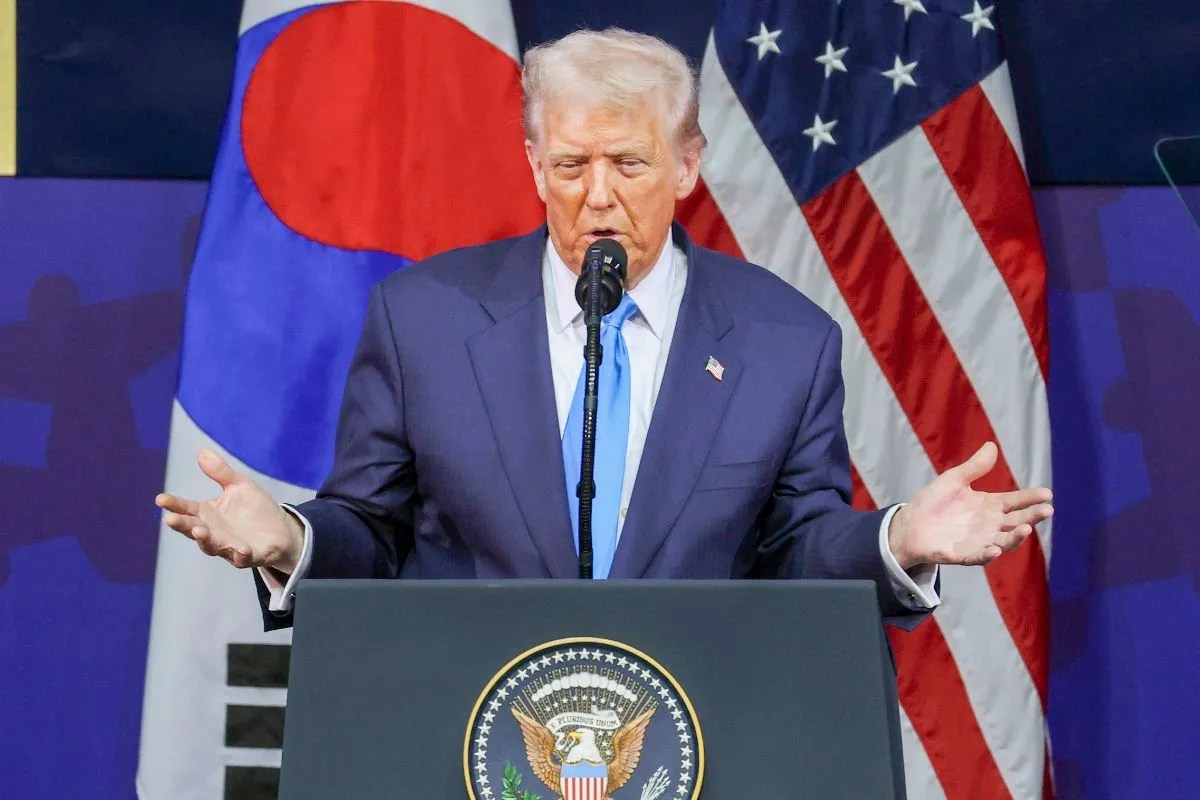
Donald Trump has never been a man of subtle whispers. He prefers the roar of a megaphone and the blunt force of a ledger. His latest ultimatum isn't just a political talking point; it is a direct assault on the global supply chain. The message is simple: if you fuel Iran’s arsenal, he will burn your economy. Recently making news lately: Systemic Vulnerability and the Failure of Internal Controls in High Finance Corporate Governance.
Specifically, a 50% tariff.
Fifty percent. That isn’t a tax. It’s an eviction notice from the American market. More insights regarding the matter are explored by Harvard Business Review.
The Invisible Ledger at Your Kitchen Table
Think about a small business owner in a mid-sized city in Europe or Asia. Let's call him Stefan. Stefan manufactures high-precision ball bearings. He doesn't care about geopolitics. He cares about tolerances, friction, and meeting his quarterly targets. One day, a middleman buys a shipment of his bearings. Stefan gets paid. The bearings move.
Six months later, those same bearings are recovered from the wreckage of an Iranian-made kamikaze drone in a conflict zone thousands of miles away.
Under the proposed Trump doctrine, Stefan’s entire country could now be looking down the barrel of a 50% tax on every single product they send to the United States. Suddenly, the luxury cars, the artisan cheeses, the high-tech machinery, and the chemicals that form the backbone of that nation’s GDP are priced out of the world’s largest consumer market.
Economic gravity is brutal. When a 50% wall goes up, the flow of goods doesn't just slow down. It stops. It shatters.
This is the human element of a tariff war. It isn't just about "countries" or "regimes." it is about the factory worker whose shift is canceled because the American orders dried up overnight. It is about the consumer in Ohio who suddenly finds that the specialized part for their tractor now costs double what it did last week. We are talking about a web of connections so tightly wound that pulling a single thread in Tehran causes the whole fabric to tear in Tokyo, Berlin, or New Delhi.
The Art of the Economic Siege
The logic behind this move is a return to a very old, very primal form of statecraft. For decades, the world operated on the "rules-based order," a polite system of sanctions and diplomatic finger-wagging. Trump views that system as a failure. He sees a world where Iran continues to circumvent restrictions through a patchwork of willing and unwilling partners.
His solution? Collective responsibility.
He is effectively telling every nation on Earth that they are now his voluntary border guards. If a country allows its ports to be used for Iranian arms trafficking, or if its banks facilitate the sale of drone engines, the penalty will not be a sternly worded letter from the UN. The penalty will be the immediate and catastrophic loss of American trade.
Leverage.
It is a word that gets tossed around in business schools, but here, it is being used like a garrote. Trump is betting that no country on the planet values its relationship with Iran more than its access to the American consumer. He is forcing a choice that most leaders have spent years trying to avoid. You can have the shadow trade, or you can have the light of the US market. You cannot have both.
The Ghost of 1930 and the Modern Fear
Economists often get a cold shiver down their spine when they hear the word "tariff." They remember the Smoot-Hawley Act of 1930, a massive spike in trade barriers that many believe turned a market crash into the Great Depression. The fear is that once you start throwing 50% numbers around, other countries don't just sit there and take it. They hit back.
But Trump’s gamble is based on the idea that the world has changed. He believes the United States is uniquely positioned to win a game of "economic chicken" because of its massive trade deficit. In his view, if we stop buying from them, they lose their livelihood; if they stop selling to us, we just find someone else to buy from.
It’s a high-stakes poker game where the chips are people’s jobs and the stability of global alliances.
Consider the complexity of modern manufacturing. A single smartphone might have components from forty different countries. If even one of those countries falls under the "Iran supplier" shadow, the entire assembly line is poisoned. Companies would be forced to scrub their supply chains with a level of intensity we’ve never seen. They would have to become private detectives, tracking every nut, bolt, and transistor back to its source to ensure nothing "Iranian-adjacent" touches their product.
The cost of this vigilance is a hidden tax on everyone.
The Emotional Core of the Threat
Why does this resonate? Why does a 50% tariff on a distant country feel like a headline that matters to a voter in a swing state?
Because it taps into a deep, underlying sense of unfairness. There is a narrative here that the "rest of the world" has been playing a double game—taking American security guarantees and American dollars while simultaneously arming the very people who destabilize the global order.
Trump is playing on the exhaustion of the American public. He is speaking to the person who is tired of seeing billions of dollars in aid go overseas while the industrial heartland feels hollowed out. By linking trade directly to national security, he is making the economy a battlefield. He is telling the world that the "free ride" is over, and the price of entry into the American dream is now total alignment with American interests.
The uncertainty is the point.
By making the threat so large—50% is a number designed to shock—he creates a climate of fear. In that climate, CEOs and Prime Ministers start making preemptive changes. They don't wait for the tariff to be enacted. They start cutting ties with Tehran now, just in case. They move their factories. They change their shipping routes. The mere threat of the tariff does 80% of the work before a single dollar is ever collected.
The Fragility of the Global Machine
We like to think of our world as a solid, permanent thing. We trust that the grocery store will have food, the gas station will have fuel, and the internet will keep humming. But that reality is built on a miraculous, fragile system of trust and open lanes.
When a superpower decides to use its market as a weapon of mass destruction, that trust evaporates. We move from a world of "efficiency" to a world of "security."
Efficiency gave us cheap TVs and overnight delivery. Security gives us local production, higher prices, and fragmented alliances.
This isn't just about Iran. It’s about a fundamental shift in how humans relate to one another across borders. It is the end of the era where business was separate from war. Now, every invoice is a potential casualty. Every shipping manifest is a legal minefield.
The man in the faded rust-red container doesn't know it yet, but the walls of his world are closing in. He thought he was just moving cargo. He didn't realize he was carrying a 50% tax on his nation's future.
The ledger is being balanced, and the ink is a deep, permanent red. Whether this brings peace through economic strangulation or triggers a global recession remains the ultimate unknown, but one thing is certain: the era of the "blind eye" in global trade has reached its expiration date.
The world is about to find out exactly how much it costs to cross the most powerful economy on Earth.
Imagine the silence in a boardroom in a country that relies on both US exports and Middle Eastern energy. The air is thick. The spreadsheets are being rewritten in real-time. This is the new reality of power—not a missile in the air, but a signature on a trade bill that can delete a nation’s prosperity with a single stroke of a pen.