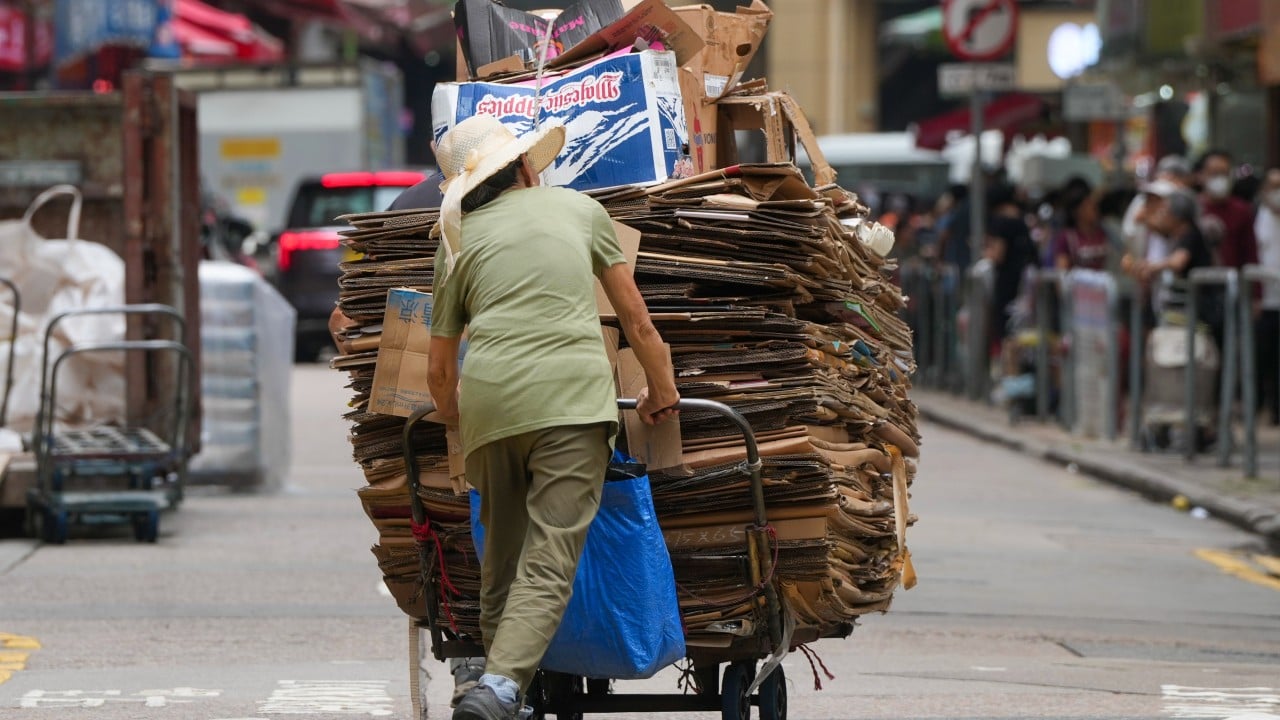
The air in the back corridors of a Mong Kok shopping mall doesn't move. It sits heavy with the scent of industrial floor cleaner and the residual heat of a thousand air conditioning units humming in unison. This is where Ah-Ping spends her nights. She is sixty-eight years old, her spine curved like a question mark, pushing a mop across tiles that will be scuffed again by ten o’clock tomorrow morning.
Last week, the news filtered down through the breakroom: a pay rise. One Hong Kong dollar.
In the high-ceilinged offices of Central, a single dollar is a rounding error. It is the coin you find behind a sofa cushion and forget to pick up. But for the 17,000 workers in Hong Kong currently earning the statutory minimum wage, that dollar is a mathematical battleground.
The increase moves the floor from HK$40 to HK$41 per hour.
To understand why this number feels like a whisper in a thunderstorm, we have to look at the grocery basket. Imagine a hypothetical scenario where Ah-Ping wants to buy a simple snack—a bowl of curry fishballs from a street vendor. Ten years ago, that snack cost ten dollars. Today, it might be twenty or twenty-five. While her wage has crept upward in tiny, grudging increments, the world around her has sprinted ahead.
The math is brutal. If Ah-Ping works an eight-hour shift, she earns an extra eight dollars a day. That isn't enough to buy a pineapple bun. It isn't enough to cover the seasonal increase in her electricity bill. It is a gesture of progress that fails to move the needle of poverty.
The Invisible Ledger
Economists often speak of "wage-push inflation," a theory suggesting that if you pay the lowest earners more, businesses will simply hike prices to compensate, leaving everyone in the same spot. It’s a clean, logical cycle on a whiteboard. On the streets of Sham Shui Po, however, the logic frays.
The critics of the HK$1 increase point out that the change is so marginal it won't even trigger that inflationary fear. It is too small to hurt the bosses, but it is also too small to help the workers. We are trapped in a middle ground where the policy satisfies a legal requirement to "review" the wage without actually addressing the cost of existing in one of the most expensive cities on Earth.
Consider the ripple effect. When the floor rises by a single dollar, the person who was already making HK$42 an hour feels the squeeze. Their "seniority" or experience is suddenly worth less in relative terms. This creates a ceiling. Employers, wary of tightening margins, keep everyone huddled as close to the floor as possible.
The gap between the "living wage"—what a human being actually needs to eat, sleep, and commute with dignity—and the "minimum wage" has become a canyon. Calculations by social advocacy groups suggest a living wage in Hong Kong should sit closer to HK$55 or HK$60. When the reality is HK$41, the difference is paid for in human capital. It is paid for in missed doctor’s appointments, in three-generation families squeezed into subdivided flats, and in the exhaustion of retirees who should be resting but are instead scrubbing floors.
The Myth of the Entry Level
There is a persistent narrative that minimum wage jobs are "starter" positions—roles for teenagers or students learning the ropes. If you walk through the wet markets or stand by the loading docks at 4:00 AM, you see the lie in that assumption.
The faces are not young.
They are the faces of the elderly who lost their savings in market crashes, or those whose sons and daughters are themselves struggling to keep a roof over their heads. For these workers, there is no "upward mobility." There is only the shift.
The HK$1 increase assumes that the struggle is static. It ignores the way rent in Hong Kong behaves like a predator, sensing any increase in income and moving to swallow it. In many cases, a marginal raise in income can actually hurt a worker if it pushes them just past the threshold for public housing eligibility or transport subsidies.
One dollar can be the difference between receiving government assistance and being cast into the "sandwich class" of the impoverished—too rich for help, too poor to live.
The Gravity of the Breadline
Why is the number so low? The Minimum Wage Commission operates on a consensus-based model, balancing the interests of labor unions and business leaders. It is a tug-of-war where the rope is made of human lives. Business owners argue that the retail and catering sectors are already bleeding, nursing wounds left by years of social shifts and a changing tourism landscape. They claim that a significant jump—say, to HK$45 or HK$50—would force small "cha chaan tengs" to close their doors forever.
There is truth there. The small shop owner is also struggling. But the burden of keeping those businesses afloat is being placed squarely on the shoulders of the person cleaning the tables.
We are essentially subsidizing our cheap wonton noodles with the poverty of the server.
When we talk about "economic competitiveness," we are often talking about how cheaply we can keep the gears turning. But a city that relies on 68-year-old women working through the night for the price of a few pieces of fruit is a city with a fragile foundation.
Beyond the Decimal Point
The debate shouldn't be about whether the raise should be HK$1 or HK$2. The conversation we are avoiding is about the value of labor in a digital age. We have become experts at devaluing the physical. We prize the "disruptor," the coder, and the financier, while the person who ensures the trash is removed and the streets are safe is treated as a line item to be minimized.
The psychological weight of a HK$1 raise is perhaps the heaviest part. It is a message from the heights of the city to the depths. It says: We see you, we recognize that things are more expensive, and this—this coin you might find in a gutter—is what we believe your dignity is worth.
Ah-Ping doesn't read the economic journals. She doesn't follow the Commission's debates. She only knows that when she goes to the market after her shift, the oranges are more expensive than they were yesterday. She looks at the price tag, then at her hands, worn smooth by the mop handle.
The city continues to glow, a neon jewel of global finance, powered by the quiet, unceasing labor of people who are being told that their lives have improved by one dollar an hour. They are expected to be grateful for the crumb while the loaf is moved further out of reach.
The mop hits the bucket. The water is gray. The clock ticks toward 5:00 AM. In the silence of the mall, the math of survival continues, cold and unforgiving, where every cent is a heartbeat and every dollar is a dream deferred.