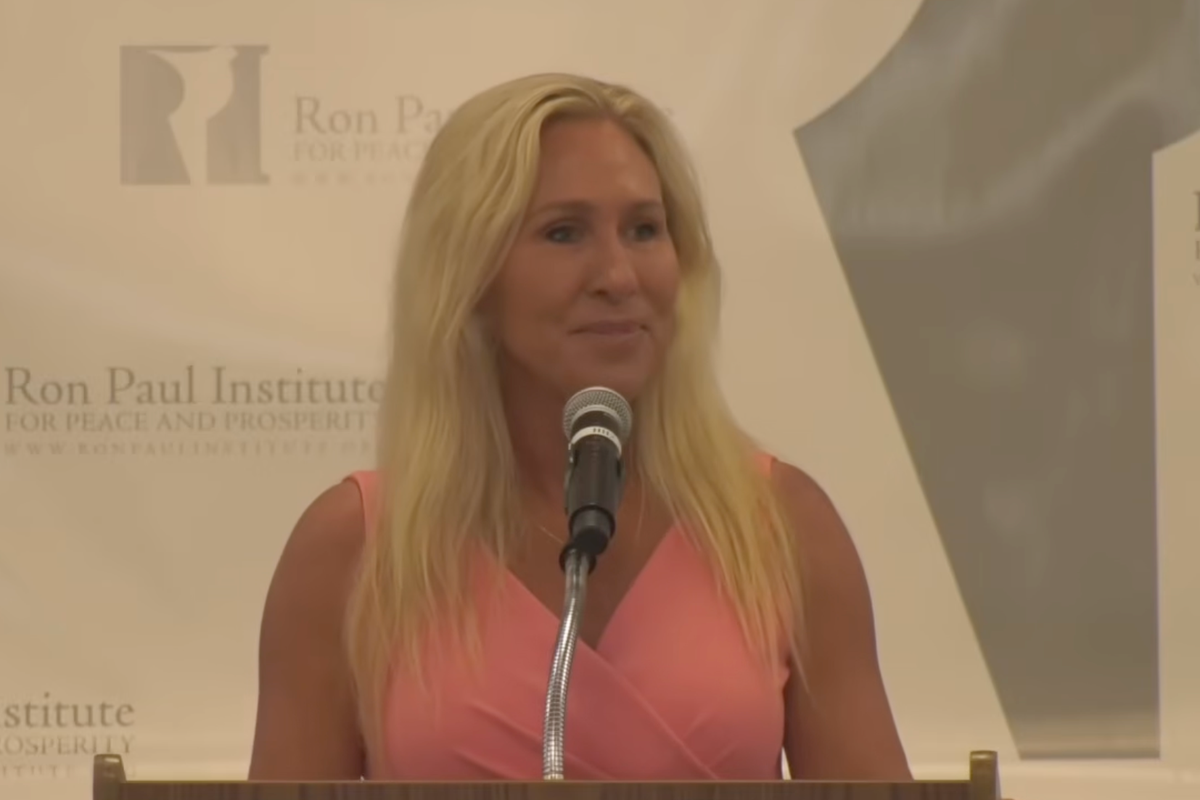
The political ecosystem of Mar-a-Lago thrives on a brutal, Darwinian logic where proximity to the center is the only currency that matters. For months, Kash Patel was viewed as the ultimate survivor, a former Pentagon official and intelligence staffer whose name was whispered as a potential CIA Director or FBI chief in a second Trump administration. But the political winds shifted with a sudden, public velocity when Marjorie Taylor Greene, a woman whose influence serves as a barometer for the MAGA movement's internal hierarchy, delivered a sharp rebuke that signaled a deeper fracture within the Republican ranks.
When Greene dismissed Patel’s current standing by noting he is "not in the inner circle anymore," she wasn't just offering a personal opinion. She was executing a calculated de-platforming. This wasn't a policy disagreement or a debate over legal strategy. It was a clear indication that the gatekeepers of the next administration are already weeding out the true believers who might become liabilities. If you liked this article, you should check out: this related article.
The Friction Between Loyalty and Viability
The problem with being a firebrand is that eventually, the fire needs a controlled environment to burn effectively. Patel built his reputation on being the ultimate "declassifier," the man who promised to rip the lid off the so-called Deep State. To his supporters, he is a hero fighting a shadow government. To his detractors, and increasingly to more pragmatic elements within the GOP leadership, he represents a level of volatility that makes Senate confirmation a literal impossibility.
Greene’s comments reflect a growing realization among Republican power brokers. They want the results Patel promises—a total overhaul of the intelligence community—but they are starting to doubt that Patel is the right vessel for that mission. The "inner circle" is no longer just a collection of loyalists; it is becoming a staging ground for people who can actually clear a background check and survive a hearing without causing a massive electoral blowback. For another look on this development, check out the recent coverage from BBC News.
Why the Takedown Matters Now
This isn't just about one man’s career prospects. It reveals the internal mechanics of a shadow transition team. If someone as high-profile as Patel can be sidelined by a six-word dismissal from a sitting Congresswoman, it suggests that the criteria for power in 2024 and 2025 have fundamentally changed.
The movement is professionalizing. In the early days of 2016, loyalty was the only metric. Today, the movement is looking for people who possess institutional knowledge paired with a willingness to use it as a weapon. Patel, despite his resume, has become a symbol of the "old" chaotic guard. By publicly distancing the movement from him, Greene is signaling to donors and mainstream allies that the next iteration of the MAGA government will be more disciplined and, consequently, more dangerous to its political opponents.
The Intelligence Community Factor
Inside the corridors of Langley and the J. Edgar Hoover Building, the news of Patel’s apparent exile was likely met with a mix of relief and skepticism. Patel has spent years promising to prosecute his former colleagues and dismantle the current hierarchy of the intelligence world.
If he is indeed out of the inner circle, the question becomes: who replaces him? The vacuum left by a populist firebrand is usually filled by a technocrat with a grudge. These are individuals who know where the files are buried but don't feel the need to post about it on social media every hour. Greene’s dismissal of Patel indicates that the movement may be moving away from the "influencer" model of government toward something more surgical.
The Fragility of Political Capital
Marjorie Taylor Greene’s rise to a position where she can effectively excommunicate a former Pentagon heavy-hitter is a masterclass in political maneuvering. She has moved from the fringes of the party to a position of "enforcer." When she speaks, she often does so with the implied backing of the top of the ticket.
For Patel, the path back to relevance is narrow. In this world, once the "inner circle" label is revoked, the donor money dries up and the invitations to the private strategy sessions at the club stop arriving. He is finding out the hard way that in a movement built on the cult of personality, there is only room for one personality at the top, and everyone else is expendable.
Mapping the New Power Structure
If Patel is the casualty, who are the victors? We are seeing the emergence of a new tier of advisors who prioritize legal armor over rhetoric. This group understands that the biggest threat to a second-term agenda isn't the "Deep State"—it's a poorly drafted executive order or a nominee who can't get past a committee vote.
The shift suggests a focus on:
- Pre-vetted candidates with clean financial records.
- Legal scholars who can justify radical shifts in agency power.
- Legislative veterans who can bridge the gap between the White House and a skeptical Senate.
Patel’s brand of high-octane confrontation doesn't fit this new, more calculated mold. He is a relic of a period when the goal was simply to break things. The goal now is to seize the machinery of government and keep it.
The Optics of the Breakup
Greene’s specific wording is fascinating because of its simplicity. She didn't call him a traitor or a RINO (Republican In Name Only). She simply said he wasn't there. It is the ultimate social death in a town built on access. It turns a former power player into a ghost.
This tactic serves a dual purpose. It protects the candidate from Patel’s more controversial statements while keeping Patel’s followers in the fold. By making it about "the circle" rather than "the ideology," the movement avoids a civil war. They aren't rejecting Patel’s ideas; they are just rejecting the man.
The Long-Term Impact on the GOP
This fracture points to a broader tension within the Republican party that will define the next decade. There is a fight between the "wrecking ball" wing and the "reconstruction" wing. Patel is the face of the wrecking ball. He wants to tear down the house. Greene, surprisingly, has aligned herself with those who want to move into the house and change the locks.
This isn't a softening of the party's platform. If anything, it is a hardening. A movement that is willing to prune its most famous loyalists in the name of efficiency is a movement that is serious about the exercise of power.
The Survival of the Fittest
Patel may try to launch a comeback, perhaps by leaning harder into independent media or through the grassroots circuit. But without the imprimatur of the inner circle, he is just another voice in a very crowded room. The MAGA movement has shown time and again that it has a high turnover rate. Yesterday’s hero is today’s footnote.
The brutal reality of this world is that loyalty is a one-way street. You give it until you are no longer useful, and then you are replaced by someone who can offer the same loyalty with less baggage. Greene wasn't just being mean-spirited; she was being a realist.
The era of the "Deep State" warrior may be reaching its expiration date, replaced by a more sophisticated, more disciplined operator who doesn't need a six-word takedown because they never sought the spotlight in the first place. This is the new blueprint for power: move in silence, strike with precision, and never let yourself become the story.


