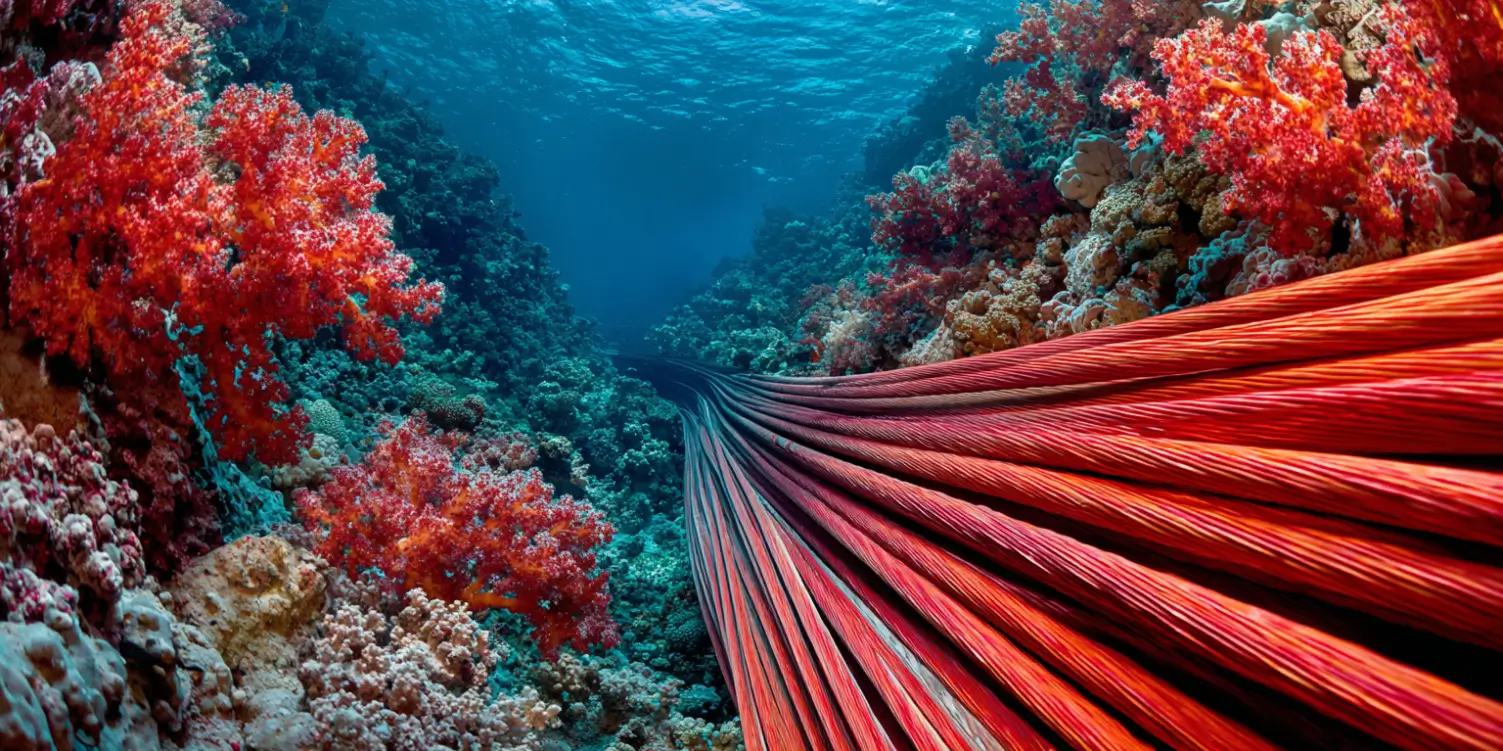
The modern world is held together by a network of glass strands no thicker than a garden hose, resting on the ocean floor in some of the most volatile waters on Earth. While the public focuses on satellite constellations and wireless 5G, 99% of all international data traffic travels through subsea fiber-optic cables. Currently, a high-stakes geopolitical standoff in the Red Sea and the Strait of Hormuz is threatening to sever these digital arteries. Reports of Iranian threats to target this infrastructure are not just a regional security concern; they represent a potential "black swan" event for the global economy.
If these cables are cut, the impact will be immediate and devastating. We are talking about more than just slow social media feeds. The Red Sea corridor carries an estimated 17% to 30% of all global internet traffic, including the backbone for financial transactions, cloud-based enterprise software, and the massive AI workloads currently being scaled by tech giants in Saudi Arabia and the UAE.
The Chokepoint Paradox
The geography of the Red Sea is a nightmare for digital resilience. All traffic between Europe and Asia is effectively funneled through the Bab el-Mandeb Strait, a narrow passage that has become a hunting ground for Houthi rebels and a focal point for Iranian naval posturing. This concentration creates a single point of failure.
In 2024, the world got a preview of this vulnerability when three major cables were severed, reportedly by the anchor of a ship sinking after a Houthi missile strike. It took five months to complete the repairs. The reason for the delay was simple: cable ships cannot operate in a war zone. This is the "how" behind the threat. An adversary does not even need a sophisticated submarine to cripple the internet; they only need to create enough instability to prevent repair vessels from entering the area.
Why the Red Sea is Different Now
Historically, subsea cables were considered "off-limits" in gray-zone warfare because damaging them hurts everyone, including the attacker. However, the current logic in Tehran and among its proxies has shifted.
- Plausible Deniability: It is nearly impossible to prove if a cable was cut by a deliberate act of sabotage, a dragging anchor, or a natural seabed shift.
- Asymmetric Leverage: By threatening the cables, Iran exerts pressure on Gulf states that host U.S. military assets. These states—specifically Saudi Arabia and the UAE—have invested billions in becoming global AI and data hubs. Their "Vision 2030" goals are entirely dependent on the very cables now under threat.
- Economic Warfare: A coordinated strike on multiple cables in the Red Sea and the Strait of Hormuz would cause a "connectivity collapse." Traffic would have to be rerouted around the Cape of Good Hope or through terrestrial routes in Russia or China, adding massive latency (lag) and crushing the efficiency of high-frequency trading and real-time supply chain management.
The India and West Asia Connection
India sits at the other end of this digital bridge. As one of the world's largest consumers of data, India relies on the Red Sea corridor for the majority of its connectivity to Europe and the Americas. If the cables snap, the "Office of the World" goes dark.
The economic fallout would be measured in billions. For a country like India, which has built its economic identity on IT services and digital payments, a prolonged outage isn't just an inconvenience; it’s a national security crisis. We are already seeing the first signs of retreat. Tech giants like Meta have reportedly paused work on segments of the massive 2Africa cable project in the region, and Alcatel Submarine Networks has issued force majeure notices to its clients.
The Illusion of Satellite Backup
There is a common misconception that Starlink or other Low Earth Orbit (LEO) satellites can save us. They cannot. While satellites are excellent for providing internet to rural areas or soldiers on a battlefield, they lack the capacity to handle the petabytes of data moved by subsea cables.
$$C = B \log_2(1 + S/N)$$
The Shannon-Hartley theorem above defines the maximum rate at which information can be transmitted over a communication channel. In practical terms, a single subsea cable can carry over 250 Terabits per second (Tbps). The entire global satellite fleet combined currently handles only a tiny fraction of that. If the Red Sea goes dark, there is no "backup" in the sky that can sustain the global financial system.
The Repair Crisis
Even if the threats remain rhetorical, the "soft blockade" is already doing damage. There are only about 60 to 80 specialized cable repair ships in the world. These vessels are slow, expensive to operate, and currently booked out months in advance. Insurance companies are now balking at covering these ships in the Red Sea.
Without insurance, the ships don't sail. Without the ships, a single "accidental" cable cut remains broken for half a year. We are entering an era where the physical security of the internet is becoming as important as cybersecurity. The "cloud" is not a magical ether; it is a physical, vulnerable network of wires under the sea, and right now, the most important section of that network is being held hostage.
The reality is that we have built a 21st-century digital economy on 19th-century maritime vulnerabilities. Protecting these cables will require a fundamental shift in how we view maritime security—moving from protecting the surface of the water to protecting the soil beneath it.
Would you like me to analyze the specific terrestrial bypass routes currently being developed through Iraq and Saudi Arabia to mitigate this risk?


/arc-anglerfish-arc2-prod-mco.s3.amazonaws.com/public/BHPBP5TJJFF5XBWKSOQWZ6G55A.JPG)