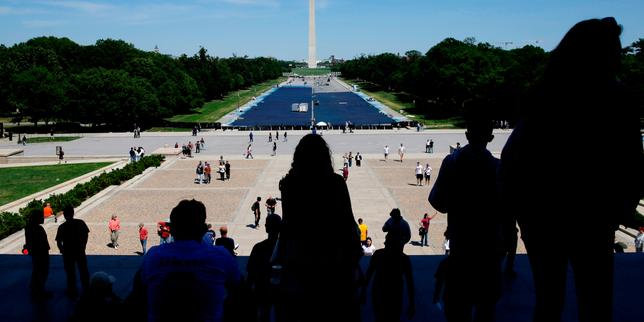
The Lincoln Memorial Reflecting Pool usually looks like a dark, moody mirror reflecting the sky and the Washington Monument. It’s an iconic piece of American history. But if you’ve seen recent photos, you’ve probably noticed something looks off. The water isn't its usual murky gray. It’s a bright, Caribbean turquoise. Donald Trump wanted the water to look better, and now it does—depending on who you ask. It’s a move that has sparked a massive debate about aesthetics, conservation, and the role of the National Park Service in political branding.
People are searching for the truth behind these "painted" water claims. Some think the concrete was literally painted blue. Others think it’s a chemical dye. The reality is a mix of maintenance demands and a specific aesthetic vision pushed by the administration. You’re seeing a shift in how we maintain national monuments, moving away from naturalistic preservation toward a more "camera-ready" look for television and social media.
Why the Reflecting Pool Looks Like a Swimming Pool
Let’s clear something up. They didn't just dump a bucket of house paint into the water. The vibrant blue color comes from a specialized dye treatment designed to suppress algae growth while providing a specific visual pop. In the past, the National Park Service (NPS) struggled with "pea soup" water. Algae thrives in the shallow, sun-drenched pool. It’s only about 18 inches deep on the sides and 30 inches in the middle. When the sun hits that water, it becomes a literal petri dish.
Trump’s team didn't like the look of the green sludge. They wanted something that looked clean and crisp for the 2024 and 2025 events. They basically treated the Reflecting Pool like the fountain at a high-end resort. It’s a drastic departure from the "natural" look that the pool has maintained for decades. Critics argue this makes one of the most somber spots in D.C. look like a tacky hotel amenity. Supporters say it’s about time we stopped letting our national treasures look like swamp water.
The Cost of Looking Good
Maintaining that bright blue isn't cheap. The Reflecting Pool holds roughly 6.75 million gallons of water. When you treat that much volume with high-grade dyes and algaecides, the bill adds up. We aren't just talking about the cost of the chemicals themselves. It's the labor. The NPS has to monitor the pH levels constantly. If the chemicals get out of balance, the dye can stain the actual stone or harm local wildlife.
Think about the ducks. The Reflecting Pool is a habitat. While the dyes used are typically "pond safe," there’s a persistent worry among conservationists that turning a historical site into a chemical-heavy feature disrupts the local ecosystem. We’ve seen reports of birds avoiding the water when the dye is at its most concentrated. Is the "perfect" photo worth the ecological trade-off? That’s the question the Trump administration answered with a resounding "yes."
A History of Maintenance Failures
To understand why this happened, you have to look at the pool's messy history. It was rebuilt back in 2012 for about $34 million. The goal was to stop it from leaking and to install a better filtration system. It didn't really work as planned. Within years, the pool was plagued by a massive outbreak of "swimmer's itch" parasites and more algae than ever.
The NPS has always been underfunded. They’ve had to make choices between fixing a roof on a historic building or cleaning the algae out of the pool. For a long time, they chose the roof. This led to the pool looking neglected. Trump’s directive changed the priority. He saw the neglect as a sign of a "failing" capital. By demanding the "repeinte" (or the "repainting" via dye), he forced the NPS to prioritize optics over standard conservation cycles.
The Optics of Power
This isn't just about water. It’s about how a leader wants the country to be perceived. A dark, reflective pool is contemplative. It’s where Martin Luther King Jr. stood. It’s where the country mourns. A bright blue pool is energetic and "new." It feels like a branding exercise.
When you see the aerial shots during a rally or a televised address, that blue water acts like a giant neon sign. It screams "clean" and "renovated." It’s the same logic used in real estate staging. You don't leave the grass brown; you paint it green. Trump applied that real estate logic to the National Mall. It’s effective for TV, but it feels jarring when you’re standing right there on the gravel path. It feels artificial. Because it is.
How the Dye Actually Works
If you’re wondering about the science, it’s actually pretty simple. The dye used is often a blend of Acid Blue 9 and Acid Yellow 23. It’s the same stuff used in food coloring and some mouthwashes. The blue dye filters out specific wavelengths of light—specifically the red end of the spectrum. Algae needs that light to photosynthesize. No light, no growth.
It’s a shortcut. Instead of using complex filtration or manual scrubbing, you just "black out" the sun for the algae. The side effect is that the water becomes opaque. You lose the deep reflection of the Washington Monument because the light can't penetrate the water and bounce back off the bottom as effectively. You get a reflection off the surface, sure, but it lacks the depth of the original, clear (but often dirty) water.
Public Reaction and the Political Divide
The reaction to the blue water has fallen almost perfectly along party lines. On social media, supporters of the move praise the "restoration" of the Mall. They see it as a sign of pride. They share the vibrant photos as proof that the country is being "cleaned up."
On the other side, historians and D.C. locals are horrified. They see it as a "Disneyfication" of a sacred space. There’s a sense that the weight of the Lincoln Memorial is being undermined by what looks like a giant slushie. Honestly, both sides are right in their own way. The pool was dirty and neglected. But the solution is undeniably artificial. It’s a clash between the "New Washington" and the "Old Washington."
What Happens Next for the Mall
This trend isn't likely to stop. Now that the precedent has been set to treat the National Mall like a set for a movie, expect more of it. We’re likely to see more aggressive "beautification" projects that prioritize immediate visual impact over long-term historical accuracy.
If you're planning a visit, don't expect the dark, glassy water from the movies. Bring polarized sunglasses. The glare off the blue dye can be intense. And keep an eye on the edges of the pool. You can often see the blue tint staining the granite where the water splashes up. It’s a permanent reminder of a temporary aesthetic choice.
If you want to see the pool for yourself, go early in the morning. The light is softer then, and the blue looks a bit more natural. Check the NPS schedule before you go, as they occasionally drain the pool for "deep cleans" when the dye buildup gets too thick. You might get there and find a giant concrete pit instead of a blue lagoon. That’s the reality of maintaining a 100-year-old monument in a 24-hour news cycle. Keep your expectations grounded. The Mall is a work in progress, and right now, that progress is bright blue.


_Biopsy.png?branch=uat_release_3)
