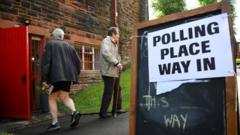
The 2026 Scottish Parliament election has moved beyond the familiar theater of constitutional flags and entered a phase of raw, fiscal survival. Voters head to the polls on May 7 facing an identity crisis that no longer centers on a border with England, but on a mounting deficit at home. While the Scottish National Party (SNP) clings to a lead in the polls, the internal math of the Scottish Government is collapsing under the weight of an aging population, a 28% funding gap in public service spending compared to England, and a healthcare system where elective waiting times are nine times higher than they were before the pandemic.
This election is not about the "if" of independence. It is about the "how" of basic governance in a nation where the Scottish Fiscal Commission warns that funding for day-to-day services will grow by a meager 1% annually while costs for social security and health are skyrocketing. The flashy promises of previous campaigns have been replaced by a grim competition of budget cuts.
The Revenue Trap and the Middle Class Squeeze
For years, Holyrood’s strategy has relied on a high-tax, high-spend model that distinguishes it from Westminster. However, the limit of this strategy has been reached. Scotland’s tax base is performing poorly relative to the rest of the UK, creating a "tax performance gap" that restricts the government's ability to fund its more generous social policies.
The SNP’s manifesto now includes desperate measures to hold onto the middle class, such as capping prices for essential food items like bread and milk. This is a radical intervention that signals how deep the cost-of-living anxiety has pierced the electorate. Meanwhile, the Scottish Conservatives are pivoting toward a scorched-earth policy on "woke" spending, promising to axe diversity roles and climate aid budgets to plug holes in domestic services.
Labour, once the dominant force in Scottish politics, finds itself in a strategic deadlock. Anas Sarwar has been forced to perform a delicate dance, distancing himself from a Westminster Labour government that has seen its honeymoon period evaporate amid policy reversals. The "Mandelson scandal" and internal disputes in London have blunted what was supposed to be a Scottish Labour resurgence. Instead of a coronation, Labour is now fighting a two-front war against a resilient SNP and a surging Reform UK.
The Reform Wildcard and the End of Two-Party Logic
The most disruptive force in the 2026 landscape is the rise of Reform UK. Polling suggests they could capture up to 20% of the vote, potentially overtaking Labour for second place. This isn't just a protest vote; it represents a fundamental shift in the unionist camp.
If Reform secures a significant bloc of MSPs, the traditional "kingmaker" roles of the Scottish Greens and Liberal Democrats will be upended. A fragmented Holyrood will make the formation of a stable coalition almost impossible. The SNP has already ruled out any deal with Reform, which leaves them either chasing a weakened Green party or attempting to govern as a minority in a chamber that is increasingly hostile to the "Bute House" style of radical environmental and social policy.
The Greens themselves are facing a backlash. Their influence on the previous government—particularly on gender recognition and deposit return schemes—has become a focal point for opposition attacks. In 2026, the Green "just transition" is being tested against the immediate reality of high heating oil costs and a decline in North Sea oil and gas revenues.
The Public Service Productivity Crisis
While politicians argue over visas and referendums, the machinery of the Scottish state is seizing up. The Institute for Fiscal Studies (IFS) has highlighted a baffling paradox: Scotland has 14% more NHS staff than it did before the pandemic, yet hospital activity has failed to return to 2019 levels. Labour productivity in the public sector is falling, and the "Barnett squeeze"—the mechanism that determines Scottish funding—is tightening.
Healthcare Performance Indicators
| Metric | Pre-Pandemic | Dec 2025/2026 |
|---|---|---|
| Wait times > 1 year | 1.0% | 9.3% |
| A&E Target Performance | Near 95% | Sub-target (Variable) |
| NHS Staffing Levels | Baseline | +14% |
The failure to translate higher spending into better outcomes is the SNP’s greatest vulnerability. The educational gap is also widening. Once the gold standard of British schooling, Scotland’s PISA scores in maths and science have been in steady decline since 2012. The 2026 election will see voters decide if they are willing to continue paying higher income tax for services that are demonstrably performing worse than those south of the border.
The Independence Deficit
Independence has not vanished, but it has changed shape. The talk of a "de facto" referendum in 2026 has largely been silenced by the reality that the movement is not ready. Even the most ardent campaigners admit that the economic case—specifically the GERS (Government Expenditure and Revenue Scotland) projections for a new state—is weak and confusing.
The 2026 vote is functioning as a holding pattern. The SNP is trying to maintain its mandate to keep the "dream" alive, while the unionist parties are attempting to prove that devolution can actually work if managed by a different set of hands. But with court backlogs at twice their pre-pandemic levels and a housing crisis that sees 18% of voters listing it as a top priority, the abstract "freedom" of a new border feels secondary to the concrete freedom of being able to see a GP or buy a first home.
The Final Reckoning for Holyrood
The 2026 campaign has stripped away the optimism of the early devolution years. We are now seeing a battle over the remains of a stretched budget. The winning party will not be the one with the most inspiring vision, but the one that can convince a skeptical public it can manage a 1.5 billion pound efficiency savings program without causing a total collapse in frontline services.
Stop looking for the "flashpoints" of old. The real conflict isn't between Edinburgh and London anymore. It is between the Scottish Government’s promises and its bank balance.
Secure the keys to Holyrood, and you inherit a house with a leaking roof and an empty pantry.