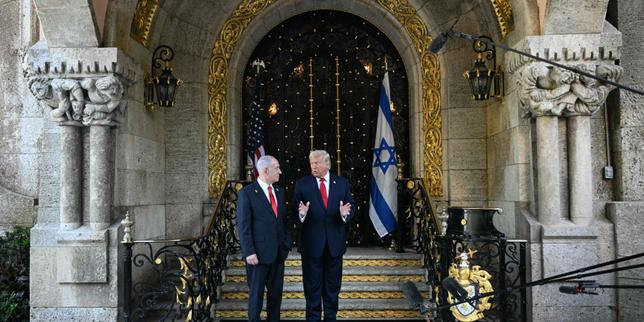
The conventional narrative surrounding the Trump administration's aggressive posture toward Iran often highlights public speeches and sudden geopolitical shifts. However, the real catalyst was a highly coordinated, behind-the-scenes lobbying effort orchestrated by Israeli Prime Minister Benjamin Netanyahu. By embedding key intelligence and strategic briefings into Donald Trump’s inner circle under the guise of diplomatic advisory groups, Netanyahu successfully shifted American foreign policy from cautious containment to direct confrontation. This calculated maneuver culminated in the systematic dismantling of the Iran nuclear deal and a dramatic escalation of military readiness in the Middle East.
Geopolitics rarely moves by accident. It moves through leverage. You might also find this related article insightful: Why the Peshawar Ancestral Houses of Raj Kapoor and Dilip Kumar are Facing Oblivion.
For decades, the relationship between Washington and Tel Aviv functioned through formal diplomatic channels, state departments, and intelligence sharing. Netanyahu changed the playbook. Recognizing that the Trump presidency operated on personal relationships and unconventional advisory structures, the Israeli government bypassed traditional statecraft. They focused instead on the specialized councils and informal policy groups that surrounded the Oval Office during Trump's first term.
The Strategy of Direct Convergence
The strategy was simple but devastatingly effective. Netanyahu aligned Israel's existential security priorities with the political brand of the Trump administration. To do this, Israeli officials did not just present raw intelligence. They packaged it into actionable political victories for an administration eager to undo the legacy of its predecessor. As highlighted in latest reports by The New York Times, the effects are significant.
The Joint Comprehensive Plan of Action (JCPOA), commonly known as the Iran nuclear deal, was the primary target. Netanyahu viewed the accord not as a diplomatic success, but as a funded pathway to an Iranian nuclear weapon. The challenge was convincing a Washington establishment that was deeply divided on the issue to take the ultimate step of abandoning it entirely.
The breakthrough occurred when Israeli intelligence secured a massive archive of internal Iranian nuclear documents from a warehouse in Tehran. This was the leverage Netanyahu needed. Rather than quietly sharing the findings with the CIA or MI6, the Israeli Prime Minister turned the disclosure into a theatrical, televised presentation delivered in English. It was a performance designed for an audience of one in the White House.
Packaging Intelligence for the Oval Office
The presentation of the Tehran archive was the turning point that reshaped American policy. It provided the necessary political cover for the United States to withdraw from the JCPOA in May 2018. This move effectively ended years of European-led diplomacy and set both nations on a path toward maximum pressure.
Behind the scenes, the coordination grew tighter. Intelligence briefings were no longer just historical data; they became operational roadmaps. Israeli security officials frequently visited Washington, bypassing traditional State Department channels to brief members of the National Security Council directly. These meetings were designed to show that Iran was vulnerable to economic strangulation and targeted military strikes.
The Operational Mechanics of Maximum Pressure
Once the diplomatic framework was shattered, the strategy shifted toward economic and military encirclement. This was the core of the maximum pressure campaign. The goal was to force Tehran into a corner where it would either have to accept a highly unfavorable new deal or risk internal collapse.
The economic sanctions re-imposed by the United States were unprecedented in their scope. They targeted Iran’s oil exports, its central bank, and its manufacturing sectors. For a time, the Iranian economy reeled under the pressure, with inflation soaring and the currency collapsing.
Yet, economic pressure alone was never the end game for Netanyahu. The ultimate objective was to neutralize Iran's regional influence and its nuclear ambitions permanently. This required a credible threat of military force, a reality that became clear as the United States began deploying additional carrier strike groups and bomber task forces to the Persian Gulf.
The Escalation Path to Confrontation
The danger of this strategy was the unpredictable nature of Iranian retaliation. Denied the ability to export oil legally, Tehran began a campaign of asymmetric warfare in the shadow zones of the Middle East. Mines were attached to tankers in the Strait of Hormuz. Drones attacked Saudi oil infrastructure at Abqaiq.
Throughout this period, Netanyahu’s advisory network urged Washington to maintain a firm line. They argued that any sign of hesitation would be interpreted by Tehran as weakness. This feedback loop created an environment where a single miscalculation could spark a wider regional war.
The climax of this escalatory cycle came in January 2020 with the assassination of Qasem Soleimani, the leader of Iran’s Quds Force. The strike, executed by an American drone near Baghdad airport, brought the two nations closer to open conflict than they had been in forty years. While the operation was carried out by American forces, the intelligence and strategic justification driving the decision bore a heavy Israeli imprint.
The Limits of Influence and the Costs of Confrontation
The alignment of American and Israeli policy during this era demonstrated the power of targeted influence. It also revealed the limits of relying on personal relationships rather than institutional consensus to drive foreign policy. When policy is built around individual leaders, it becomes fragile and subject to the whims of domestic political cycles.
The maximum pressure campaign succeeded in damaging Iran’s economy, but it failed to achieve its primary stated goals. Iran did not return to the negotiating table to sign a more restrictive treaty. Instead, it gradually restarted its uranium enrichment program, moving closer to weapons-grade material than it had been while the JCPOA was active.
Furthermore, the aggressive posture isolated the United States from its traditional European allies, who scrambled to keep the remnants of the nuclear deal alive. This division weakened the international coalition that had originally forced Iran to negotiate, proving that unilateral action often comes at the expense of long-term strategic alliances.
The Resilience of the Adversary
Tehran proved more resilient than the architects of maximum pressure anticipated. By developing an economy centered on smuggling, local production, and deep trade ties with China and Russia, Iran managed to survive the worst of the economic blockade. This shift accelerated a dangerous realignment, pushing Iran closer to America’s primary global competitors.
This geopolitical shift created a more complex challenge for Washington. Iran was no longer just a regional rogue state; it was becoming embedded in a larger, anti-Western bloc. The strategy that was supposed to isolate Tehran instead helped integrate it into a new network of global defiance.
The Legacy of the Shared Agenda
The legacy of this intense period of U.S.-Israeli coordination continues to shape the Middle East today. The institutional guards that once moderated American foreign policy were bypassed, creating a precedent where foreign leaders can exert disproportionate influence on Washington’s strategic choices through informal power structures.
The region remains locked in a cycle of gray-zone warfare. The informal advisory networks established during the Trump presidency set a new standard for how international alliances operate in an era defined by political volatility.
The primary lesson of this chapter in modern history is that strategic alignment is rarely a product of shared values alone. It is manufactured through the precise application of political pressure, timed intelligence disclosures, and the exploitation of personalized governance. As Washington and Jerusalem continue to navigate the Iranian challenge, the blueprints drawn during those critical years remain the foundation of their shared playbook, ensuring that the threat of major regional conflict is never far from the surface.


_Biopsy.png?branch=uat_release_3)
