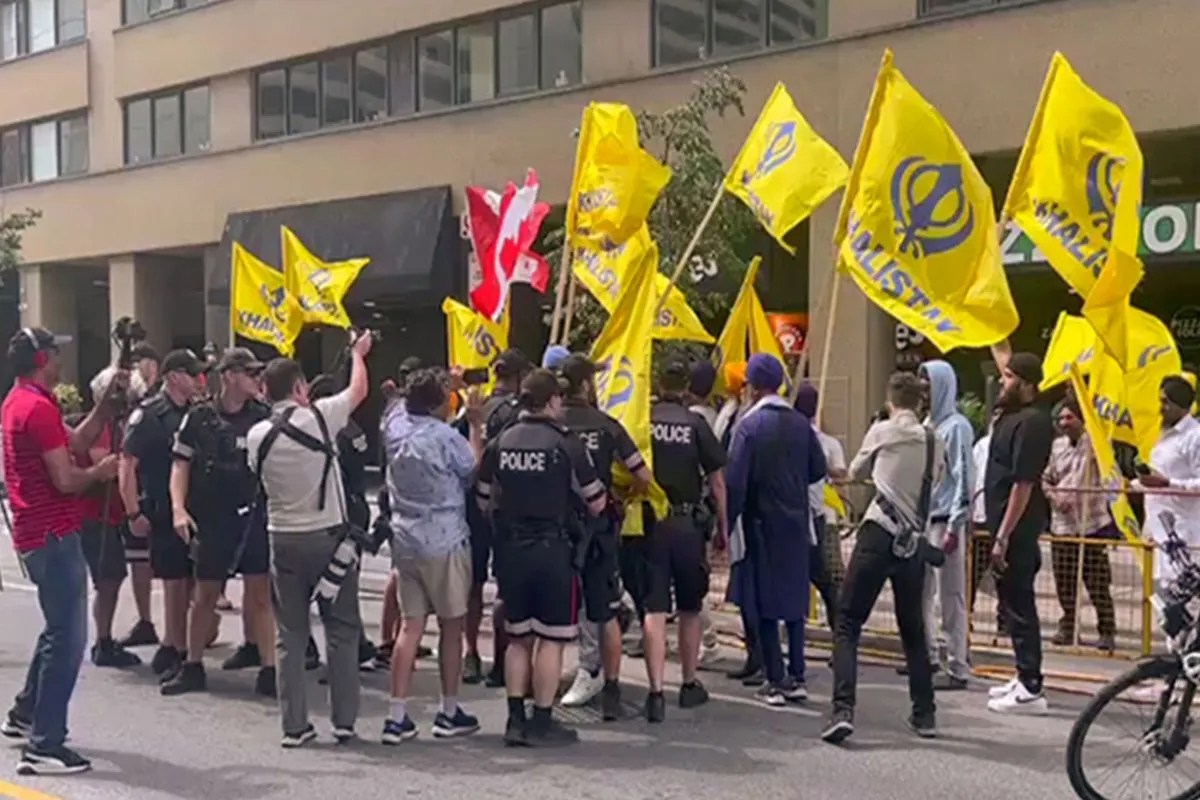
The coffee shop in Brampton smells of cardamom and rain. Outside, the gray Ontario sky hangs heavy, mirroring the mood of a community caught in a silent, suffocating tug-of-war. For decades, Canada marketed itself as a sanctuary of multiculturalism—a place where you could bring your culture, your faith, and your dreams without the baggage of the old world. But lately, the baggage has arrived. It didn't come in suitcases; it came in the form of whispers, threats, and a creeping radicalism that now keeps families awake at night.
Intelligence reports no longer dance around the issue. They point toward a grim reality: the same extremist elements that have long targeted Indian sovereignty are now hollowing out the safety of the very country that gave them refuge. This isn't just a diplomatic spat between New Delhi and Ottawa. This is about the grocery store owner who fears his windows will be smashed if he doesn't display a certain poster. It is about the student who feels the cold shoulder of a radicalized peer group.
Consider a hypothetical citizen named Arjun. He moved to British Columbia ten years ago. He wanted a yard for his kids and a job where merit mattered more than lineage. Today, Arjun avoids the local community center. Why? Because the walls are plastered with the faces of men who died holding assault rifles. He sees the radicalization of the youth, fueled by social media algorithms and old-school intimidation. He sees the Canadian government’s hesitation to act, a hesitation often masked as a defense of free speech. To Arjun, it doesn't feel like free speech. It feels like a storm.
The Invisible Grip of Extremism
Intelligence agencies are finally peeling back the curtain on how these networks operate. It is a sophisticated machinery. It isn't just about loud protests or provocative banners at a parade. It is about money. It is about the control of local institutions. It is about the systematic silencing of moderate voices within the Sikh diaspora.
The reports suggest a terrifying expansion. What started as a movement focused on a "homeland" thousands of miles away has morphed into a domestic threat within Canada. Radical elements have built a state within a state. They influence local politics. They leverage the sheer weight of their organized voting blocs to ensure that mainstream politicians look the other way. When a local leader stays silent while a mural glorifying a terrorist is erected, the message to the moderates is clear: you are on your own.
This isn't an exaggeration. The data shows a sharp uptick in extortion, targeted harassment, and violent clashes between groups. The "K-word"—Khalistan—has become a polarizing wedge driven into the heart of a once-integrated community. It isn't just a political stance anymore. It is a brand of identity politics that demands absolute loyalty. If you aren't with them, you are a traitor.
The Failure of the Sanctuary Myth
Canada’s pride has always been its "mosaic" approach to integration. Unlike the American melting pot, Canada encouraged people to keep their edges. But edges can be sharp. When those edges are honed by extremist ideologies, the mosaic begins to crack.
The intelligence findings reveal that the threat is no longer "over there." It is here. It is in the suburban streets of Surrey. It is in the halls of power in Ottawa. The radical elements have successfully hijacked the narrative of human rights to shield themselves from scrutiny. Every time a law enforcement agency tries to probe deeper, the cry of "religious persecution" or "foreign interference" is raised. It is a brilliant, albeit cynical, defense mechanism.
But the truth is more nuanced and far more dangerous. The reports indicate that these groups are increasingly involved in organized crime—smuggling, money laundering, and drug trafficking. The ideology provides the cover; the crime provides the capital. This nexus of extremism and the underworld is what makes the current situation so volatile. It isn't just about a dream of a separate state; it is about the cold, hard reality of power and profit on Canadian soil.
The Cost of Silence
What happens when a government prioritizes short-term electoral gains over long-term national security? We are seeing the answer play out in real-time. The diplomatic freeze between India and Canada is the public face of the crisis, but the private face is much more tragic. It is the fracture of families. It is the radicalization of a generation of Canadian-born youth who have never even stepped foot in Punjab, yet are being fed a diet of grievance and glory.
The intelligence report makes one thing startlingly clear: the window for intervention is closing. If the Canadian state continues to treat this as a "foreign issue" that will eventually blow over, it risks losing control of its own domestic peace. You cannot host a fire in your backyard and expect it to only burn your neighbor’s fence. Eventually, the wind shifts.
The wind has shifted.
The threat is multifaceted. It involves sophisticated cyber-propaganda, the intimidation of journalists, and the manipulation of the charitable sector. It is a ghost war being fought in the dark, and the Canadian public is only just beginning to see the shadows.
The Human Toll of Policy
Behind the headlines and the geopolitical maneuvering, there are people like Sunita. She is a first-generation immigrant who runs a small catering business. She used to love the local festivals. Now, she stays home. She’s seen the faces of the people leading the marches, and she recognizes the anger in their eyes. It’s an anger that doesn't belong in a peaceful Canadian suburb.
"We came here to leave the trouble behind," she says, her voice barely a whisper over the hiss of the espresso machine. "But the trouble followed us. And now, the people who are supposed to protect us are pretending the trouble doesn't exist."
Sunita’s fear is the most damning indictment of the current situation. When the citizens of a country—especially those from minority communities—no longer feel that the state can protect them from the radicals in their own midst, the social contract is broken.
The Path of Least Resistance
Why has it taken so long for these intelligence reports to surface, or rather, to be taken seriously? The answer lies in the uncomfortable intersection of bureaucracy and identity politics. In the Canadian political landscape, the Sikh vote is a powerful, concentrated force. For years, the path of least resistance for any politician was to attend the rallies, wear the colors, and ignore the extremist rhetoric bubbling under the surface.
But the "least resistance" path has led to a dead end.
The reports now suggest that the level of infiltration is deeper than previously feared. It isn't just a few rogue actors. It is a coordinated effort to influence Canadian policy and public opinion. This isn't just about India’s concerns anymore. It is about Canada’s sovereignty. It is about whether a Western democracy can prevent its soil from being used as a staging ground for global instability.
The irony is thick. Canada, a nation that prides itself on being a global peacekeeper, has become a reluctant host to a movement that thrives on conflict. The "sanctuary" has become a "stronghold."
The Awakening
There is a growing sense of unease that can no longer be ignored. The intelligence is out. The facts are on the table. The maps of influence, the flow of suspicious funds, and the documented cases of harassment provide a trail that leads to a disturbing conclusion: the threat is real, it is growing, and it is homegrown.
Correcting this won't be easy. It will require a level of political courage that has been absent for a long time. It will mean distinguishing between legitimate political expression and the promotion of violence. It will mean standing up to the bullies who have used the cover of "community leadership" to silence dissent.
The challenge for Canada is to prove that its multiculturalism isn't a suicide pact. It must show that it can protect the rights of the individual against the tyranny of the radicalized group.
As the rain continues to fall over Brampton, the patrons in the coffee shop slowly disperse. They walk to their cars, heads down, avoiding eye contact. In a healthy society, a coffee shop is a place of connection. Here, it feels like a place of caution. The shadows are long, and the sun hasn't been seen in days.
The Maple Leaf is still flying, but it is shivering in a cold, unfamiliar wind.