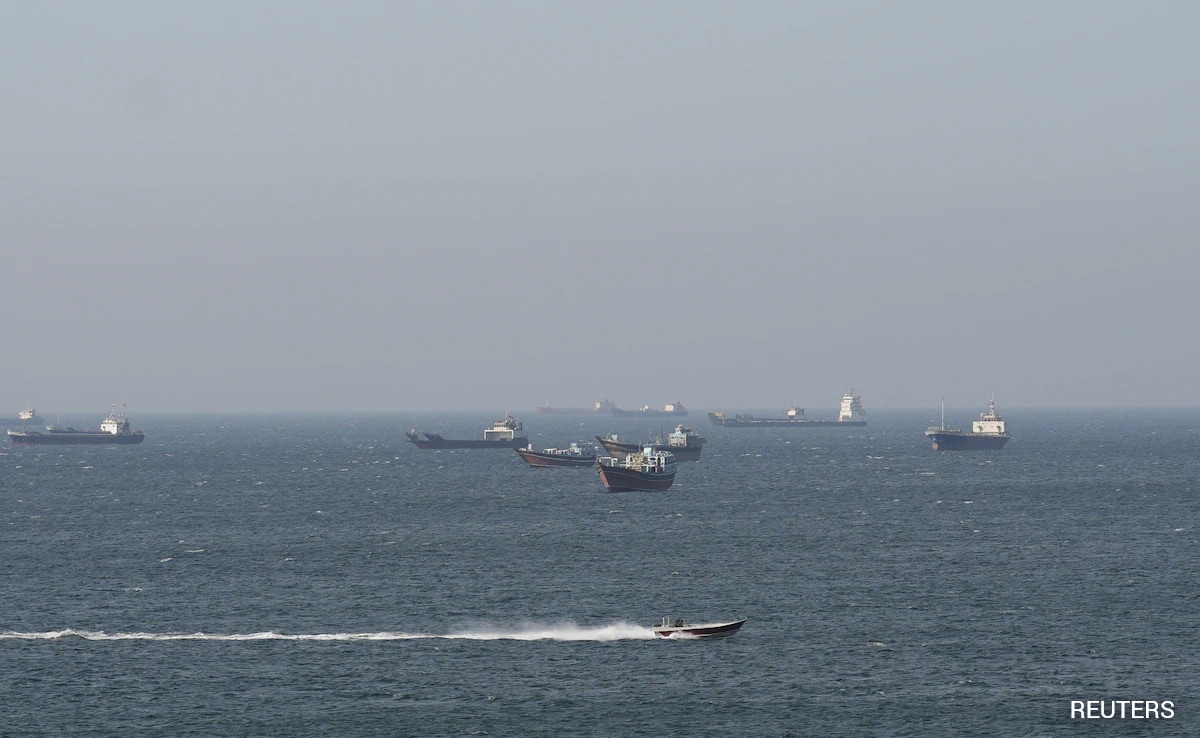
The metal hums. It is a constant, low-frequency vibration that travels through the soles of your boots and settles in your teeth. On the bridge of a 150,000-ton tanker, the world feels infinite and claustrophobic all at once. To your left, the jagged coastline of the Musandam Peninsula rises like a row of broken teeth. To your right, the Iranian coast looms, a haze of desert heat and radar installations.
You are navigating the Strait of Hormuz. For an alternative look, check out: this related article.
This narrow strip of water, barely twenty-one miles wide at its tightest squeeze, is the jugular vein of the global economy. One-fifth of the world’s oil flows through here. Every light bulb flickering in a London flat, every gallon of gas pumped in a Tokyo suburb, and every plastic toy manufactured in a Chinese factory likely owes its existence to the safe passage of ships through this corridor. But over the last seventy-two hours, the hum of the engines has been drowned out by the scream of fast-attack craft and the heavy silence of guns being uncovered.
Panic doesn't start with a bang. It starts with a radio crackle. Related analysis on this trend has been provided by Al Jazeera.
The Geometry of Fear
On Friday afternoon, the captain of a mid-sized chemical tanker—let’s call him Elias—watched a blip on his radar that shouldn't have been there. It wasn't the slow, predictable trudge of another merchant vessel. This was fast. Erratic.
Elias represents the invisible workforce of the sea. These are men and women who spend months away from their families, navigating geopolitical minefields they didn't create. When a speedboat from the Islamic Revolutionary Guard Corps (IRGC) swerves into your path, the abstract headlines about "regional tensions" suddenly become very physical.
Imagine a highway where the lanes are made of water and the police are replaced by masked men with rocket launchers. That was the reality this weekend. Reports surfaced of vessels being shadowed by Iranian patrol boats, their crews forced to execute bone-jarring U-turns in crowded shipping lanes to avoid boarding. These aren't just navigational errors. They are calculated signals sent from one capital city to another, written in the wake of gray-hulled ships.
The math of the Strait is brutal. If you are a captain, you have two choices when a foreign military vessel orders you to stop in international waters. You can comply, risking a long detention and the seizure of a billion-dollar cargo. Or you can run, risking a kinetic escalation that could ignite a global energy crisis.
This weekend, several chose to turn back.
The Cost of a Degree
When a tanker makes a sudden U-turn in the Strait, the ripple effect doesn't stop at the shoreline. It hits the commodities markets in Singapore and New York within seconds.
The Strait operates on a two-way traffic separation scheme. There is an inbound lane and an outbound lane, separated by a thin buffer zone. It is a delicate choreography. When one ship breaks formation because of a threat, every vessel behind it has to react. It is a high-stakes game of "telephone" played with steel hulls and thousands of tons of volatile crude.
Think of the insurance premiums. This is the "invisible tax" of the Hormuz. Every time a shot is fired or a threat is broadcast over Channel 16, the cost of insuring a voyage through the Persian Gulf spikes. Shipping companies pass those costs to refineries. Refineries pass them to the consumer. You feel the tension in the Middle East every time you swipe your card at the gas station. It isn't just about supply and demand; it is about the price of risk.
But for the crews, the risk isn't measured in cents per gallon. It’s measured in the distance between their deck and the water.
The tactics observed this weekend were particularly aggressive. Witnesses reported "bridge-to-bridge" threats—radio communications where Iranian authorities claimed the merchant vessels were violating local laws or environmental regulations. It is a legalistic veneer for what is essentially a show of force. The vessels are often approached by swarms of small, fast boats, a "wolf pack" tactic designed to overwhelm the senses of the bridge crew.
The Silent Guardians
While the fast boats danced around the tankers, there was another presence in the water. High above, the drone of reconnaissance aircraft provided a grainy, thermal-imaged view of the chaos. Deep below, the silent silhouettes of Western naval assets moved in a counter-ballet of deterrence.
The United States and its allies have spent decades trying to perfect the art of the "de-escalatory presence." The goal is to be visible enough to discourage an attack, but not so aggressive that you provoke one. It is a tightrope walk over an ocean of oil.
Consider the psychological pressure on a young naval officer aboard a destroyer like the USS McFaul. You are watching a merchant ship being harassed. You have the firepower to end the confrontation in seconds. But you also know that one wrong move—one panicked trigger pull—could start a war that closes the Strait for months.
That closure would be catastrophic. If Hormuz were to be blocked, the global supply of oil would drop by roughly 20%. There is no pipeline on earth with the capacity to bypass it entirely. The world would see an immediate, paralyzing energy shortage.
The Human Pivot
Why now? Why this weekend?
Geopolitics is rarely about a single event. It is a slow-motion collision of interests. We are seeing the fallout of stalled nuclear negotiations, the seizure of Iranian oil in other parts of the world, and a domestic political landscape in Tehran that rewards "revolutionary" action.
But talk to the sailors, and they don't care about the JCPOA or sanctions. They care about the fact that they can't sleep. Sleep deprivation is the silent enemy on these ships. When you are under constant threat of boarding, the crew stays on high alert. Adrenaline is a finite resource. After forty-eight hours of "man-overboard" drills and "piracy-attack" simulations, the human mind begins to fray.
Mistakes happen when people are tired.
A navigator misreads a buoy. A helmsman overcorrects. In the narrow confines of the Strait, a mistake of fifty yards can lead to a grounding or a collision. This weekend’s chaos wasn't just about the threat of gunfire; it was about the threat of exhaustion. The Iranian tactics are designed to wear down the resolve of the international shipping community, making the cost of doing business too high to bear.
The Mirror of the Sea
There is a strange beauty in the Strait at night, provided you can ignore the warships. The bioluminescence in the water glows neon green as the bow cuts through the waves. The stars are so bright they seem to touch the mast.
On Saturday night, as the reports of gunfire subsided and the "U-turns" became less frequent, a sense of uneasy normalcy returned. But it is a fragile peace. The ships that turned back are now hovering in the Gulf of Oman, waiting for a "window" of safety that might never truly come.
We often talk about the "global community" as an abstract concept. But in the Strait of Hormuz, the global community is a collection of steel boxes and human beings trying to get from Point A to Point B without dying. We are all tethered to this twenty-one-mile gap. We are all passengers on those tankers, whether we realize it or not.
The weekend’s events were a reminder that the world’s most vital infrastructure isn't made of cloud servers or fiber-optic cables. It is made of salt water, heavy fuel oil, and the courage of people who have to stare down a gun barrel just to keep the lights on.
As the sun rose over the mountains of Iran on Sunday morning, the tankers began their transit again. The engines hummed. The vibration returned to the boots of the captains. They watched the horizon, waiting for the next blip on the radar, knowing that the distance between a normal day and a global disaster is sometimes just the length of a single radio call.
The Strait doesn't forget. It just waits for the next tide.