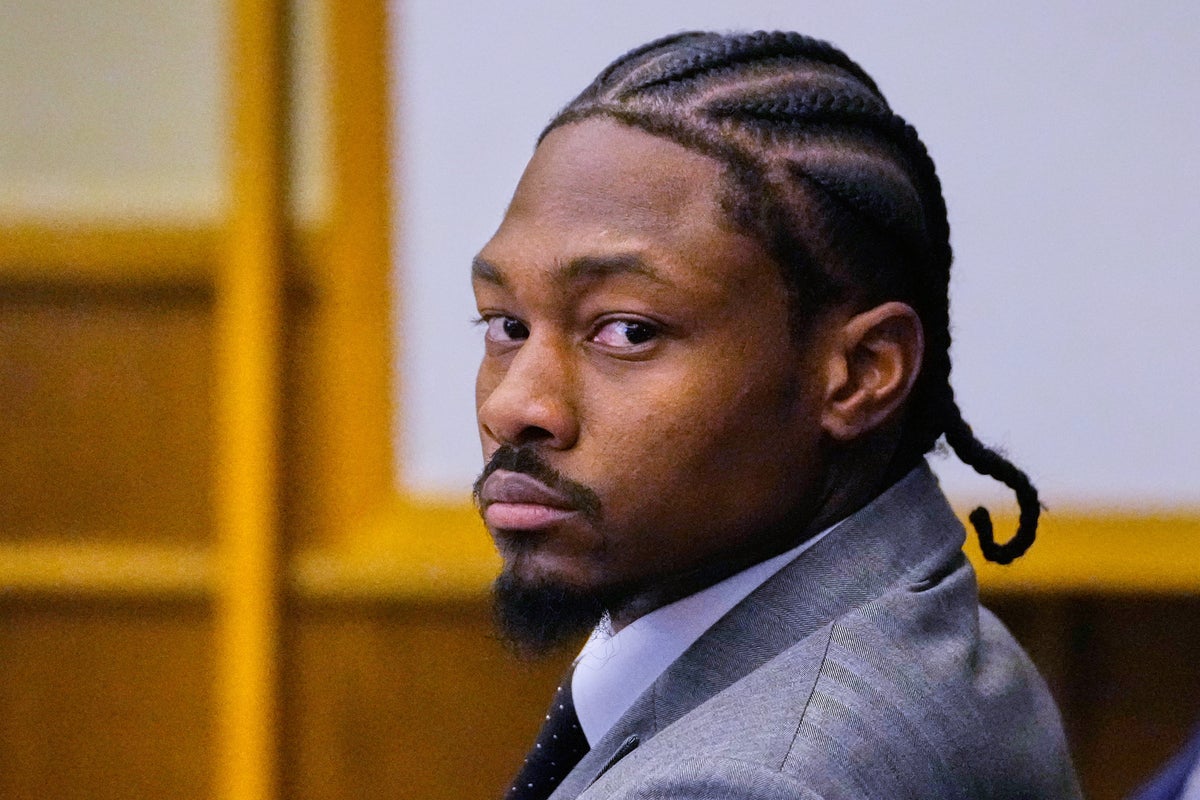
The courtroom is a place where oxygen feels expensive. It is a vacuum of polished wood, fluorescent humming, and the suffocating weight of what-ifs. For Stefon Diggs, a man whose entire professional life is defined by explosive movement and the roar of sixty thousand voices, the stillness of a legal proceeding must have felt like a different planet.
He sat there. Waiting.
Outside those walls, the world had already done what it does best: it had moved on to the next headline, the next highlight reel, the next controversy. But inside, the stakes were stripped of their athletic glamour. This wasn't about a missed block or a dropped pass in the end zone. This was about a name. Specifically, his name, and whether it would forever be tethered to the word "guilty."
When the judge finally spoke the words—not guilty—the air rushed back into the room. But the story of how we got there, and what happens to a man when the court of public opinion moves faster than the court of law, is far more complex than a simple acquittal.
The Weight of the Jersey
In the world of professional football, players are often treated as avatars rather than humans. We see them through the lens of fantasy points and contract disputes. When a headline drops—Stefon Diggs charged with assault—it triggers a mechanical sequence of events. Team PR departments prepare statements. Agents go into damage control. Fans take to social media to argue about character flaws or defensive posturing.
The human at the center of it all becomes a ghost in his own narrative.
Consider the reality of an assault trial. It is a grueling dissection of a single moment in time. Every movement is scrutinized. Every word spoken in the heat of a confrontation is weighed. For an athlete like Diggs, whose physicality is his greatest asset on the field, that same physicality becomes a liability in a courtroom. A hand on a shoulder is interpreted differently when that hand belongs to a Pro Bowl wide receiver.
The trial wasn't just about the facts of the incident. It was about the perception of power.
The prosecution built a case around the idea of aggression. They painted a picture of a man who uses his stature to intimidate. They relied on the classic trope of the "diva" athlete—someone who believes the rules don't apply to them because they can run a sub-4.4 forty-yard dash. It is a narrative as old as the league itself, and it is one that juries find easy to digest.
But the defense had a different story to tell. They didn't rely on stardom. They relied on the gaps in the testimony.
When the Witnesses Falter
The core of the "not guilty" verdict didn't lie in a dramatic, cinematic revelation. It lay in the mundane inconsistencies of human memory.
The alleged assault was supposed to be a clear-cut case of an unprovoked attack. Yet, as the defense began to pull at the threads, the fabric of the accusation started to unravel. Witnesses who were certain of what they saw during their initial statements became hesitant under the cold glare of cross-examination. Timelines shifted. Details blurred.
One witness claimed the physical altercation lasted minutes; the forensic evidence suggested seconds. Another spoke of a specific sequence of blows that didn't align with the medical reports.
These aren't just legal technicalities. They are the friction points of truth. In a courtroom, "beyond a reasonable doubt" is a massive, towering wall. To scale it, the prosecution needs a ladder made of iron-clad facts. In the Diggs case, they were trying to climb with a ladder made of wet paper.
The jury saw the holes. They saw the way the story changed depending on who was telling it. And more importantly, they saw the lack of physical evidence to support the severity of the claims.
It is a terrifying thing to realize that a person’s entire legacy can hang on the shaky memory of a stranger who was looking the wrong way at the wrong time.
The Invisible Stakes of a Reputation
We like to think that a "not guilty" verdict erases the problem. We treat it like a scoreboard. Game over. Diggs wins.
But the reality of a high-profile trial is that the stain is often permanent. Even with the gavel coming down in his favor, the search results for Stefon Diggs will forever be peppered with the word "assault." Sponsors look at the risk. Teams look at the "distraction."
There is a psychological toll to being accused of something that cuts against the grain of your character. Diggs has always been a polarizing figure in the NFL—celebrated for his route-running and criticized for his emotional outbursts on the sideline. But there is a canyon-sized gap between being a "difficult teammate" and being a violent criminal.
Throughout the trial, Diggs remained uncharacteristically quiet. There were no Instagram rants. No cryptic tweets. Just the silence of a man who realized that for once, his feet couldn't outrun the situation.
This quietness was perhaps the most telling part of the entire saga. It suggested a level of gravity that fans rarely see. It wasn't about "beating the case." It was about the realization that he was vulnerable in a way that no linebacker could ever make him.
The Aftermath of the Verdict
So, what remains?
Diggs returns to the field, but he does so with the ghost of the courtroom trailing him. The "not guilty" verdict is a shield, but it isn't a suit of armor. Every time he gets into a heated exchange on the field or speaks his mind in a press conference, there will be those who point back to this trial as "proof" of a hidden darkness.
The trial reminds us that we are obsessed with the fall. We love the trajectory of a star being pulled back down to earth by the gravity of their own mistakes. When they are exonerated, there is almost a sense of disappointment in the air—the spectacle is over, and we didn't get the ending we expected.
But for the man in the polished wood room, the ending was the only one that mattered.
Stefon Diggs walked out of that courthouse and back into the sunlight of his life. He didn't celebrate. He didn't gloat. He simply left. Behind him, the courtroom was cleaned, the transcripts were filed away, and the next case was called.
The legal system had done its job, finding the truth in the spaces between the contradictions. But the court of public opinion is still out. It is always out. And for an athlete in the modern age, the trial never truly ends.
He is free.
Yet, as he prepares for another season of highlights and heartbreak, he knows that the most important win of his career didn't happen on the turf. It happened in the silence of a room where nobody was cheering, and where the only thing he had left to defend was the one thing no contract can buy back.