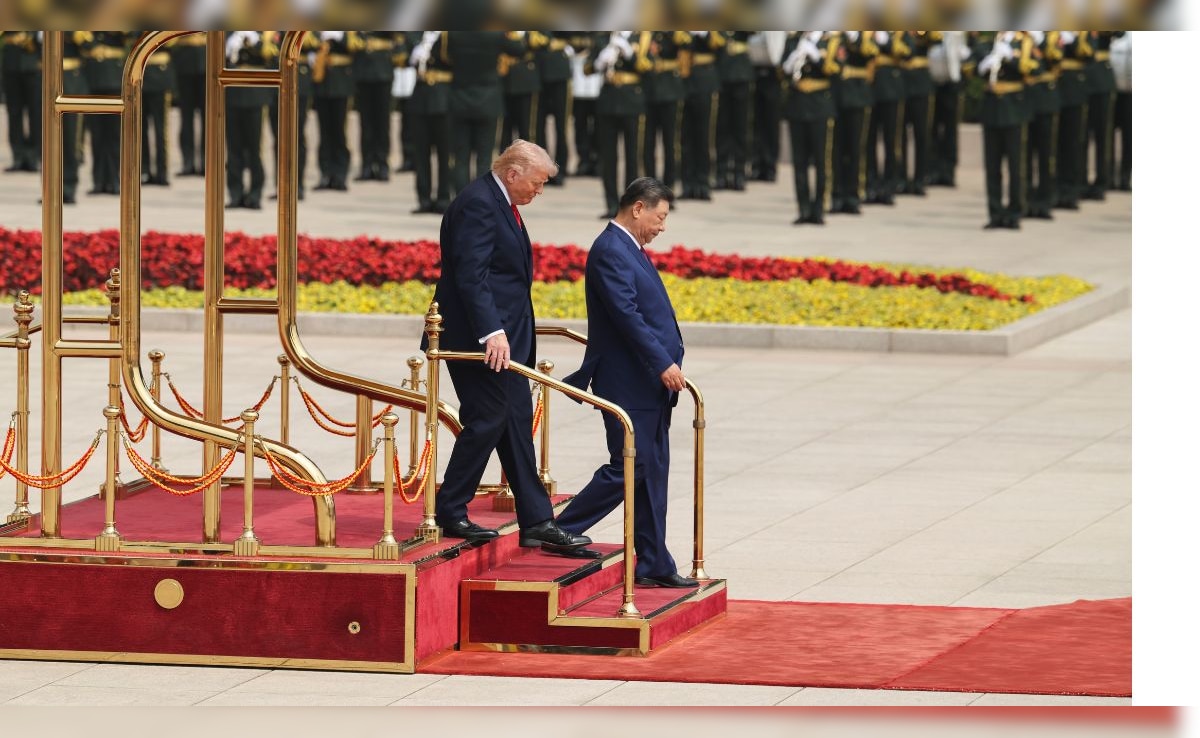
The Great Hall of the People is a space designed to make an individual feel small. Its ceilings are vast, its carpets are thick enough to swallow the sound of a footfall, and the air carries the weight of a thousand geopolitical shifts. But on a Tuesday evening in Beijing, the immense geopolitical tension between the United States and China wasn't being negotiated with shouting matches or signed treaties. It was being mediated by a bowl of soup.
To the casual observer, the state banquet for Donald Trump and Xi Jinping looked like a display of excessive wealth. To the chefs in the kitchen, it was a high-stakes performance of Huaiyang cuisine, a culinary tradition where the sharpness of a knife is as vital as the sharpness of a diplomat’s wit.
In the West, we often view a meal as a break from work. In Chinese statecraft, the meal is the work.
The Anatomy of a Cold Peace
Consider the chef. Let’s call him Master Chen—a hypothetical composite of the masters who labor in the Great Hall's kitchens. He doesn't care about trade deficits or maritime borders. His world is measured in the thickness of a ginger slice. For this banquet, he isn't just cooking; he is constructing a bridge made of broth.
Huaiyang cuisine is one of the Four Great Traditions of Chinese food. It hails from the region around the lower reaches of the Yangtze River. It is not the numbing heat of Sichuan or the hearty, salty weight of Shandong. It is subtle. It is light. It is notoriously difficult to master because it relies on "suya"—an elegant simplicity that masks incredible technical complexity.
When Master Chen prepares a dish like "Matsu’s Tofu," he isn't just dicing. He is performing a feat of engineering. He takes a block of soft tofu and, with a heavy cleaver, shreds it into thousands of strands until it resembles a fine chrysanthemum floating in a clear broth. If his hand shakes, the dish is ruined. If the broth is cloudy, the message is lost.
The message to the American delegation was clear: We have the patience to do this. We have the history. We have the precision.
Why the Menu Matters More Than the Speech
While the world waited for news of "big deals," the real story was written on the menu card. The selection of Huaiyang cuisine was a calculated move. It is often referred to as the "civilized" cuisine. Because it avoids overwhelming spice or heavy oils, it is the safest bet for international palates, but it also serves as a subtle reminder of China’s soft power.
The menu included:
- Hors d’oeuvres
- Coconut-flavored bird’s nest soup
- Filet steak with black pepper
- Seafood chowder
- Dry-braised prawns
- Sautéed vegetables in gravy
- Sichuan spicy chicken
Notice the balance. The Sichuan chicken provides a nod to the bold, assertive nature of modern China. The steak is a concession to the American guest’s well-known preferences. But the heart of the meal remains the Huaiyang influence—the steamed seafood and the meticulously prepared vegetables.
The table itself was a landscape. A massive floral arrangement stretched down the center, depicting the "Belt and Road" geography. It was a literal map of ambition, softened by the scent of fresh lilies.
The Invisible Stakes of the Empty Chair
Imagine you are a diplomat sitting at that table. You are exhausted. The jet lag feels like a physical weight behind your eyes. You have spent the day arguing over intellectual property and market access. You are looking for a reason to distrust the person across from you.
Then, the soup arrives.
It is clear. It is hot. It is perfect. For a moment, the friction of the day melts into the sensory experience of the present. This is the "gastronomic diplomacy" that has governed human interaction for millennia. It’s hard to threaten a man with a trade war while you are both marveling at the same braised prawn.
But the stakes are invisible. A poorly timed course or a dish that is too alien to the guest can be read as a slight. In 1972, when Richard Nixon came to China, the banquet was a tectonic shift. It signaled that the "Bamboo Curtain" was lifting. Every clink of a Moutai glass was a signal to the world that the era of isolation was over.
For the Trump-Xi meeting, the cuisine had to perform a different task. It had to project stability. In a world of volatile tweets and shifting alliances, the Huaiyang tradition represents a China that is ancient, disciplined, and immovable.
The Art of the Pivot
History is often taught as a series of dates and battles. This is a mistake. History is a series of human reactions.
When the two leaders toasted, they weren't just drinking. They were participating in a ritual that demands a specific kind of posture. In Chinese culture, the height at which you hold your glass relative to your counterpart speaks volumes about your perceived status. To clink lower is to show respect; to clink higher is to assert dominance.
Watching the footage, you see a dance of micro-adjustments. A slight tilt of the head. A shared laugh over a particular dish. These are the lubricants of empire.
The critics will say it’s all theater. They aren't wrong. But theater is how we prevent reality from becoming too violent. The banquet acts as a buffer zone. It is a controlled environment where the "other" is humanized through the shared necessity of eating.
The Knife’s Edge
Back in the kitchen, the pressure is suffocating. Master Chen knows that a single bone found in the fish or an overcooked vegetable isn't just a culinary failure; it is a national embarrassment.
The precision of Huaiyang cuisine is the perfect metaphor for the current state of Sino-American relations. It is a delicate balance of heat and time. If the fire is too high, the flavor is scorched. If it is too low, the dish is stagnant.
We often talk about "hard power"—tanks, carriers, currency. We talk about "soft power"—movies, music, values. But there is a third category: "visceral power." It is the power to influence how someone feels in their own body.
A state banquet is the ultimate exercise in visceral power. It aims to leave the guest feeling satiated, respected, and perhaps a little bit intimidated by the sheer depth of the host’s culture.
The meal ended with fruit and ice cream—a simple, cooling finish. The plates were cleared. The leaders rose. The cameras captured the handshakes.
The menus will eventually be archived in museums or tucked away in the scrapbooks of aides. The flavors will fade from the tongues of the delegates. But the "Tone for Diplomacy" had been set. It wasn't set by the words spoken into the microphones, but by the quiet, tireless work of the men and women in white hats who understand that sometimes, the most powerful thing you can do is serve a perfect bowl of soup.
The Great Hall returned to its silent, echoing grandeur. Outside, the Beijing night was cold, but inside, the air still smelled faintly of ginger and steamed fish—the lingering scent of a peace held together by nothing more, and nothing less, than the art of the table.