The coffee machine in the breakroom hums with a mechanical indifference that feels increasingly personal. For twenty years, Sarah didn't just manage the inventory for a regional logistics firm; she felt the pulse of it. She knew when a storm in the Atlantic would delay a shipment of steel before the weather reports even turned red. She knew which drivers would push through the night and which ones needed a Saturday off to stay sane. Now, a black box on her desk—an interface she was told would "assist" her—does the feeling for her. It predicts the storms. It optimizes the drivers. It has turned her intuition into an artifact.
Sarah is the human face of a statistical displacement. She isn't unemployed, not yet. But she is being hollowed out.
Thousands of miles away, in glass towers overlooking the Pacific, the architects of this hollowing are starting to sweat. They see the data Sarah doesn't. They see the widening gyre between the productivity their tools create and the wages the world actually pays. They recognize that if you automate the middle class out of a purpose, you eventually automate yourself out of a customer base. This realization has birthed a new movement among the tech elite: a desperate, high-stakes scramble to propose a "New Deal" for the age of automation.
The Architects of the Aftermath
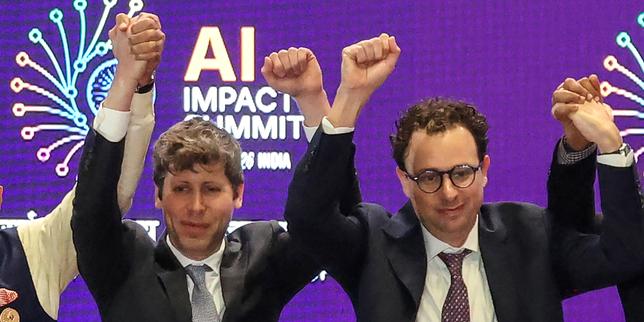
Sam Altman, the face of OpenAI, has become a sort of secular missionary for Universal Basic Income (UBI). His logic is as cold as it is revolutionary. If software can perform the cognitive labor that once required a college degree, the traditional link between "work" and "survival" snaps. He suggests a world where the wealth generated by machines is captured and redistributed. It sounds like socialism, but it is actually a survival strategy for capitalism.
Consider the irony. The same men who spent the last decade breaking the labor market are now the ones offering to fix it. It’s like an arsonist handing you a fire extinguisher while the curtains are still smoldering.
Elon Musk and Marc Andreessen have their own versions of this prophecy. Musk talks of "universal high income," a world where machines provide so much abundance that cost becomes irrelevant. Andreessen, the quintessential techno-optimist, argues that we shouldn't tax the robots but rather accelerate their arrival so the benefits accrue faster. They are all, in their own way, trying to solve the "Sarah Problem." They are trying to figure out what to do with a population that has been stripped of its economic utility but still possesses the power to vote—or to revolt.
The Myth of the Frictionless Future
We are told that this transition will be a "Great Re-skilling." That is a lie told by people who have never had to tell a fifty-year-old father of three that his expertise in manual machining is now worth less than the electricity used to power a 3D printer.
Economic history is often sanitized into "shifts." We talk about the Industrial Revolution as a period of growth, glossing over the decades of child labor, urban squalor, and social upheaval that paved the way for the 40-hour work week. The difference today is the sheer velocity. Steam engines took a century to change the world. Generative AI is doing it in the time it takes to ship a software update.
The proposed New Deals—be they UBI, shorter work weeks, or massive taxes on compute power—all share a single, terrifying assumption: that human labor is becoming an optional luxury.
But labor was never just about money. It was about the social glue of the "office," the pride of a finished project, and the structure of a Tuesday morning. When the tech moguls propose a monthly check as a solution to AI displacement, they are treating a soul-crushing identity crisis as a simple accounting error.
The Sovereign Individual vs. The Collective
Silicon Valley has long worshipped the "Sovereign Individual"—the idea that a single person with a laptop can change the world. This philosophy is now colliding with the reality of mass automation. If the "Sovereign Individual" can replace ten thousand Sarahs, the social contract effectively dissolves.
The New Deal being floated in boardrooms isn't just about cash. It's about data sovereignty. Some thinkers, like Jaron Lanier, propose "Data Dignity." The idea is simple: if AI is trained on our collective work—our emails, our art, our spreadsheets—then we should be paid royalties for our contribution to the machine's intelligence.
Imagine a world where Sarah doesn't get a government handout, but a micropayment every time the logistics AI uses a pattern she helped establish over two decades. It transforms the "user" from a source of free training data into a shareholder in the digital future. It acknowledges that the machine is nothing without the ghost of our past efforts.
The Invisible Stakes of the "Compute Tax"
To fund these grand social experiments, the gurus are looking at the one thing the machines can't live without: energy and silicon.
A "Compute Tax" is the modern version of the land tax. In the 18th century, wealth was dirt. In the 20th, it was oil. In the 21st, it is the ability to process billions of parameters per second. By taxing the hardware that runs the AI, governments could theoretically fund the social safety nets required to catch those falling out of the economy.
But the resistance is fierce. Critics argue that taxing compute is like taxing the printing press in 1450. They claim it will drive innovation to shores with fewer rules, leaving the "protected" nations with a high social safety net but a stagnant economy. It is a race to the bottom where the prize is a slightly less miserable displacement.
The Emotional Ledger
Back in the breakroom, Sarah doesn't care about compute taxes or data dignity. She feels the silence of a phone that no longer rings with urgent problems. The problems are solved before they reach her.
The tech elite are right about one thing: the current path is unsustainable. You cannot have a functioning society where the means of production are concentrated in a few server farms while the rest of the world survives on digital breadcrumbs. Their "New Deal" is a recognition that the pitchforks are coming, and they would rather pay a premium for peace than face a reckoning.
The real danger isn't that the machines will become sentient and kill us. It’s that they will become efficient and ignore us. We are building a world that is incredibly good at answering questions but has forgotten why we asked them in the first place.
As the sun sets over the data centers of Northern Virginia and the hills of Palo Alto, the lights stay on. The machines don't sleep. They are calculating the next move, the next optimization, the next way to remove "friction" from the world. We are the friction. And unless we find a way to make our humanity more valuable than their efficiency, the New Deal won't be a bridge to a better future—it will be a severance package for the human race.
Sarah leaves the office at 5:00 PM sharp. Her work is done, or rather, it was done for her. She walks to her car, her hands still smelling of the coffee she didn't really need, wondering when the machine will finally decide that even her presence at the desk is a variable that can be optimized away.