A stack of sixty billion euros does not look like money. It looks like a mountain. If you laid those notes end-to-end, they would wrap around the Earth hundreds of times, a paper ribbon trying to bind a broken world together. But in the offices of the United Nations and the European Union, this number is not a ribbon. It is a ledger of ghosts.
Earlier this year, a joint assessment released a figure that should have stopped the world's heart: the estimated cost to rebuild the Gaza Strip is at least 60 billion euros. The timeline? Twelve years. That takes us to 2036.
Numbers of this magnitude usually belong to the world of space exploration or the GDP of mid-sized nations. When applied to a strip of land only 41 kilometers long, the math becomes surreal. It translates to a decade and a half of constant, grinding labor just to reach the baseline of "functional."
Consider a man named Omar. He is a hypothetical composite of the thousands of shopkeepers who once navigated the narrow streets of Gaza City. In 2023, Omar had a storefront, a ledger of his own, and a stack of colorful fabrics. Today, Omar stands on a pile of gray dust that used to be his bedroom. To Omar, 60 billion euros is an abstraction. He just needs a bag of cement. But there is no cement. There is only the realization that his son, currently ten years old, will be twenty-two before the city around them looks like a city again.
The Weight of the Rubble
The first hurdle isn't building. It’s moving.
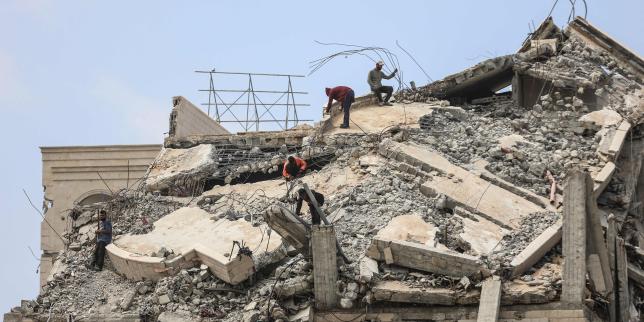
The UN estimates there are roughly 37 million tons of debris scattered across the territory. To understand that volume, imagine a line of dump trucks stretching from Paris to Dubai, each one heavy with the pulverized remains of lives. This isn't just "trash." This is hazardous waste mixed with unexploded ordnance and the tragic, unspoken remains of those who didn't get out in time.
The logistics of simply clearing the land are a nightmare of engineering and ethics. You cannot just bulldoze a neighborhood when the soil is laced with asbestos and white phosphorus. You have to sift. You have to treat the earth as if it were a crime scene and a graveyard simultaneously.
The cost of this "clearing phase" alone eats up years of the 2036 timeline. It is a period of negative progress. You spend billions just to reach zero. Only when the ground is bare and the toxins are buried can the first brick be laid. For the people living in tents in the interim, this is the slowest clock in the world.
The Invisible Infrastructure
When we talk about reconstruction, the mind goes to shiny apartment towers and paved roads. Those are the easy parts. The real cost—the reason the EU and UN are staring at a 60-billion-euro hole—is the stuff beneath the skin of the earth.
Gaza’s water table was already a disaster before the recent escalations. Now, the desalination plants are crippled, the sewage pipes are shattered, and the electrical grid is a memory. To fix this, you don't just patch a pipe. You have to reinvent a lifecycle.
Think of the electricity. You cannot run a modern hospital or a water pump on hope. You need a grid that doesn't exist. The international community is essentially proposing the construction of a 21st-century city-state from the ashes of a 20th-century ruin. The technological requirements are immense. We are talking about solar arrays, smart grids, and high-efficiency waste management systems because the old ways of dumping and burning are no longer viable in such a dense, traumatized space.
The "business" of this reconstruction is also a paradox. Who insures a crane in a conflict zone? Who signs the contract for a bridge when the geopolitical foundations are shifting like sand? The 60 billion euros isn't just for materials; it's a "risk premium." It’s the price of doing business in a place where the sun sets on uncertainty every single night.
The Education Gap
By 2036, a generation will have grown up in the shadow of the crane.
The UN reports that nearly every school in the territory has been damaged or destroyed. Education is a fragile thread. When you snap it for a year, you lose a grade. When you snap it for five, you lose a workforce.
The reconstruction plan includes the rebuilding of universities and primary schools, but buildings don't teach. The hidden cost is the intellectual capital. The teachers who have fled, the doctors who are gone, the engineers who are now refugees elsewhere. If you build a world-class hospital for 500 million euros but have no surgeons to staff it, you haven't rebuilt anything. You've just built a monument to an absence.
This is where the human-centric narrative hits a wall of cold reality. The money can buy the concrete, but it cannot buy back the time. It cannot undo the psychological scarring of a child who spent their formative years learning the difference between the sound of an outgoing shell and an incoming strike.
The Geopolitical Toll Booth
There is a cynical truth that often stays off the balance sheets: reconstruction is a political lever.
The EU and the UN are the primary donors, but they are not the only stakeholders. Every bag of flour and every ton of steel that enters the territory must pass through checkpoints governed by security concerns and political theater. If the borders remain a bottleneck, the 2036 deadline will slide to 2046, then 2050.
Efficiency is a luxury Gaza has never had. In the past, the "dual-use" list—items that could be used for both civilian construction and military purposes—has included basic necessities like wood and cement. Under these restrictions, building a simple house takes three times longer and costs four times as much as it would in Cairo or Tel Aviv.
The 60-billion-euro estimate assumes a level of cooperation that hasn't existed in decades. It assumes that the world will remain interested in Gaza for the next twelve years.
History suggests otherwise. International attention is a strobe light. It flashes brilliantly during a crisis, then fades as the next tragedy takes center stage. We saw it after the 2014 conflict. Pledges were made in Cairo, billions were promised, but only a fraction was actually delivered as the world’s focus drifted to other borders.
The Psychology of the Long Haul
If you are Omar, standing on your pile of dust, the 60-billion-euro figure feels like a lie.
It is too large to be real and too far away to be helpful. He doesn't need a 2036 master plan. He needs a roof for the winter of 2026. This disconnect between macro-economics and micro-survival is where hope goes to die.
The reconstruction isn't just about physical structures; it's about the restoration of agency. A man with a job and a home is a man with a stake in the future. A man in a tent, waiting for a billionaire's committee to approve a plumbing contract, is a man with nothing to lose.
The stakeholders in Brussels and New York know this. They aren't just calculating the cost of bricks; they are calculating the cost of stability. If the reconstruction fails—or if it is perceived as a hollow promise—the cycle of violence will simply reset. The 60 billion euros is an investment in breaking that cycle. It is, perhaps, the most expensive peace treaty ever written, yet it hasn't been signed by anyone.
The Scars in the Soil
Even if every cent is paid and every building is raised by 2036, Gaza will not be the same.
Architectural memory is a real thing. The old neighborhoods, with their labyrinthine alleys and Ottoman-era echoes, are gone. They will be replaced by planned blocks, wide boulevards designed for surveillance and ease of transport, and prefabricated aesthetics. The soul of a city is often found in its imperfections, in the way a vine grows over a centuries-old wall. You cannot buy a century-old wall with 60 billion euros.
The new Gaza will be a manufactured place. It will be efficient. It will be modern. But for those who remember the smell of the jasmine before the dust, it will always feel like a stranger’s house.
We are witnessing the attempt to purchase a future for a people who have had their past pulverized. The sheer scale of the 60-billion-euro figure is a testament to the scale of the destruction, but it is also a confession. It is the world admitting how much it costs to fix what should never have been broken.
Omar looks down at a piece of tile he found in the dirt. It’s blue, a fragment of the kitchen where his wife used to make coffee. He puts it in his pocket. It weighs almost nothing. But in the grand, cold math of the UN and the EU, that single piece of tile represents a debt that will take a generation to repay.
The cranes will come. The money will flow through a thousand hands. The dust will eventually settle. But 2036 is a long way away, and the wind in Gaza is very cold tonight.