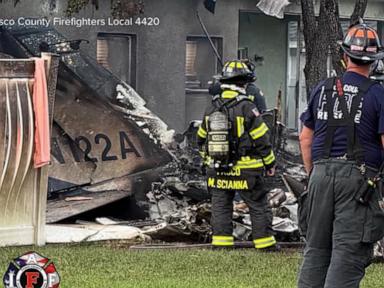
The afternoon in Clearwater, Florida, usually smells like salt air and lawn clippings. It is the sound of a neighbor’s sprinklers clicking in a rhythmic, metallic stutter and the distant hum of the US-19 traffic. On a Tuesday like any other, the sky is a flat, brilliant blue that seems too vast to ever be dangerous. Residents go about the invisible business of living. They fold laundry. They argue over what to put on the grocery list. They check the mail.
Then the engine sound changes.
It is a subtle shift at first, the kind of mechanical throat-clearing that only someone who lives near a municipal airport truly notices. The steady drone of a small plane—perhaps a Beechcraft or a Cessna—stumbles. It coughs. In that split second, the relationship between the ground and the air transforms. The sky is no longer a backdrop. It is a weight.
When a small plane loses its fight with gravity over a residential neighborhood, the physics of the tragedy are documented in cold, hard numbers by the National Transportation Safety Board (NTSB). They talk about stall speeds, manifold pressure, and wreckage paths. They map out the debris field in meters. But the data cannot capture the way a living room wall looks when it becomes an entry point for an engine block. It cannot describe the silence that follows the roar.
The Weight of a Shadow
Think about a pilot in that cockpit. Let’s call him Miller. Miller isn't a villain, and he isn't a hero yet. He is a man looking at a failing instrument panel, watching the suburban sprawl of Florida rise up to meet him like a predator. In the cockpit of a light aircraft, there is no "eject" button. There is only the frantic search for a patch of green—a golf course, a park, a wide boulevard—that isn't covered in roofs and lives.
Below him, the neighborhood is a grid of vulnerabilities. Florida’s residential architecture, often a mix of stucco and frame, wasn't built to withstand the kinetic energy of a descending aircraft. When the plane clips a power line, the neighborhood goes dark. The television stops mid-sentence. The microwave timer freezes.
The impact is not like the movies. There is no slow-motion buildup. It is a sudden, violent intrusion of the impossible into the mundane. One moment, a woman is standing at her kitchen sink; the next, her ceiling is gone, replaced by the smell of high-octane aviation fuel and the searing heat of a post-crash fire. The fire is the real enemy here. Light aircraft are essentially flying fuel tanks. When they rupture, the liquid doesn't just burn; it flows. It follows the slope of the driveway. It seeps into the cracks of the sidewalk.
The Neighborhood Aftermath
The first responders who arrive at these scenes describe a specific kind of chaos. It’s the contrast that haunts them. They see a charred wing resting against a child’s swing set. They find flight manuals scattered among the hydrangeas. In Clearwater, as the black smoke began to tower over the palm trees, the neighbors didn't run away. They ran toward it.
This is the human element that the news tickers miss. They report "four homes damaged" or "two fatalities confirmed," but they don't mention the man from three doors down who grabbed his garden hose, knowing it was useless against a chemical fire, but sprayed it anyway because he couldn't stand to do nothing. They don't talk about the local police officer who had to keep the crowd back while staring at a tail fin that looked exactly like the one on the model planes he built with his son.
Statistically, flying is safer than driving. We’ve heard it a thousand times. We repeat it to ourselves when the turbulence hits at thirty thousand feet. But that statistic feels like a lie when a plane is in your backyard. General aviation—the category for private, non-commercial flights—carries a much higher risk profile than the big commercial jets. There is less redundancy. There is often only one engine. There is often only one pilot. When things go wrong, the margin for error is thin as a sheet of paper.
The Physics of Luck
Consider the sheer improbability of where a plane falls. A few feet to the left, and it hits the empty street. A few feet to the right, and it levels a bedroom where a toddler is napping. This is the "invisible stake" of living in the flight path of a local airport. It’s a low-probability, high-consequence gamble that thousands of people make every day without thinking about it.
In the Clearwater crash, the fire consumed the primary structure almost instantly. The heat was so intense that it melted the siding on the house next door. This is a recurring theme in Florida aviation accidents. The density of the housing, combined with the sandy soil and flat terrain, means there is nowhere for a distressed pilot to go but down.
When we look at the footage from a neighbor's Ring camera, we see the plane’s final seconds. It’s a blur of white and silver. It’s too fast to process. You realize that for the people on the ground, there was no warning. No siren. Just a shadow that moved too quickly and a sound that didn't belong in a quiet cul-de-sac.
The Long Shadow of the NTSB
Long after the flames are out and the yellow tape is removed, the investigators remain. They are the cartographers of disaster. They pick through the soot with brushes and tweezers, looking for the "why." Was it a fuel pump failure? Did the pilot suffer a medical emergency? Was there a bird strike?
These questions matter for the insurance companies and the lawyers, but they rarely provide closure for the neighborhood. For the residents, the "why" is secondary to the "where." They look at the empty lot where a house used to be, and they see a ghost. They look up every time they hear a propeller, their necks craning instinctively, their hearts skipping a beat until the sound fades into the distance.
The trauma of a neighborhood plane crash is a communal weight. It breaks the illusion of the "home as a fortress." We spend our lives building walls to keep out the rain, the cold, and the strangers. We never think about the ceiling. We never think about the sky.
The Resilience of the Grounded
In the days following the crash, the neighborhood began to mend, but the scars are permanent. There is a specific kind of silence that hangs over a street after a tragedy like this. It’s not a peaceful silence; it’s an expectant one.
The people of Clearwater will go back to their routines. They will buy new groceries. They will fix their fences. But the geography of their lives has changed. The corner where the plane went down is no longer just a corner. It is a landmark of the day the world fell.
There is a strange, flickering bravery in staying. You keep living in the house with the new siding. You keep planting flowers in the soil that was once soaked in fire suppressant. You accept that the sky is a neighbor you cannot control.
As the sun sets over the Gulf, the small planes continue to circle for their final approach at the nearby airfield. Their lights blink—red, green, white—against the purple dusk. To most of the world, they are just dots of light, moving toward a destination. But to the people on that one street in Clearwater, they are reminders of how fragile the roof over your head truly is.
The sprinklers start clicking again. The laundry is brought in from the line. The world stays turned toward the earth, while the air remains indifferent, vast, and heavy.