In a quiet lab in Beijing, a researcher watches a digital shadow dance. On the screen, a car navigates a rain-slicked street. The water beads on the windshield with haunting accuracy. The reflection of neon signs in the puddles isn't just a visual trick; it is a calculated prediction. This is a world model. It is not just "seeing" pixels; it is understanding that water is slippery, that light bends through glass, and that if the car hits that patch of ice, the weight will shift $m \cdot a$ in a way that dictates life or death.
While the West has spent the last two years obsessing over chatbots that can write mediocre poetry, a different race has been quietly accelerating. This isn't about who can generate the best corporate email. It’s about who can build a digital twin of reality itself.
Li, a hypothetical but representative senior engineer at a Chinese autonomous driving firm, doesn't spend his days worrying about "hallucinations" in text. He worries about friction. He worries about how a delivery scooter in Shanghai weaves through traffic with a logic that defies Western programming. To Li, the debate over who has the better Large Language Model (LLM) feels like arguing over who has the prettiest library while his team is busy building the world outside the windows.
The consensus among industry insiders, including high-level executives at firms like 4Paradigm, is becoming uncomfortably clear. China is moving faster in world models not because they have better math, but because they have more "dirt" under their fingernails.
The Data Scarcity Myth
We often hear that data is the new oil. It’s a tired phrase. Data is actually more like soil. You can’t just have a lot of it; it has to be the right kind, and you have to be willing to plant in it immediately.
Western AI development has hit a strange snag: the "clean data" wall. Companies spend billions trying to scrub the internet to find high-quality text to train the next version of a chatbot. They are looking for verbs and nouns. Meanwhile, Chinese firms are gorging on the messy, chaotic, real-world telemetry of a billion daily commutes, millions of factory floor rotations, and the frantic logistics of a hyper-digitized economy.
World models require physical groundedness. They need to understand the "why" of the physical universe. If you drop a ball, it falls. If a pedestrian looks at their phone, they might not see the truck. In the United States, regulatory caution and a fragmented industrial base mean that this kind of physical data is siloed. It’s locked in proprietary vaults or slowed by the very valid, yet time-consuming, concerns of privacy and litigation.
In China, the feedback loop is a jagged, high-speed circle. When an executive mentions "abundant data," they aren't just talking about volume. They are talking about the variety of the "edge cases"—the weird, unpredictable things that happen in the real world that teach an AI what reality actually looks like.
The Deployment Trap
Consider the difference between a prototype and a product. In many Silicon Valley boardrooms, the goal is the "Sota"—the State of the Art. It’s a trophy. You publish a paper, you get the accolades, you move the benchmark by $0.5%$.
But the Chinese approach is defined by what insiders call "fast-follow and faster-fit." They are not waiting for the model to be perfect. They are deploying it into the guts of the manufacturing supply chain while it’s still learning.
This creates a terrifyingly effective evolution.
Imagine two students learning to ride a bike. One student sits in a classroom, studying the physics of balance, the torque of the pedals, and the aerodynamics of the helmet. The other student just gets on the bike and falls over a hundred times. By the time the first student finishes their thesis on balance, the second student is already three miles down the road.
China is the second student.
World models thrive on this. Because these models are meant to predict the future state of a physical environment, they need to be corrected by that environment constantly. Every time a Chinese autonomous van makes a mistake in a controlled industrial park, the world model grows stronger. It learns the "weight" of reality.
The Invisible Stakes of the Physical World
Why does this matter to someone who isn't an engineer?
The stakes are found in the "Action-Perception" loop. If the U.S. wins the LLM race, we get the best digital assistants. We get better search engines. We get more efficient coding tools. These are massive wins for the white-collar world.
But if China wins the world model race, they win the physical world.
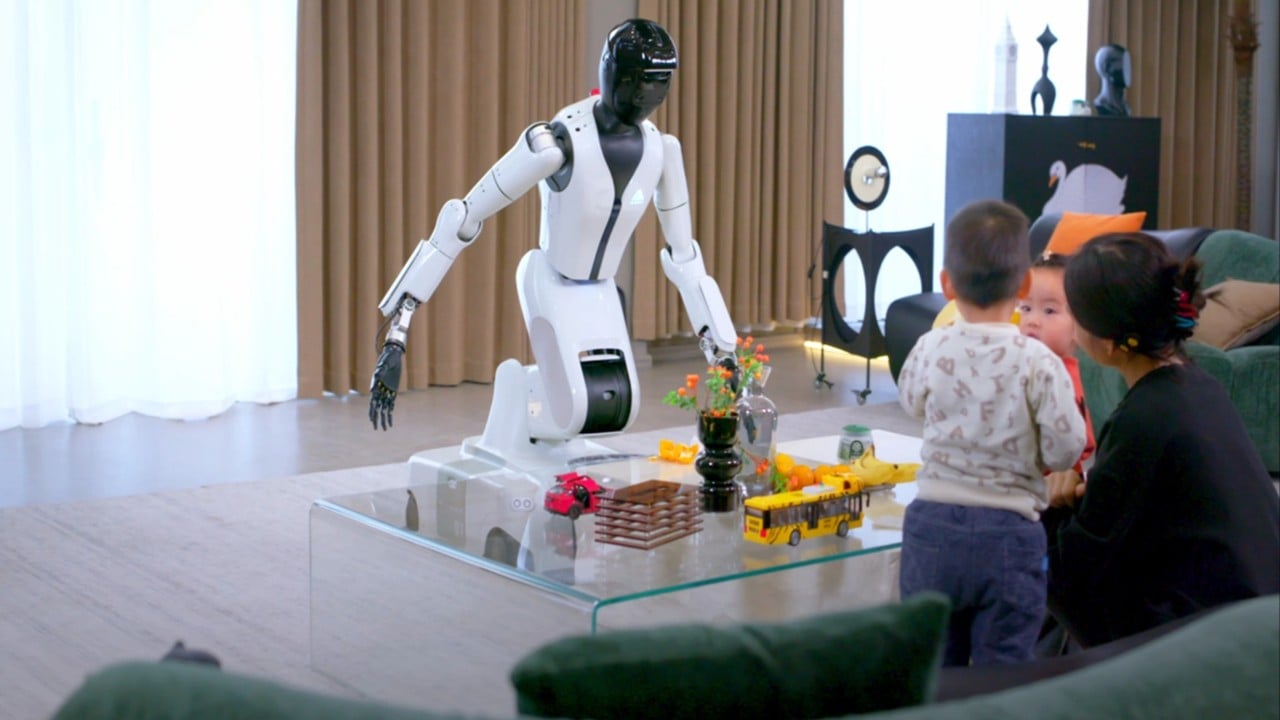
They win the robotics that will run the factories of 2030. They win the autonomous logistics chains that will move goods across the globe at a fraction of the current cost. They win the "embodied AI"—the machines that don't just talk to us, but do things for us.
There is a visceral fear that we are building the "brain" of the future while our competitors are building the "nervous system." A brain without a nervous system is just a jar on a shelf. A nervous system with even a "good enough" brain can move mountains.
The Cultural Engine of Urgency
There is a specific kind of exhaustion in the eyes of developers in tech hubs like Zhongguancun. It’s the look of the "996" culture—9 a.m. to 9 p.m., six days a week. While the West debates the ethics of work-life balance and the existential risks of "Superalignment," the Chinese executive suite is focused on the immediate survival of their firms in a hyper-competitive domestic market.
This desperation breeds a different kind of innovation. It’s not the innovation of the "moonshot"; it’s the innovation of the "street fight."
When you are in a street fight, you don't care if your technique is elegant. You care if it works. This pragmatism allows Chinese firms to bypass the "AI safety" bottlenecks that are currently slowing down Western deployment. To be clear, this isn't necessarily a good thing for humanity in the long run. The risks of unaligned world models are profound. If a model understands how to manipulate physical objects but doesn't have a "moral" framework, the consequences aren't just a rude chatbot—it’s a malfunctioning heavy-duty crane or a catastrophic traffic gridlock.
But in the race for dominance, the person who stops to put on their seatbelt often loses the drag race.
The Mirror is Cracking
The gap is closing in a way that is hard to see if you are only looking at benchmarks.
The U.S. still holds the crown for raw compute power. The $H100$ chips are the gold standard, and the export bans are a genuine hurdle for Beijing. But a curious thing happens when you starve a brilliant engineer of resources: they become efficient.
Chinese researchers are becoming masters of "small-parameter" brilliance. They are finding ways to squeeze world-model performance out of less hardware. They are optimizing the code because they have to.
Meanwhile, we are seeing a shift in how these models are structured. The transition from "Predict the next word" to "Predict the next frame" is the fundamental pivot of our decade. In this new arena, the "abundant data" mentioned by Chinese executives acts as a massive gravitational pull.
Reality is the ultimate dataset.
If you have a billion sensors in a thousand cities constantly feeding back the messy truth of existence, your model will eventually outpace a model that has only read the internet. The internet is a reflection of what we say. A world model is a reflection of what is.
The Human Cost of the Lead
In the end, this isn't just about silicon and electricity. It’s about the people who will live in the world these models build.
If the prediction of the Chinese executive holds true—that their edge in data and deployment is insurmountable—we are looking at a future where the physical infrastructure of the planet is "managed" by an intelligence that was raised in a different cultural and regulatory greenhouse.
We are talking about the "Operating System of Reality."
If you control the world model, you control the simulation that every robot, every car, and every smart factory uses to make decisions. You don't just own the software; you own the laws of physics as the machines understand them.
The researcher in Beijing closes his laptop. The digital car has finished its journey. It didn't crash. It predicted the hydroplaning before it happened. It understood the rain.
The West is still teaching its AI to talk about the rain. China is teaching its AI to drive through it.
The mirror is no longer just reflecting our world; it is beginning to anticipate it. And in a race where the prize is the ability to map the future, the person who moves fastest isn't the one with the biggest map—it’s the one who is already walking the terrain.