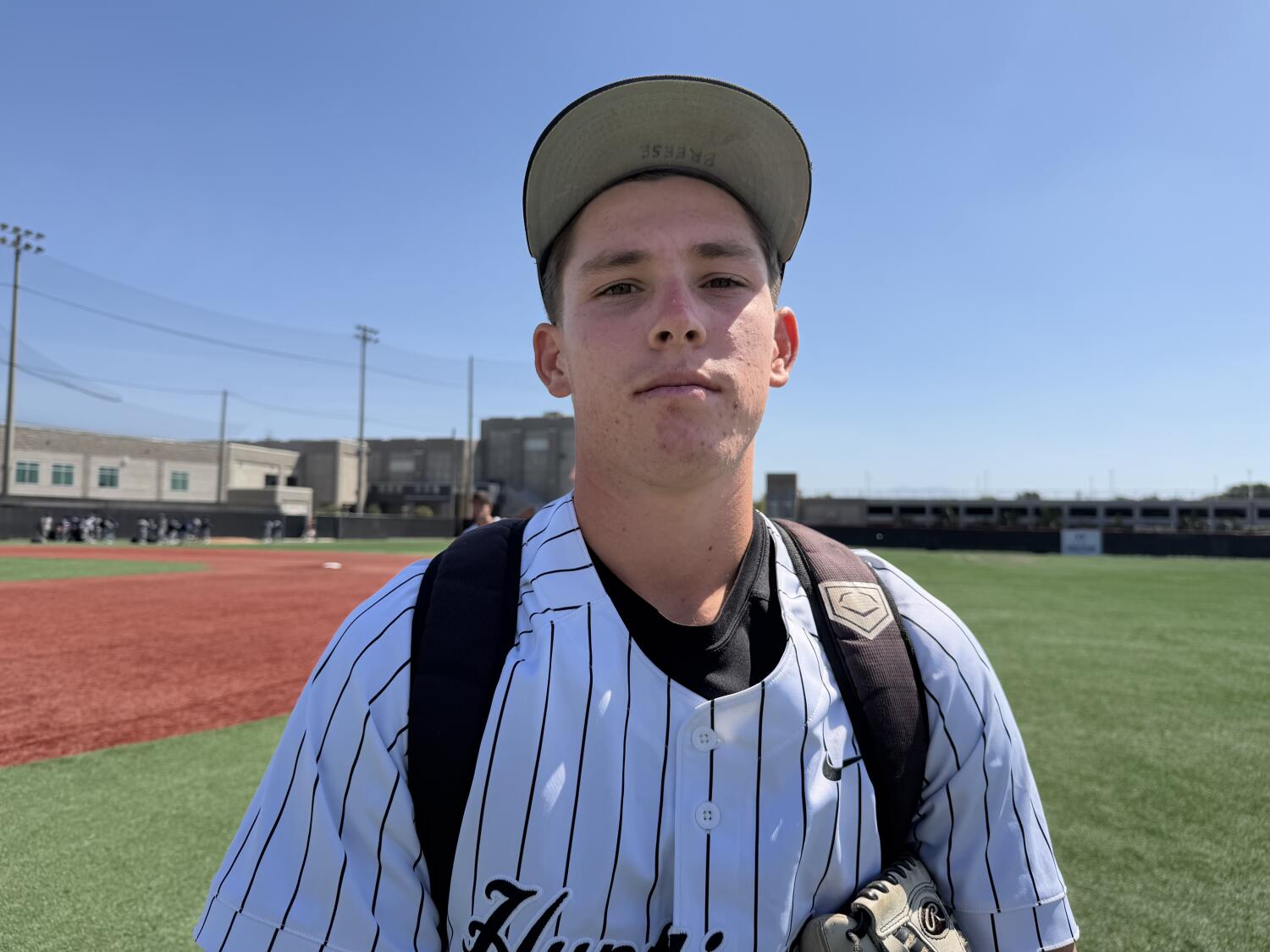
Sports writers love a "silent assassin." They see a kid like Huntington Beach's Tanner Brown, note the lack of chest-thumping, and immediately start drafting a narrative about "composure" and "letting the game do the talking." It’s a comfortable, lazy trope. It paints a picture of a mental giant who is too focused to be bothered by the chaos of a high-leverage inning.
They’re wrong. Read more on a connected topic: this related article.
In the world of high-level scouting, "letting your facial expressions do the talking" isn't a sign of maturity; it's a lack of communication. We've spent decades romanticizing the unreadable athlete, forgetting that on a baseball diamond, silence often masks a void where leadership and strategic adjustment should live.
The Myth of the Stoic Ace
The standard argument for Brown’s approach is that he doesn't get rattled. He stays level. He’s the same guy whether he’s up by five or facing a bases-loaded jam. Local media eats this up because it makes for an easy hero arc. It suggests that if you just shut your mouth and throw strikes, the results will follow. Further analysis by Bleacher Report delves into related perspectives on the subject.
But here is the reality of the collegiate and professional transition: the higher you go, the more the "poker face" becomes a liability.
Pitching is not an individual sport. It is a collaborative effort between the mound, the plate, and the seven guys behind them. When a pitcher is a total enigma—showing zero emotion, zero intensity, and zero vocal feedback—the defense starts to play on their heels. They aren't feeding off the pitcher's energy because there is no energy to feed off.
I’ve seen dozens of left-handers with "plus" command and "stoic" demeanors flame out in Single-A because they couldn't command the room. They couldn't snap a sagging infield back to attention with a look or a shout. They let their "facial expressions do the talking," but the infielders weren't looking at their eyes; they were looking for a leader.
The Left-Handed Bias
Let’s talk about the "Southpaw Curve." Scouts are notoriously soft on left-handers. If a righty has a silent demeanor, he’s called "uninspired." If a lefty does it, he’s "surgical."
Tanner Brown is a beneficiary of this bias. Because he’s a lefty with a repeatable delivery, his lack of outward intensity is rebranded as "professionalism." This is a dangerous miscalculation. Lefties already deal with a different set of physics. The natural tail on the ball, the angle of the breaking stuff—it’s built-in deception. When you add a stoic personality to a deceptive delivery, you aren't being "focused." You’re being invisible.
Success at the next level requires a presence. Think about the great lefties. Randy Johnson didn't have a poker face; he had a face that promised violence. Clayton Kershaw doesn't "let his facial expressions do the talking"; he wears his competitive drive like a suit of armor. These guys aren't just throwing pitches; they are imposing their will on the environment.
A pitcher who refuses to show emotion is often a pitcher who is afraid of their own adrenaline. They suppress the "highs" to avoid the "lows," resulting in a flat-line performance that lacks the "extra gear" needed to escape a 9th-inning meltdown.
The High School Comfort Zone
Huntington Beach is a talent factory. When you’re playing on a team stacked with Division 1 commits, you can afford to be the silent guy on the mound. The defense is elite. The run support is guaranteed. In that vacuum, "composure" is easy.
Imagine a scenario where Brown isn't backed by an All-County lineup. Imagine him on a struggling mid-major college roster where the shortstop just booted a routine double-play ball and the catcher is missing blocks.
In that moment, the "silent treatment" fails.
A leader has to engage. He has to show the team that the error didn't break him, not by staring blankly at the grass, but by actively reclaiming the mound. The "Prep Talk" narrative ignores the fact that high school dominance is often a product of environment rather than internal fortitude. Brown’s stoicism isn't necessarily a strength; it’s a luxury afforded by his zip code.
The Data of Intensity
There is a measurable correlation between "perceived intensity" and batter discomfort. Pitching isn't just about velocity and spin rate; it's about the psychological occupation of the batter’s mind.
When a pitcher shows fire—a fist pump after a big K, a visible snarl after a tight pitch—it forces the batter to react. It adds a layer of "human element" that messes with a hitter's timing and rhythm. A pitcher who is a robot is a pitcher who can be figured out. Robots are predictable. Human beings with temperaments are dangerous.
Data from advanced biometric tracking suggests that pitchers who "express" their stress through controlled outward displays often have lower cortisol levels during high-stress moments than those who internalize everything. By refusing to let the steam out, the "stoic" pitcher is actually more likely to suffer from a sudden, catastrophic loss of command when the pressure reaches a boiling point. It’s the "pressure cooker" effect.
Why Scouting Reports Get It Wrong
Scouts love a kid who doesn't cause trouble. "Quiet," "hard-working," and "focused" are the gold stars of a scouting report. They see Brown and think, "This kid won't be a headache in the clubhouse."
That’s a low bar for excellence.
The goal shouldn't be to avoid being a headache; the goal should be to be the heartbeat of the organization. The players who move the needle are the ones who demand more from their teammates. If your facial expression is doing all the talking, you aren't saying enough. You aren't telling your second baseman to shade toward the bag. You aren't telling your catcher that the umpire’s zone is moving. You’re just a guy throwing a ball toward a glove.
The Counter-Intuitive Truth about "Composure"
True composure is the ability to feel the fire and direct it, not the ability to pretend the fire doesn't exist.
If I’m a hitting coach, I love a stoic pitcher. I know exactly what I’m getting. He’s not going to try to "beat" me with emotion. He’s going to stay in his lane. I can sit on his tendencies because I know his pulse isn't going to change. Give me the guy who is "too emotional" any day. That guy is unpredictable. He’s going to find a way to throw 94 mph when he’s been sitting 91 mph all game, just because he’s pissed off.
Tanner Brown is a great high school pitcher. But the "silent" narrative being built around him is a disservice to his development. If he wants to win at the next level, he needs to find his voice. He needs to stop being a "poker face" and start being a protagonist.
The "Prep Talk" article wants you to believe that Brown’s silence is his superpower. In reality, it might be his ceiling.
Stop drafting for "quiet." Start drafting for "loud." The game is played at 100 mph, and you can't win a drag race with a muffler on.