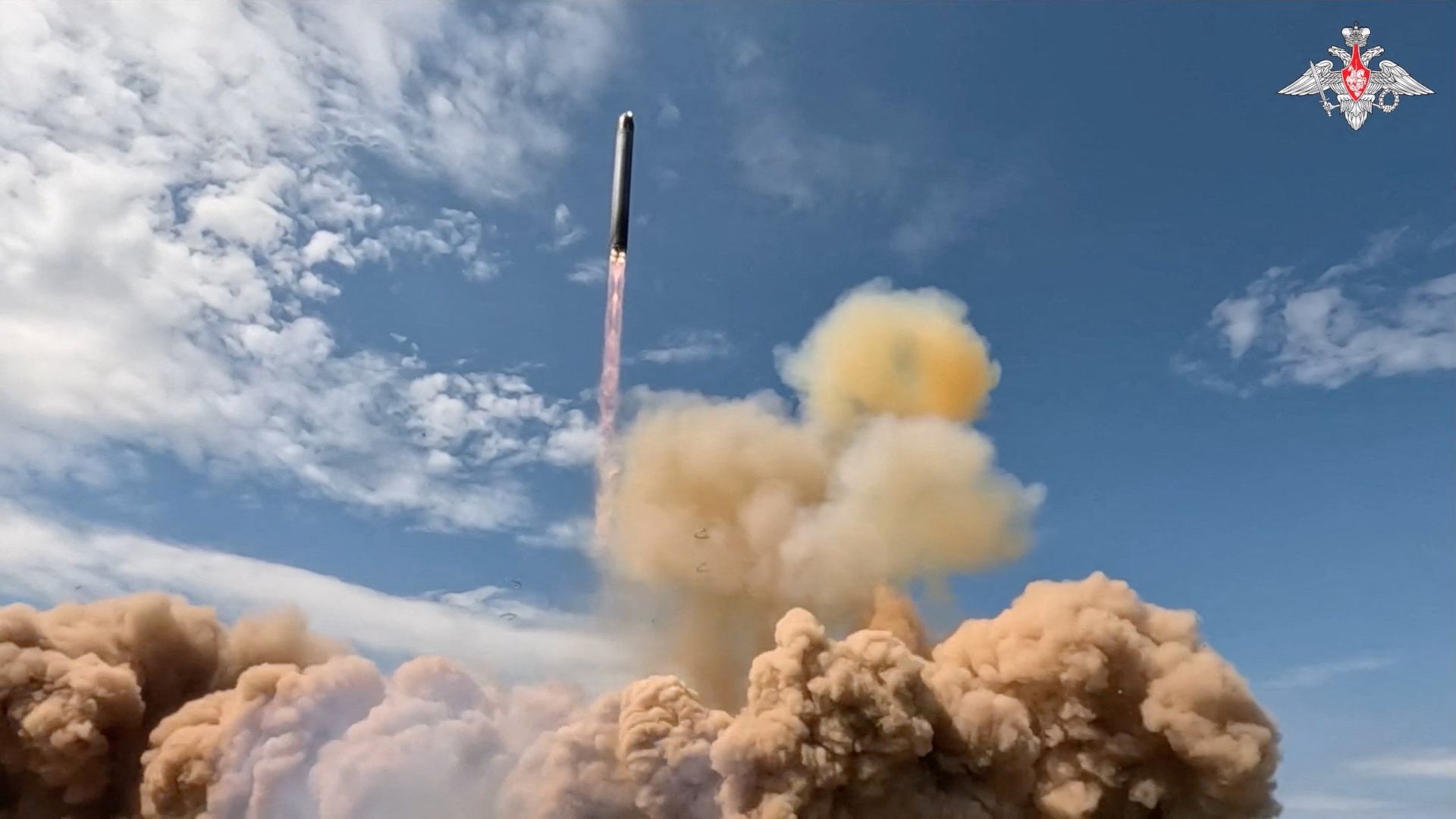
The deployment of the RS-28 Sarmat—colloquially termed 'Satan II' by NATO—represents more than a simple hardware upgrade; it is a calculated restructuring of the global nuclear escalation ladder. By transitioning from the aging R-36M2 Voevoda to the Sarmat platform, the Russian Federation aims to nullify existing and projected Western Missile Defense (BMD) architectures through a combination of extreme kinematic performance and payload versatility. The strategic intent is to restore the credibility of a second-strike capability that can bypass the North Pole-centric radar coverage that has defined the Cold War logic of the last sixty years.
The Kinematic Breakthrough of Global Reach
The Sarmat’s primary strategic value derives from its liquid-fueled propulsion system, which grants it a range estimated at 18,000 kilometers. This range enables "Fractional Orbital Bombardment" (FOBS) capabilities, allowing the missile to reach targets in the United States by traveling over the South Pole. Current U.S. early-warning radar and interceptor sites, such as those in Alaska and California, are oriented toward the Arctic. A Southern approach bypasses these sensors entirely, forcing a multi-billion dollar reconfiguration of Western defensive positioning.
The missile's launch phase, or "boost phase," is significantly shortened compared to its predecessors. This is a deliberate design choice to counter heat-seeking satellite sensors and sea-based interceptors. By reaching cruising altitude and velocity faster, the Sarmat reduces the window in which it is most vulnerable to interception. During this phase, the missile is at its largest and slowest relative to its final velocity; shortening this window creates a massive data-processing burden for Aegis-class or Ground-Based Midcourse Defense (GMD) systems.
Payload Dynamics and the Proliferation of Re-entry Vehicles
Strategic deterrence is a function of "probability of penetration." The Sarmat maximizes this probability through the deployment of Multiple Independently Targetable Re-entry Vehicles (MIRVs). While the exact configuration remains classified, the airframe is designed to carry 10 to 15 heavy nuclear warheads, or a combination of warheads and sophisticated decoys.
The payload efficiency is governed by the following mass-to-yield ratio logic:
- Saturation Logic: By deploying a high volume of warheads from a single bus, the attacker forces the defender into a "leakage" scenario. If a defensive system has a 90% intercept rate—an optimistic figure for current technology—the arrival of 10 warheads ensures that at least one reaches the target.
- Decoy Integration: Modern penetration aids (PENAIDS) include inflatable balloons that mimic the radar signature of a warhead in the vacuum of space. The Sarmat's massive throw-weight allows it to carry hundreds of these decoys, effectively blinding the radar logic of interceptor missiles which must decide which target to engage in a matter of seconds.
- The Avangard Integration: The most critical payload option is the integration of the Avangard Hypersonic Glide Vehicle (HGV). Unlike standard ballistic warheads that follow a predictable parabolic arc, the Avangard glides at speeds exceeding Mach 20 and performs lateral maneuvers. This unpredictability renders traditional Newtonian intercept calculations obsolete.
The Silo Hardening and Survival Variable
A nuclear deterrent is only effective if it can survive a first strike by an adversary. The Sarmat is designed for deployment in "super-hardened" silos. These underground launch tubes are engineered to withstand the overpressure of a near-miss nuclear detonation.
The transition to the Sarmat allows Russia to maintain a "launch-on-warning" posture. Because the missile utilizes liquid fuel, it can be stored in a ready-to-fire state for long periods—a technical hurdle that previously plagued liquid-fueled ICBMs. This chemical stability ensures that the Russian Strategic Rocket Forces can respond to an incoming strike within a 3-to-5 minute window, effectively maintaining the "Mutual" in Mutual Assured Destruction.
Economic and Logistical Constraints of Deployment
While the rhetoric surrounding the Sarmat focuses on destruction, the underlying reality is governed by industrial capacity. The transition from prototype to full-scale deployment is hampered by several structural bottlenecks:
- Microelectronic Procurement: Despite domestic designs, high-precision inertial navigation systems often rely on specialized components. Sanctions and supply chain disruptions affect the rate at which these guidance systems can be produced at scale.
- Testing Cadence: A weapon system of this complexity requires a rigorous flight-test program. Historically, Russian ICBM programs have required a dozen or more successful tests before "combat duty" is declared. The current accelerated timeline suggests a higher tolerance for technical risk than was seen in the Soviet era.
- Maintenance Overhead: Liquid-fueled engines, while powerful, are more corrosive and volatile than solid-fueled counterparts. This necessitates a massive logistical footprint involving specialized fueling teams and hazardous material handling, increasing the "Cost per Alert Minute" of the weapon system.
The Psychology of Strategic Signaling
The announcement of deployment serves a dual purpose: hardware replacement and psychological operations. In the context of the current geopolitical climate, the Sarmat is a "veto" weapon. It signals to NATO that conventional military support for regional conflicts has an absolute ceiling. By reminding adversaries of the Sarmat's existence, the Kremlin seeks to enforce a "sphere of influence" by raising the cost of intervention to an existential level.
This creates a "Security Dilemma" where Western powers must decide whether to invest in next-generation interceptors—such as directed energy weapons or space-based sensors—or to engage in a new round of arms control negotiations. The Sarmat effectively ends the era of post-Cold War nuclear stability, as it was designed specifically to exploit the gaps in the 2002 U.S. withdrawal from the Anti-Ballistic Missile (ABM) Treaty.
Vulnerabilities in the Kill Chain
No weapon system is invulnerable. The Sarmat's reliance on a fixed silo makes its coordinates known to every satellite in orbit. This leads to a specific strategic vulnerability: "Pinpoint Counterforce."
If an adversary can achieve a circular error probable (CEP) of less than 30 meters with a conventional or low-yield nuclear strike, even a hardened silo can be neutralized. Therefore, the Sarmat’s effectiveness is entirely dependent on Russia's ability to defend the airspace around the silos and maintain a credible "dead hand" system (Perimetr) that can authorize a launch even if the central command is decapitated.
The shift toward mobile launchers (like the Yars system) was a response to silo vulnerability, yet the Sarmat returns to the silo-based model. This indicates a shift in Russian philosophy back toward "heavy" deterrence, where the sheer volume of the strike outweighs the necessity of hiding the launcher.
The Shift from Stability to Volatility
The deployment of the Sarmat fundamentally alters the "Escalation Dominance" framework. In previous decades, nuclear weapons were seen as the "Weapon of Last Resort." The Sarmat’s ability to bypass defenses and carry hypersonic vehicles blurs the line between conventional and nuclear conflict. If a nation believes its defensive shield is useless, it may be more prone to a "pre-emptive" strike in a moment of crisis, fearing that it cannot intercept an incoming Sarmat salvo.
The technical specifications of the Sarmat suggest a future where the "OODA Loop" (Observe, Orient, Decide, Act) for national leaders is compressed from thirty minutes to under ten. The reduction in decision-making time increases the risk of accidental nuclear war triggered by sensor malfunctions or cyber-attacks on early warning systems.
Strategic Directive for Global Defense Architectures
Western defense strategy must now pivot from "Point Defense" to "Multi-Domain Neutralization." To counter the Sarmat, the current reliance on midcourse interceptors is insufficient.
- Space-Based Sensor Layers: Deployment of a "Proliferated Warfighter Space Architecture" (PWSA) is required to track the Sarmat through its entire flight path, especially the low-altitude glide phase of the Avangard.
- Left-of-Launch Operations: Focus must shift to cyber and electronic warfare aimed at the command-and-control nodes. Neutralizing the missile before it leaves the silo is the only high-probability defense.
- Asymmetric Deterrence: Rather than matching Russian heavy ICBMs one-for-one, Western powers are likely to emphasize distributed, sea-based, and air-launched cruise missiles that present a thousand targets instead of fifteen.
The deployment of the RS-28 Sarmat is the definitive signal that the "New Look" of Russian nuclear forces is complete. It forces a total reassessment of the viability of ballistic missile defense and necessitates a return to a "Pure Deterrence" model where safety is found not in the ability to stop a missile, but in the certain knowledge that its use ensures the total erasure of the status quo for all parties involved.