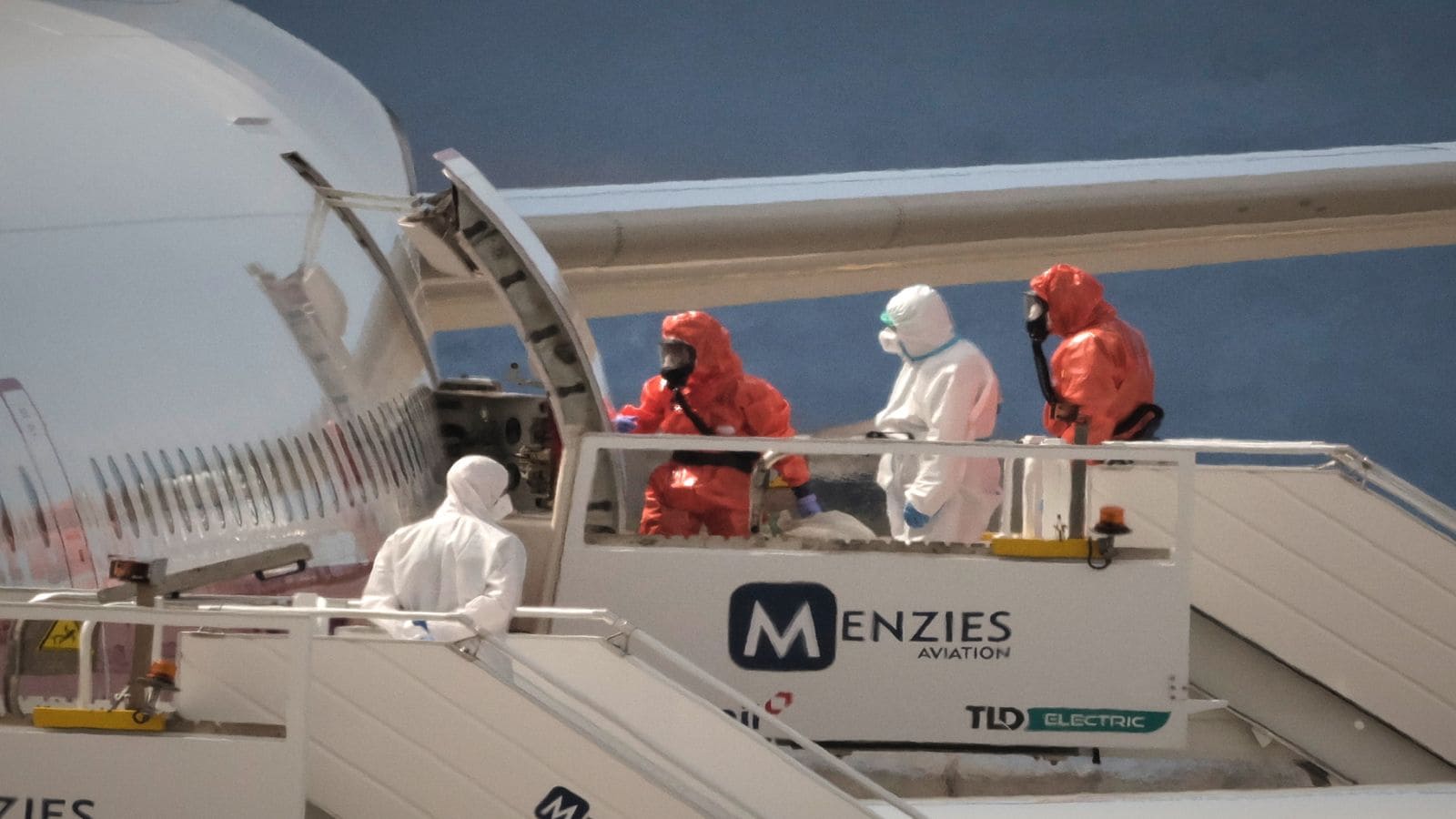
Hantavirus Pulmonary Syndrome (HPS) represents a high-fatality, low-transmissibility biological profile that shares almost no epidemiological commonalities with SARS-CoV-2. Public anxiety regarding new viral outbreaks often stems from a failure to distinguish between virulence (the severity of the disease) and infectivity (the ease of spread). While COVID-19 achieved global saturation through asymptomatic respiratory shedding and a low barrier to entry, Hantavirus is constrained by a rigid zoonotic transmission cycle. The risk to the general public is mathematically negligible, provided the specific environmental vectors are understood and mitigated.
The Transmission Bottleneck: Zoonotic Constraint vs. Human-to-Human Velocity
The primary reason Hantavirus cannot replicate the trajectory of COVID-19 lies in its transmission mechanism. SARS-CoV-2 is an aerosolized pathogen that utilizes the human respiratory tract as its primary vessel for both infection and dissemination. This creates a feedback loop of exponential growth. In related updates, we also covered: The Cognitive Architecture of Species Dysphoria and the Logic of Misanthropic Extremity.
In contrast, Hantavirus operates within a Dead-End Host Framework. In North America, the virus is carried primarily by the deer mouse (Peromyscus maniculatus). Humans become infected through the inhalation of aerosolized droppings, urine, or saliva of infected rodents.
- The Lack of Human-to-Human Propagation: With the exception of the Andes virus strain in South America, Hantavirus does not move from person to person. An outbreak is therefore a series of isolated spillover events rather than a chain reaction.
- Environmental Dependency: Viral viability is tied to rodent population density and human encroachment into specific rural or semi-rural habitats.
- The Dilution Effect: Because the virus requires a specific animal vector, the "effective R0" (basic reproduction number) in a modern urban environment is effectively zero.
Pathophysiological Mechanics: Pulmonary Edema vs. Systemic Hyperinflammation
To understand why the medical response to Hantavirus differs from COVID-19, one must examine the specific cellular targets. Mayo Clinic has also covered this fascinating subject in great detail.
SARS-CoV-2 targets the ACE2 receptor, leading to a multi-system inflammatory response that can persist for months. Hantavirus targets the endothelial cells, specifically those lining the capillaries in the lungs. This triggers Hantavirus Pulmonary Syndrome (HPS).
The Capillary Leak Syndrome
When the virus infects the pulmonary endothelium, it does not necessarily kill the cells directly. Instead, the body’s immune response causes the capillaries to become "leaky." Fluid from the blood vessels floods the air sacs (alveoli) in the lungs. This results in:
- Hypovolemia: A decrease in the volume of blood circulating in the body as fluid shifts into the lungs.
- Myocardial Depression: The heart’s ability to pump is compromised by the physical pressure and chemical signals.
- Rapid Progression: Unlike the slow burn of COVID-19, HPS often moves from "flu-like symptoms" to "respiratory failure" within 24 to 48 hours.
The case fatality rate (CFR) for HPS is approximately 38%. While this is significantly higher than the CFR for COVID-19, the high mortality is exactly what prevents the virus from spreading effectively in the wild; pathogens that kill their hosts too quickly or lack a mechanism for easy transmission fail to achieve pandemic status.
Risk Quantification and Environmental Variables
The "outbreak" terminology often used in media reports ignores the Ecological Trigger Hypothesis. Hantavirus cases do not spike because the virus has mutated; they spike because the rodent population has experienced a "mast year."
- Trophic Cascades: An increase in rainfall leads to an abundance of seeds and insects.
- Population Boom: Rodent populations swell in response to the food surplus.
- Human Interface: Humans cleaning out old sheds, cabins, or storage units in these areas encounter concentrated viral loads in enclosed spaces.
The risk is not a function of "social distancing" between humans, but of structural hygiene. Risk mitigation focuses on the "Three-Step Exclusion" strategy:
- Seal: Closing entries larger than 1/4 inch to prevent rodent ingress.
- Trap: Reducing local populations using snap traps (avoiding glue boards which keep the animal alive and secreting fluids).
- Clean: Disinfecting disturbed areas with bleach or heavy-duty disinfectants to neutralize the virus before it can be aerosolized.
Diagnostic Differentiation: Identifying the Early Signal
A critical failure in public health messaging is the "symptom overlap" panic. Early HPS symptoms—fever, muscle aches, and fatigue—mirror COVID-19, influenza, and the common cold. However, HPS lacks the upper respiratory symptoms common to those viruses.
- Exclusionary Indicators: If a patient presents with a sore throat, runny nose, or chronic earaches, the probability of Hantavirus is statistically diminished.
- The Thrombocytopenia Marker: A key clinical indicator for HPS is a rapid drop in platelet count (thrombocytopenia) and the appearance of "immunoblasts" (atypical white blood cells) in the blood smear. These markers appear before the onset of pulmonary edema.
The Structural Incompatibility of Hantavirus with Pandemic Models
For a pathogen to achieve pandemic status, it must satisfy three criteria in the Epidemiological Triad: a susceptible host, a conducive environment, and an efficient mode of transmission.
Hantavirus fails the transmission criterion. It is a "stuttering chain" infection. Even if a traveler from a rural area enters a densely populated city while infected, they pose zero risk to the people in the airport or on the plane. The virus is trapped within the individual.
Furthermore, Hantavirus is highly sensitive to environmental degradation. It is an enveloped virus, meaning it has a lipid outer layer that breaks down quickly when exposed to sunlight (UV radiation) and detergents. Unlike persistent bacteria or more resilient non-enveloped viruses, the Hantavirus "half-life" in an open, well-ventilated area is measured in hours, not days.
Strategic Resource Allocation in Public Health
The "panic" mentioned by public health officials is often a byproduct of misallocated attention. From a strategy perspective, treating Hantavirus as a "potential COVID" leads to a waste of diagnostic resources and unnecessary strain on the healthcare system.
Instead, the response must be localized and targeted.
- Sentinel Surveillance: Monitoring rodent populations and viral prevalence in "hot spot" rural areas provides a lead time for public warnings.
- Differential Diagnosis Education: Training clinicians in high-risk geographic zones to look for the "capillary leak" signature rather than just "respiratory distress."
- Ventilation Protocols: Shifting the focus from masks (which are useful but secondary) to the wet-cleaning of potentially infested spaces.
The delta between COVID-19 and Hantavirus is not just a matter of scale; it is a matter of fundamental biology. One is a societal disruptor that exploits human connectivity; the other is a localized biological hazard that exploits human contact with the natural world.
Public health strategy must emphasize that the "threat" of Hantavirus is manageable through individual environmental controls. There is no requirement for broad-scale lockdowns, mask mandates, or international travel restrictions because the virus lacks the machinery to utilize those networks. The most effective defense against Hantavirus is not a vaccine or a social policy, but a spray bottle of 10% bleach and the sealing of a floorboard.
Efforts should remain focused on the Rodent-Human Interface Index. By quantifying the density of carrier species in proximity to human dwellings, health departments can issue localized alerts that prevent the spillover before the first patient even enters an ICU. This is a problem of ecological management, not pandemic preparedness.