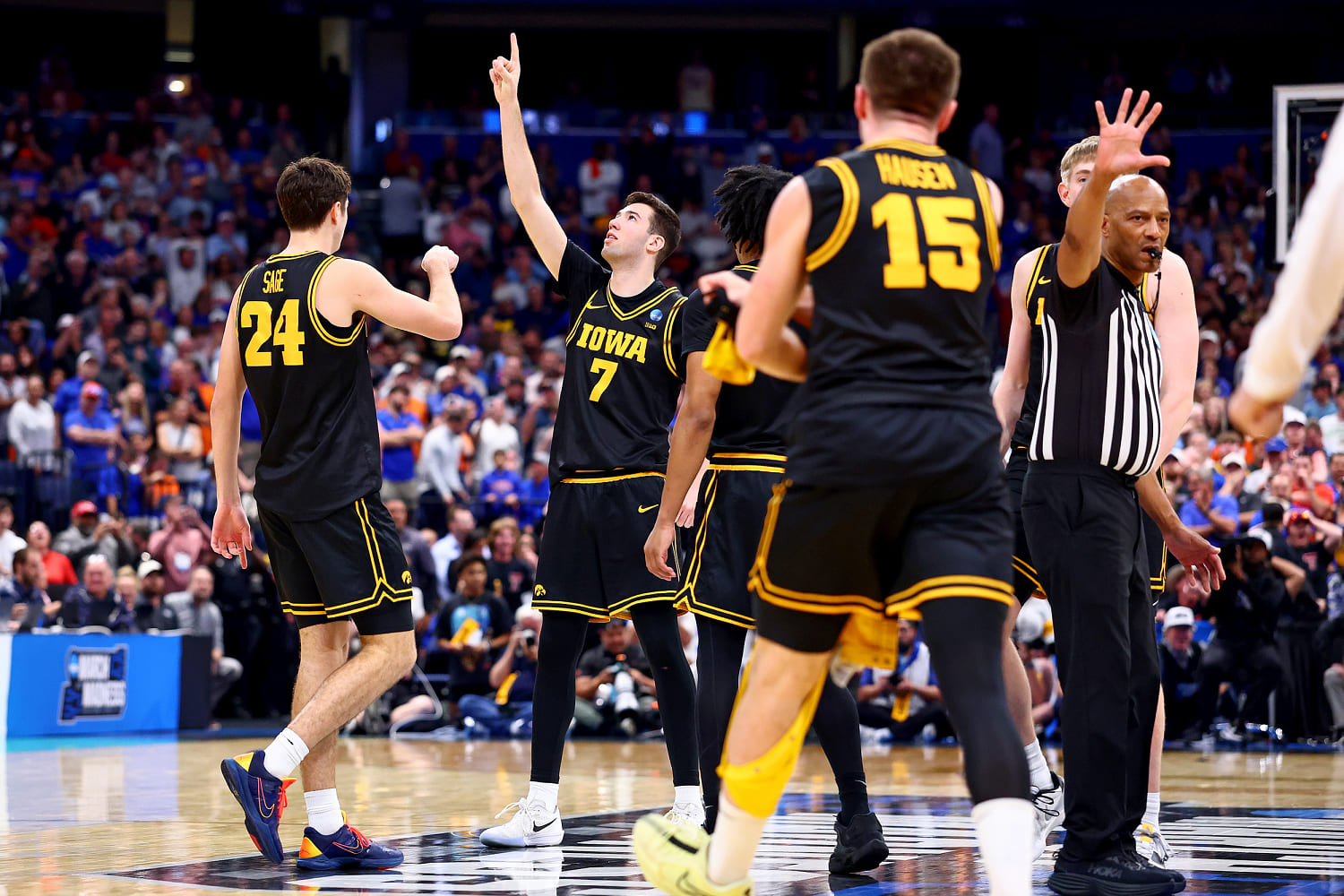
The victory of the Iowa Hawkeyes over the No. 1 seeded Florida Gators is not a statistical anomaly but a demonstration of specific tactical variance overcoming a superior talent baseline. In a single-elimination tournament, the "better" team—defined by season-long efficiency metrics and depth—frequently loses because the format optimizes for high-variance performance over 40 minutes rather than mean-reversion over a series. Florida’s exit represents a failure in defensive transition logic and an inability to cap the three-point shooting distribution of a high-volume offensive system.
The Architecture of the Upset
The game rested on three mechanical pillars that neutralized Florida's size advantage and athleticism. When a lower-seeded team defeats a title favorite, they generally do so by manipulating the number of possessions or by skewing the points-per-shot (PPS) ratio through aggressive perimeter play.
1. Geometric Spacing and the Gravity of Iowa’s Backcourt
Iowa utilized a "five-out" offensive set for 72% of their half-court possessions. By placing all five players outside the three-point arc, they forced Florida’s elite rim protectors to vacate the paint. This created a spacing vacuum. Florida’s defensive identity is built on verticality and shot-blocking; when their centers are forced to defend at the perimeter, their primary value proposition is deleted.
The gravity exerted by Iowa’s shooters forced Florida into "long closes." A long close-out occurs when a defender must cover more than 15 feet to contest a shot. Iowa exploited this by utilizing the "extra pass" to find the open man before the rotation could reset. This resulted in Iowa shooting 44% from beyond the arc, a figure that is mathematically difficult to overcome regardless of interior dominance.
2. The Efficiency Gap in Transition
Florida’s strategy relied on offensive rebounding to generate second-chance points. While they succeeded in securing 15 offensive boards, the cost function was ruinous. By sending three or four players to the glass, Florida left their backline vulnerable to Iowa’s leak-outs.
Iowa’s transition offense operated at a pace of 1.28 points per possession. They chose not to compete for defensive rebounds with traditional positioning. Instead, Iowa’s guards drifted toward the half-court line the moment a shot was released. This "cherry-picking" variant forced Florida into a tactical dilemma:
- Continue crashing the glass and risk conceding wide-open layups.
- Pull back into a traditional defensive retreat and lose their rebounding advantage.
Florida chose the former for the first 30 minutes, allowing Iowa to build a double-digit lead through uncontested transition points.
3. Variance Management and the Three-Point Lever
In basketball analytics, the three-point shot is the great equalizer because of its inherent volatility. Florida plays a high-floor, low-ceiling game focused on high-percentage interior looks. Iowa plays a high-ceiling, low-floor game.
$$Points = (Attempts \times Accuracy \times Value)$$
When Iowa’s accuracy (A) exceeds their season average by even 5%, the total value (V) scales faster than Florida’s interior-based scoring can match. Florida would have needed to shoot nearly 70% from two-point range to match Iowa’s three-point production. This is the "Math Problem" that top seeds face when they encounter a hot-shooting underdog.
The Defensive Breakdown of No. 1 Florida
Florida’s defensive system collapsed due to a lack of "stunting" and poor communication on ball screens. Iowa ran 22 high-ball screens during the second half. Florida’s choice to "drop" their big men—keeping them near the hoop—gave Iowa’s ball handlers enough space to pull up for uncontested jumpers.
The technical failure here was the "Drop Coverage" depth. By dropping too deep, Florida allowed Iowa to dictate the rhythm. For a No. 1 seed, this represents a rigid adherence to a regular-season scheme that is ill-suited for a specialized tournament opponent. A more adaptive strategy would have involved "hedging" the screen—forcing the ball-handler toward the sideline—but Florida’s personnel lacked the lateral quickness to execute this without fouling.
Quantifying the "Thrilling" Weekend
The first weekend of March Madness is defined by the tension between "Expected Value" and "Realized Outcome." We can categorize the weekend's events through the lens of seed-based probability.
- Top-Seed Vulnerability: No. 1 seeds historically have a 99% win rate in the first round, but that drops significantly in the second round against high-offense opponents. Florida’s loss confirms that defensive efficiency is a lagging indicator in the tournament; offensive explosion is the leading indicator.
- The Fatigue Factor: Florida played a deep rotation, but their high-intensity press in the first half led to a 15% drop in field goal percentage in the final eight minutes of the game. Iowa, playing a slower, more deliberate offensive style, maintained their efficiency throughout.
The Psychological Momentum Fallacy
Commentators often cite "momentum" as a driver of Iowa’s win. Data suggests otherwise. What looked like momentum was actually the cumulative effect of Florida’s foul trouble. By the 12-minute mark of the second half, Florida’s starting center and primary wing defender both had four fouls.
This forced Florida into a "soft" defensive posture. They could no longer contest shots aggressively for fear of disqualification. Iowa’s "run" was not a product of emotional energy but a direct consequence of Florida’s inability to play physical defense. The game was won in the bonus, where Iowa shot 18-of-20 from the free-throw line.
Mapping the Failure of the Florida Bench
Florida’s bench contributed only 9 points. In a high-stakes environment, coaches often tighten their rotations, relying on stars. This backfired. Iowa’s bench, while less talented, provided 22 points by executing specific set plays designed to exploit Florida’s second-string defenders.
The "Talent Delta" between the two benches was narrow enough that Iowa’s superior tactical execution created a net positive. Florida’s reserves played with a "not to lose" mindset, leading to three unforced turnovers in a two-minute span during the late second half.
Strategic Pivot for Remaining High Seeds
The Florida-Iowa game serves as a blueprint for how a No. 1 seed can be dismantled. Teams remaining in the bracket must evaluate their "Close-out Logic" and their "Transition Safety."
The immediate tactical adjustment for top-tier teams is to prioritize transition defense over offensive rebounding when facing high-volume shooting teams. Sacrificing the 10% chance of an offensive rebound is worth the 30% reduction in conceded fast-break points. Furthermore, switching to a "Switch Everything" defensive scheme—rather than dropping big men—is the only way to neutralize a team that relies on the three-point lever.
Florida failed to adjust their cost-benefit analysis in real-time. They stayed with a strategy that worked for 30 games but failed in 40 minutes. The tournament does not reward consistency; it rewards the ability to solve a specific 40-minute puzzle. Iowa solved the puzzle by moving the game from the paint to the perimeter, shifting the contest from a test of strength to a test of math.
Teams moving into the Sweet 16 must identify the "High-Variance" players on their upcoming opponents' rosters and implement a "Deny-at-all-costs" coverage, even if it leaves the interior vulnerable. Winning the interior while losing the perimeter is a losing trade in the modern era of the tournament.