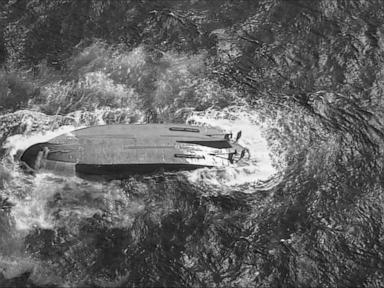
The recovery of a capsized vessel following a major cyclonic event is not a discovery of a static object, but the investigation of a failed system within a high-entropy environment. When a ship disappears during a typhoon and is subsequently located overturned with six crew members missing, the analytical focus must shift from a narrative of "unfortunate events" to a rigorous examination of three critical failure points: hydrostatic stability thresholds, the communication black hole during extreme meteorological stress, and the physics of the capsized hull as a survival or recovery environment. Understanding the loss of these six individuals requires deconstructing the mechanical and procedural breakdowns that occur when a vessel transitions from a navigable asset to a drifting casualty.
The Kinematics of Capsizing in Extreme Sea States
The transition from a stable vessel to an overturned wreck is governed by the relationship between the Righting Lever ($GZ$) and the external forces applied by wind and wave action. In a typhoon, these forces are non-linear. The loss of six crew members suggests a rapid capsize event, likely triggered by one of three mechanical triggers:
- Synchronous Rolling: This occurs when the vessel’s natural roll period matches the wave period, leading to an exponential increase in roll angle until the "angle of vanishing stability" is exceeded.
- Parametric Rolling: Primarily affecting container ships or vessels with large bow and stern flares, this involves a sudden, heavy rolling motion caused by changes in the waterplane area as waves pass along the hull.
- Shifting Cargo or Free Surface Effect: If the ship’s internal integrity is compromised—either through the movement of unsecured cargo or the ingress of water into large compartments—the center of gravity ($G$) shifts upward or laterally. This reduces the $GM$ (Metacentric Height), making the vessel "tender" and prone to a permanent list that eventually leads to inversion.
When a ship is found overturned, the hull acts as a sealed pressure vessel. The fact that the crew remains missing rather than being found within the hull indicates either an attempted emergency egress during the capsize or a breach in the hull's integrity that prevented the formation of viable air pockets.
The Information Gap: Why Ships "Disappear"
Modern maritime operations rely on a redundant layer of tracking technologies: AIS (Automatic Identification System), LRIT (Long-Range Identification and Tracking), and EPIRBs (Emergency Position Indicating Radio Beacons). A ship "disappearing" implies a total systemic failure of these broadcasts.
The primary bottleneck in typhoon-sector communications is the physical degradation of the signal path. Sea spray, extreme precipitation, and the physical destruction of antennae by hurricane-force winds can terminate AIS broadcasts long before the ship actually founders. Furthermore, if a vessel capsizes rapidly, the hydrostatic release unit (HRU) on an EPIRB may fail to deploy if it becomes trapped under the inverted hull or fouled in rigging. This creates a "dead zone" between the last known position (LKP) and the eventual discovery site, where the vessel is a "ghost," drifting according to the sum of surface currents and windage on the exposed keel.
The Search and Rescue (SAR) Probability Map
Search operations for the six missing crew members are dictated by the Probability of Containment (POC) and the Probability of Detection (POD). Once the ship is located, the SAR mission bifurcates into two distinct operations:
Internal Hull Penetration
Divers or Remotely Operated Vehicles (ROVs) must assess the interior for "survivability envelopes." These are voids where air may have been trapped during the inversion. The probability of survival in these zones decreases over time due to:
- Hypothermia: Even in tropical waters, the rate of heat transfer in water is 25 times faster than in air.
- Atmospheric Degradation: The conversion of oxygen to carbon dioxide, compounded by the potential off-gassing of cargo or fuel.
- Structural Instability: An overturned hull is a dynamic environment. Internal debris shifts constantly, creating hazards for rescue teams and potentially crushing survivors.
External Drift Modeling
If the crew successfully abandoned the ship before the capsize, they are treated as "targets" within a Lee Way model. This model calculates the drift of a life raft or a person in water (PIW) by factoring in the prevailing current ($U_{current}$) and the wind-induced leeway ($L$).
$$L = a + bV_w$$
Where $a$ and $b$ are constants based on the object's shape and $V_w$ is the wind velocity. In the aftermath of a typhoon, these variables are highly volatile, often resulting in a search area that expands exponentially every hour, quickly exceeding the capabilities of available aerial and surface assets.
The Failure of Procedural Redundancy
The disappearance of a vessel in a monitored maritime corridor points to a breakdown in the Swiss Cheese Model of accident causation. In this framework, multiple layers of protection (weather routing, structural maintenance, crew training, emergency equipment) must align their "holes" for a catastrophe to occur.
- Weather Routing Failure: Did the vessel attempt to "proach" (maneuver around the storm) or was it caught in the dangerous semicircle of the typhoon?
- Structural Fatigue: High-cycle loading during a storm can lead to catastrophic weld failures or hatch cover displacements.
- Human Element: The decision-making process under extreme fatigue. As the vessel's motion becomes violent, the crew's cognitive load increases, often leading to a delay in the "Mayday" broadcast until the vessel's power plant fails or the list becomes unrecoverable.
Forensic Reconstruction of the Event
To solve the disappearance and the status of the six missing crew, investigators must prioritize the recovery of the Voyage Data Recorder (VDR), the maritime equivalent of a "black box." The VDR contains bridge audio, radar snapshots, and engine telemetry. Analysis of this data typically reveals a "cascade of failures" rather than a single point of collapse.
If the VDR indicates a sudden loss of propulsion, the vessel would have lost the ability to steer into the waves, leaving it "dead in the water" (DIW). A DIW vessel in a typhoon will inevitably broach—turning broadside to the seas—which is the most common precursor to a rapid capsize. This sequence explains why no distress signal may have been sent: the crew was likely fully occupied with engine room emergencies or manual stabilization efforts until the moment of inversion.
The discovery of the overturned ship is merely the first data point in a complex forensic map. The missing crew represents the "human cost" of a mechanical threshold being crossed. Strategic recovery efforts must now balance the high-risk environment of an unstable, inverted hull against the diminishing probability of finding survivors in the surrounding sea. The operational focus shifts to the "last clear chance" doctrine—identifying if there was any point where the intervention of external rescue could have altered the outcome, or if the typhoon's energy simply overwhelmed the vessel's designed safety margins.
The immediate priority for maritime authorities is the stabilization of the wreck to prevent environmental contamination from fuel oil, followed by a systematic deck-by-deck sweep. If the crew is not found within the hull, the search moves into a terminal phase, acknowledging that the atmospheric and sea conditions during the typhoon likely exceeded the survival limits of standard life-saving appliances.
Operational success in these scenarios is not measured by the discovery of the wreck, but by the extraction of data that prevents the next systemic failure. The six missing individuals are a testament to the fact that despite satellite arrays and steel hulls, the maritime industry still operates at the mercy of hydrostatic limits and the unpredictable fluid dynamics of a cyclonic sea.