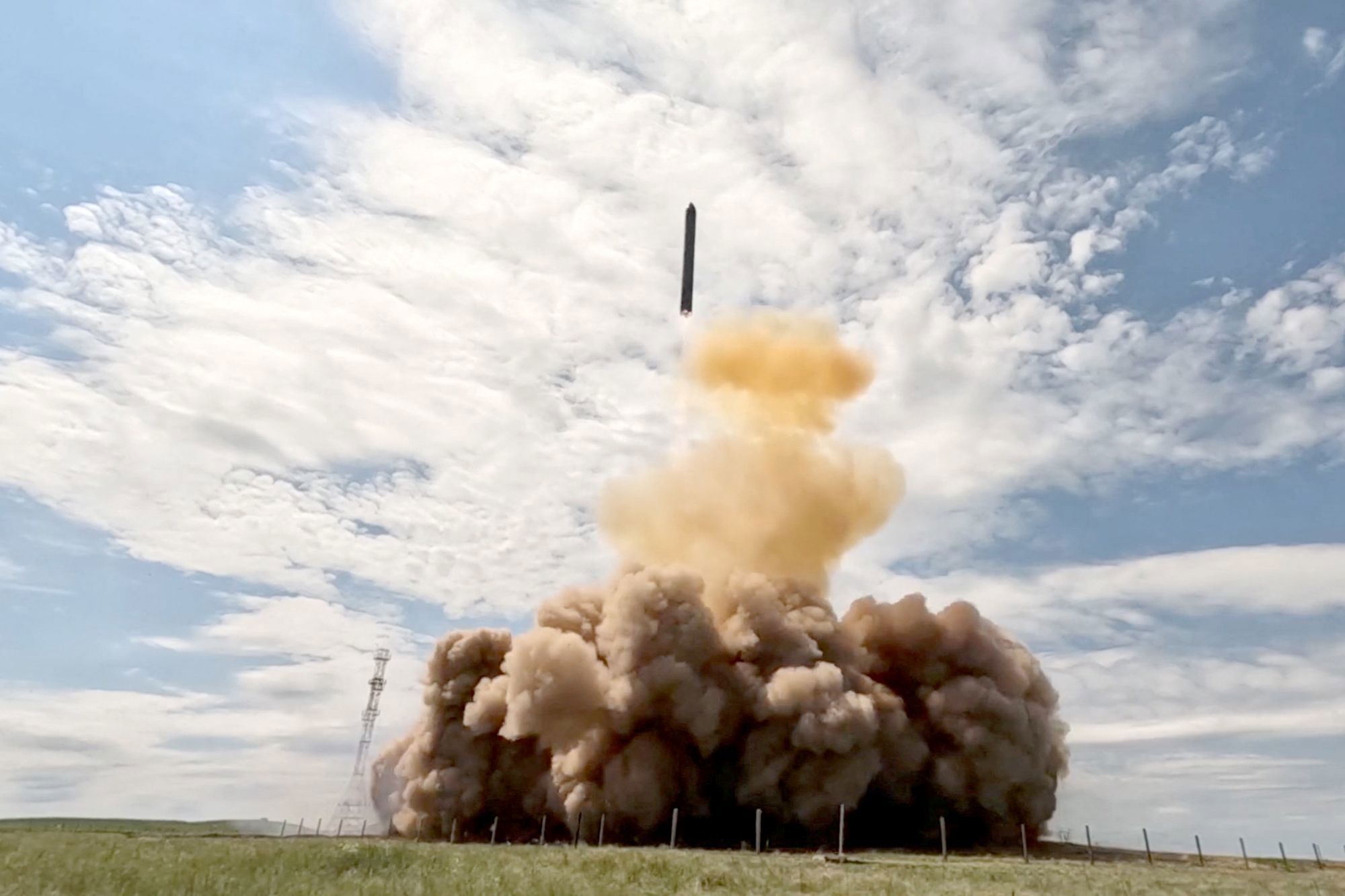
The deployment of the RS-28 Sarmat—colloquially termed "Satan II"—represents a shift from quantitative nuclear parity to qualitative asymmetry in the strategic triad. While media discourse often focuses on the emotive potential of "world-ending" weaponry, the actual utility of this system lies in its specific orbital mechanics and its role as a functional deterrent against preemptive kinetic strikes. The Sarmat is not merely a larger missile; it is a dedicated platform designed to exploit the physical and geographic limitations of current North American Aerospace Defense Command (NORAD) sensor arrays and interceptor geometries.
The Tri-Axis Threat Profile of the Sarmat
To understand the strategic significance of the RS-28, one must deconstruct its capabilities into three distinct functional domains: payload versatility, orbital trajectory, and terminal phase evasion.
1. Payload Fractioning and MIRV Saturation
Unlike its predecessor, the R-36M, the Sarmat utilizes a highly efficient liquid-fuel propellant system that maximizes the "throw-weight" or the mass of the payload it can loft into orbit. This capacity allows for the integration of 10 to 15 Multiple Independently Targetable Reentry Vehicles (MIRVs). The mathematical advantage of MIRV technology is found in the saturation of defensive interceptors. If a single missile carries 15 warheads, a defensive battery with a 90% intercept success rate still faces a statistical certainty that at least one warhead will penetrate the shield. The cost-exchange ratio heavily favors the aggressor; the expense of a single interceptor missile often equals or exceeds the cost of a single reentry vehicle, forcing the defender into an economically unsustainable "shoot-look-shoot" doctrine.
2. Fractional Orbital Bombardment (FOBS)
The most critical technical leap of the Sarmat is its ability to execute a Fractional Orbital Bombardment. Standard Intercontinental Ballistic Missiles (ICBMs) follow a predictable parabolic arc, typically traveling over the North Pole to reach targets in the Northern Hemisphere. Existing Ground-Based Midcourse Defense (GMD) systems in Alaska and California are positioned specifically to monitor and intercept this northern corridor.
The Sarmat possesses the fuel reserves to take the "long way" around, traveling over the South Pole. This trajectory circumvents the primary radar and interceptor concentrations of the United States. By approaching from the south, the missile exploits a "blind spot" in the legacy early-warning architecture, effectively reducing the defender's reaction window from thirty minutes to a fraction of that time.
3. Hypersonic Integration: The Avangard Glidewheel
The Sarmat serves as the primary launch vehicle for the Avangard hypersonic glide vehicle (HGV). While traditional reentry vehicles follow a fixed ballistic path, an HGV can maneuver within the atmosphere at speeds exceeding Mach 20.
- Atmospheric Skipping: The Avangard uses aerodynamic lift to "skip" along the upper atmosphere, making its final impact point unpredictable until the final seconds of flight.
- Thermal Resistance: The vehicle is constructed from composite materials capable of withstanding temperatures up to 2,000°C, ensuring structural integrity during high-G maneuvers that would disintegrate standard warheads.
The Economic and Industrial Bottlenecks of Modernization
Russian claims regarding the "invincibility" of the Sarmat must be weighed against the industrial realities of high-precision manufacturing and the current constraints on the Russian aerospace sector. The transition from the R-36M (produced in Ukraine during the Soviet era) to the Sarmat (produced at the Krasmash plant in Siberia) represents an attempt at total vertical integration.
The primary bottleneck is the reliability of the liquid-propellant engines. While liquid fuel provides higher specific impulse—allowing for the aforementioned South Pole trajectories—it requires complex plumbing, turbopumps, and highly corrosive oxidizers. Maintenance cycles for these systems are significantly more intensive than for solid-fuel counterparts like the American Minuteman III or the Russian RS-24 Yars. The strategic risk for the Kremlin lies in the "readiness rate": a liquid-fueled fleet is more susceptible to technical failure during long-term silo storage.
Furthermore, the integration of the Avangard HGV introduces a high degree of complexity in the guidance and control systems. Operating at hypersonic speeds creates a plasma sheath around the vehicle, which can interfere with radio communications and GPS/GLONASS signals. Solving the "blackout" problem requires sophisticated autonomous inertial navigation systems that are sensitive to the global semiconductor supply chain.
Deterministic Outcomes of the Escalate to De-escalate Doctrine
The Sarmat is the hardware manifestation of the Russian military doctrine often described as "Escalate to De-escalate." This framework posits that the use (or threatened use) of a high-yield, technologically superior weapon in a conventional conflict will force an adversary to sue for peace to avoid total annihilation.
The logic operates on a gradient of perceived risk:
- Signaling: Test launches of the Sarmat coincide with periods of high geopolitical tension to demonstrate technical viability.
- Paralysis: By highlighting the inability of current missile defenses to stop the Sarmat, Russia aims to decouple the United States from its European allies, creating a "decoupling" effect where the US might hesitate to defend an ally if its own mainland is defenseless against a South Pole strike.
- Sanctuary Sovereignty: The missile ensures that the Russian "nuclear bastion"—its heartland and SSBN (ballistic missile submarine) ports—remains untouchable by conventional high-precision strikes from NATO.
The Mathematical Collapse of Mutual Assured Destruction (MAD)
The introduction of the Sarmat and the Avangard signals the potential collapse of the traditional MAD model. MAD relies on "Second Strike Capability"—the idea that even if one side is hit first, they can respond with enough force to destroy the attacker.
The Sarmat disrupts this balance by introducing a "First Strike" incentive. If a weapon can arrive with almost no warning (via the South Pole) and bypass all defenses, a nation might believe it can decapitate the enemy's leadership and disable their retaliatory silos before a counter-launch is authorized. This reduces the "Strategic Stability" index, as both sides are incentivized to move to a "launch-on-warning" posture, where the window for human verification of a nuclear event is dangerously compressed.
Strategic Recommendation for Global Security Infrastructure
Defense planners must pivot from a policy of "kinetic interception" to "comprehensive resilience." The physics of the Sarmat suggest that trying to "hit a bullet with a bullet" is no longer a viable primary defense strategy against a saturated MIRV attack or an HGV.
The necessary shift involves:
- Space-Based Sensor Layers: Deploying a constellation of Low Earth Orbit (LEO) satellites capable of tracking the thermal signatures of HGVs throughout their entire flight path, not just the launch phase. This eliminates the "blind spot" created by the South Pole trajectory.
- Distributed Command and Control: Moving away from centralized "decapitation" targets toward a decentralized, hardened communication network that ensures a retaliatory strike is possible even if primary hubs are lost.
- Directed Energy Research: Accelerating the development of high-energy lasers or microwave systems that can engage warheads at the speed of light, bypassing the lead-time requirements of traditional interceptor missiles.
The RS-28 Sarmat is a rational response to the evolution of missile defense. Its existence proves that in the physics of nuclear warfare, the offense consistently maintains a lower cost-of-entry than the defense. The strategic play is not to build a bigger shield, but to render the "first strike" advantage moot through sensor ubiquity and system redundancy. The era of the predictable ballistic arc is over; the era of non-linear, multi-axis nuclear maneuvers has begun.