Liege Airport (LGG) currently functions as the primary high-velocity intake valve for Chinese cross-border e-commerce into Europe, yet the very volume that defines its success is now threatening its operational solvency. The shift from consolidated palletized freight to a fragmented "small parcel" model has inverted the traditional efficiencies of air cargo. While total tonnage may suggest growth, the unit-level complexity of processing millions of individual packages—largely driven by platforms like Temu, Shein, and AliExpress—has introduced a logistical friction that transcends physical space. This is not a capacity crisis in the sense of tarmac acreage; it is a throughput crisis defined by the limitations of digital processing, customs verification, and the physical sorting of low-density, high-volume items.
The Structural Shift from B2B to B2C Logistical Architectures
Traditional air freight relies on the B2B model, where a single Air Waybill (AWB) represents a consolidated shipment of high-value goods. A single aircraft might carry 100 tons of freight distributed across 30 to 40 Main Deck Load (MDL) positions. In this legacy framework, the labor-to-revenue ratio is highly favorable. If you found value in this post, you might want to read: this related article.
The current e-commerce influx utilizes the de minimis threshold—exempting shipments under €150 from certain duties—to ship directly to consumers. This transforms a 100-ton payload into tens of thousands of discrete data points. Each parcel requires:
- Individual digital entry into the Import Control System (ICS2).
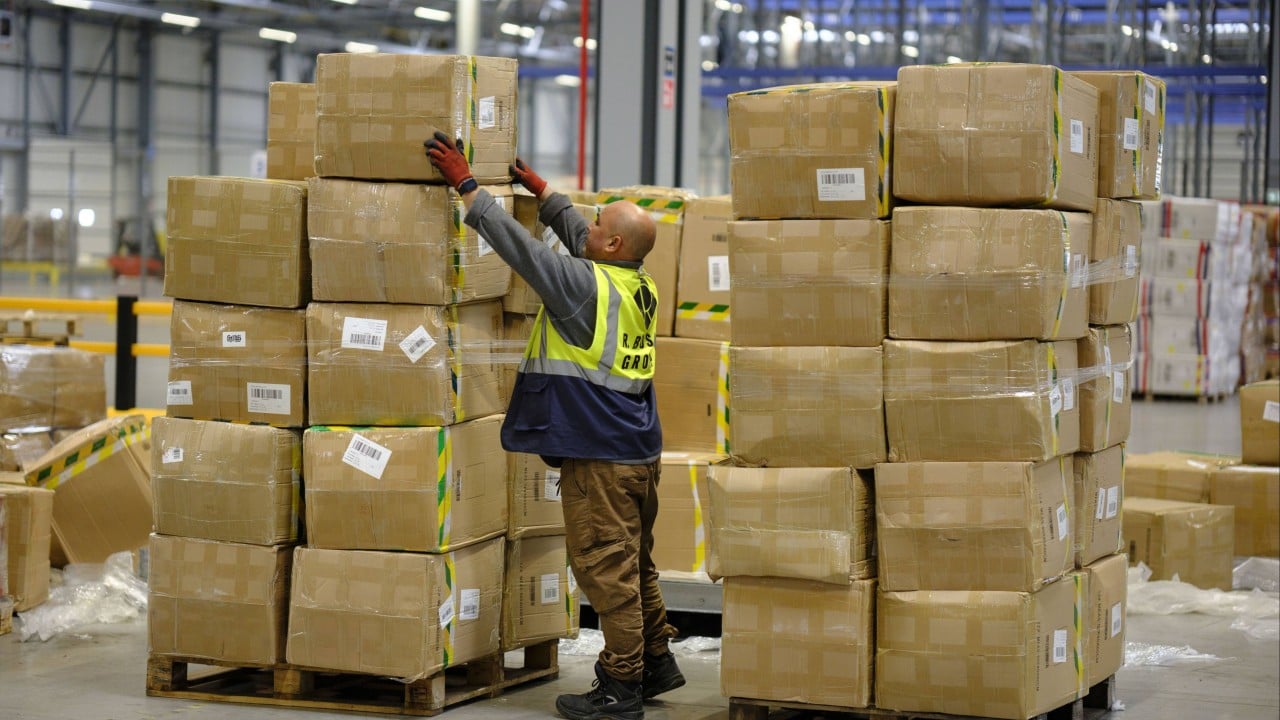
- Individual physical handling during the "break-bulk" phase.
- Specific last-mile routing instructions.
The result is a radical increase in "touches" per ton. If a standard cargo pallet requires five human or machine interventions to move from aircraft to truck, a fragmented e-commerce load requires several hundred. This volume-induced complexity acts as a tax on the airport’s "brownfield" infrastructure, which was designed for the velocity of pallets, not the granularity of packets. For another look on this development, check out the latest update from Reuters Business.
The Customs Bottleneck as a Physical Constraint
In a data-driven logistics environment, the speed of cargo is gated by the speed of regulatory clearance. Liege has become a victim of its own jurisdictional efficiency. By specializing in rapid customs processing, it attracted the bulk of Chinese e-commerce, but the sheer density of these shipments has outpaced the Belgian Customs’ ability to conduct risk assessments without triggering massive backlogs.
The "Green Lane" concept relies on pre-arrival data. However, the quality of data provided by disparate small-scale sellers in China is often inconsistent. When 5% of a 50,000-parcel shipment contains clerical errors or suspicious declarations, the entire "stream" slows down. Customs officials cannot simply sample a pallet; they must reconcile a digital flood. This creates a physical queue on the apron and in the bonded warehouses. When warehouses reach 90% utilization, operational efficiency doesn't just decline linearly—it collapses. Movement becomes restricted, and the time spent reshuffling existing stock to make room for new arrivals consumes the labor hours intended for outbound processing.
The Three Pillars of Capacity Erosion
To understand why Liege is hitting a wall, we must categorize the erosion into three distinct operational pillars:
1. Volumetric vs. Mass Displacement
Aircraft are reaching "cube-out" long before they "gross-out." E-commerce goods, often heavily packaged in plastic mailers with significant air pockets, have a low density. This means more planes are required to move the same weight of goods compared to industrial machinery. For Liege, this translates to more take-off and landing cycles (slots) per unit of economic value, exhausting the airport’s environmental and noise quotas prematurely.
2. Labor Elasticity and the Night-Shift Constraint
Liege operates 24/7, with a heavy emphasis on night flights to meet next-day delivery windows. The labor market for specialized ground handlers is inelastic. You cannot double a workforce overnight to handle a 200% surge in parcel volume. As the complexity of sorting increases, the "output per man-hour" drops. This creates a labor-driven bottleneck that no amount of capital expenditure on conveyors can immediately solve.
3. Digital Infrastructure Debt
Many legacy ground handling systems (GHS) were not built to track 100,000 individual SKUs per flight. The "data weight" of these shipments causes latency in the information exchange between the airline, the ground handler, and the courier. When the physical parcel moves faster than its digital twin, it sits idle. This "data-dwell time" is currently the most significant hidden cost in the Liege ecosystem.
The Cost Function of Fragmentation
The economic viability of the small-parcel model at LGG is governed by a diminishing marginal return on volume.
$$C(v) = F + \alpha(v) \cdot v$$
In this function, $C$ is the total operational cost, $F$ represents fixed infrastructure costs, and $v$ is the volume of parcels. The coefficient $\alpha(v)$ is the variable cost per parcel. In traditional logistics, $\alpha$ decreases as $v$ increases due to economies of scale. In the current Liege scenario, $\alpha$ is increasing.
This "diseconomy of scale" occurs because the complexity of sorting $N$ items into $M$ destinations grows at a rate faster than linear volume. As the number of parcels $(N)$ increases, the probability of errors, mis-sorts, and regulatory interventions increases exponentially, driving up the cost of recovery and exception handling.
The Regulatory Counter-Current
The European Commission’s proposal to abolish the €150 duty-free threshold is a looming exogenous shock to this business model. Currently, the "flood" is incentivized by tax avoidance. If every parcel, regardless of value, requires full duty calculation and VAT collection at the border, the administrative burden on Liege will increase by an order of magnitude.
The airport is currently optimized for a "low-friction, low-value" flow. A transition to a "high-compliance, low-value" flow would require a total redesign of the terminal interface. The space currently used for rapid sorting would need to be reallocated for long-term bonded storage while duties are contested or processed.
Analyzing the "China-Liege" Dependency
Liege has deliberately positioned itself as the "Alibaba Airport" of Europe. This strategic concentration creates a high degree of "Counterparty Risk." If Chinese domestic consumption rises or if geopolitical tensions lead to "friend-shoring" of supply chains, Liege’s specialized infrastructure becomes a stranded asset. Unlike Schiphol or Frankfurt, which have diversified belly cargo from passenger flights, Liege is a pure-play freighter hub.
The current capacity limit is a symptom of "over-specialization." The airport’s infrastructure is being consumed by a single, high-maintenance cargo type that provides lower margins than specialized pharma or perishables, yet demands more in terms of throughput and regulatory bandwidth.
Mitigation and the Shift to "Flow-Through" Facilities
To survive this capacity ceiling, Liege must pivot from being a storage-and-sortation hub to a pure "flow-through" facility. This requires:
- Off-Dock Processing: Moving the "break-bulk" and customs inspection to satellite facilities outside the airport perimeter to preserve airside space for aircraft turnaround.
- AI-Enhanced Predictive Clearing: Using machine learning to flag "high-confidence" shippers, allowing their parcels to bypass physical inspection based on historical compliance data.
- Intermodal Cannibalization: Shifting some of the e-commerce volume to rail or road feeder services from other, less congested entry points in Southern or Eastern Europe to balance the load.
The bottleneck at Liege Airport is a harbinger for the global aviation industry. The transition from "moving pallets" to "moving data-rich packets" requires a fundamental reassessment of what an airport is. It is no longer a transport node; it is a high-speed data processing center that happens to deal with physical mass.
The strategic imperative for Liege is to aggressively de-prioritize raw tonnage as a KPI and instead focus on "Revenue per Square Meter of Sorting Space." Failure to make this shift will result in a permanent state of congestion that will eventually drive the major e-commerce platforms to seek alternative, more technologically integrated gateways like Leipzig or Budapest. The competitive advantage of Liege was once its "openness"; now, its survival depends on its "filtration."
Deploying high-density automated storage and retrieval systems (ASRS) specifically designed for sub-5kg payloads is the only path to regaining operational margin. Manual handling of these volumes is a terminal strategy.