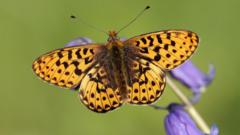
The United Kingdom is a lot quieter and more colorless than it was in the 1970s. If you grew up in the British countryside a few decades ago, you likely remember clouds of Small Tortoiseshells and Peacocks crowding the buddleia in your garden. Today, you're lucky to see a handful. This isn't just nostalgia talking or a trick of memory. We have half a century of cold, hard data to prove that British butterflies are in a tailspin.
The latest findings from the UK Butterfly Monitoring Scheme (UKBMS) show a grim reality. Since 1976, roughly 80% of butterfly species have declined in either abundance or distribution. That’s a staggering figure. We aren't just losing rare, specialized species tucked away in remote nature reserves. We're losing the "common" ones that define the British summer. When the common things start disappearing, you know the foundation of the ecosystem is cracking.
Half a century of counting what we're losing
The UK has the best butterfly data on the planet. For 50 years, thousands of volunteers have walked the same paths, week after week, counting every wingbeat. This long-term record is invaluable because butterfly populations naturally swing wildly based on the weather. A single "good" year can mask a long-term disaster. But when you zoom out to a five-decade view, the noise of the weather fades away and the signal is clear. We're witnessing a steady, relentless erosion of biodiversity.
Most people don't realize how fast it's happening. The data suggests that habitat specialists—those butterflies that need very specific types of chalk grassland or ancient woodland—have been hit the hardest. Species like the High Brown Fritillary are now hanging on by a thread. But even the generalists, the "wider countryside species" like the Wall Brown, are vanishing from huge swathes of their former range.
Why the UK is becoming a desert for insects
I’ll be blunt. We’ve turned the British landscape into a hostile environment for anything with six legs. The primary culprit is how we use our land. Intensive agriculture has stripped away the "messy" bits of the countryside. We’ve lost 97% of our wildflower meadows since World War II. Think about that number. It’s nearly 100%. We replaced diverse ecosystems with monoculture crops and chemically treated "green concrete" pastures that offer zero food for larvae.
Nitrogen pollution is another silent killer. When we over-fertilize fields, the runoff seeps into the soil of nearby road verges and hedgerows. This encourages aggressive grasses like nettles and docks to outcompete the delicate wildflowers that butterflies need to survive. Then there’s the climate issue. You might think warmer summers would help a cold-blooded insect. In some cases, it does. Some species, like the Comma and the Jersey Tiger moth, are moving further north. But for many others, the increased frequency of extreme droughts is a death sentence. When the plants they rely on wither and die in July, the caterpillars starve. It’s that simple.
The myth of the garden savior
I often hear people say they’re doing their bit by planting a lavender bush or a butterfly bush (Buddleja). Don’t get me wrong, nectar is great. It’s the fuel that keeps adults flying. But a butterfly's life isn't just about sipping sugar water. They spend the vast majority of their lives as eggs, caterpillars, and pupae.
If your garden is full of nectar but lacks the specific host plants for caterpillars, you aren't saving butterflies. You're just running a gas station for a fleet of dying cars. Most caterpillars are incredibly picky eaters. The Brimstone needs Buckthorn. The Orange-tip needs Cuckooflower or Garlic Mustard. If those aren't in the landscape, the life cycle breaks. We need to stop thinking about "pretty" gardens and start thinking about "functional" habitats.
What the 50 year data actually tells us about our future
Butterflies are the canary in the coal mine. They react faster to environmental changes than birds or mammals do. If the butterflies are going, the rest of the insect world is likely right behind them. This matters for more than just aesthetics. These insects are a vital part of the food chain. They pollinate crops and provide a massive food source for songbirds and bats.
The UKBMS data shows that even in protected areas, butterflies are struggling. This suggests that "islands" of conservation aren't enough. A ten-acre nature reserve doesn't work if it's surrounded by miles of pesticide-drenched fields. We need connectivity. Insects need corridors to move, migrate, and find mates.
What you can actually do right now
Stop waiting for the government to fix this. Policy moves at a glacial pace, but your garden or local community space can change tomorrow. If you want to see a reversal in these 50-year trends, you have to get comfortable with a bit of "ugly" nature.
- Stop mowing your lawn. Seriously. Cut it once in March and once in September. Let the "weeds" bloom. Bird’s-foot-trefoil and Clovers are lifelines for several species.
- Plant for the babies, not just the adults. Research which butterflies are in your area and plant their specific larval food plants. If you have space, let a patch of nettles grow in a sunny spot for Peacocks and Red Admirals.
- Say no to chemicals. Pesticides don't discriminate. If you're spraying to kill aphids, you're likely killing butterfly larvae too.
- Join the count. The only reason we know how bad things are is because of the UKBMS and the Big Butterfly Count run by Butterfly Conservation. Add your data to the pile. Knowledge is the first step toward a solution.
We've spent 50 years documenting a tragedy. It’s time to spend the next 50 fixing it. Buy some Buckthorn, leave the mower in the shed, and demand that your local council stops spraying road verges. The butterflies don't have another 50 years to wait.