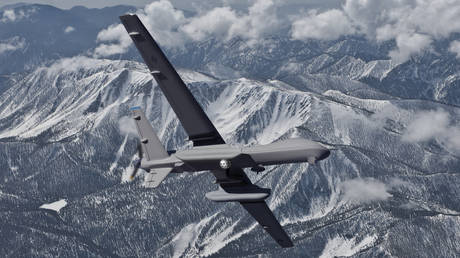
The era of American aerial dominance is hitting a wall. You might think the most expensive fighter jets in the world give us an edge, but on the ground in Ukraine and in the Pacific, that's not what's happening. The New York Times recently highlighted a terrifying reality that military planners have whispered about for years. Russia and China are out-innovating and out-producing the United States in the one area that defines modern conflict: autonomous drones.
We aren't just losing a lead. We're losing the ability to compete in a high-attrition environment.
In a conflict like the war in Ukraine, drones aren't precious assets. They're disposable. They're the new bullets. When Russia deploys thousands of cheap, AI-enhanced loitering munitions, they don't care if half get jammed. They care about the three that hit a billion-dollar air defense system. The US military is still obsessed with building "exquisite" tech—perfect, expensive, and slow to manufacture. Meanwhile, our adversaries are embracing the messy, fast, and cheap reality of AI-driven warfare.
The silicon curtain is closing
The problem isn't that American engineers aren't smart enough. It’s the bureaucracy. If you want to sell a drone to the Pentagon, you're looking at years of testing and red tape. By the time a "Small Unmanned Aircraft System" reaches a soldier’s hands, the software is already obsolete. China doesn't have this problem. They have DJI and a dozen other companies that can iterate in weeks.
Russia has turned into a massive laboratory. They're testing AI algorithms in real-time against Western jamming technology. Every week, their drones get slightly better at recognizing a Leopard tank or a HIMARS launcher without needing a human pilot. They're training their models on actual combat data, not simulations. That’s an advantage you can't buy in a lab in Virginia.
The US relies on a handful of massive defense contractors. These companies are great at building aircraft carriers. They’re terrible at building $500 drones that need a software update every Tuesday to stay relevant. We’re bringing a knife to a gunfight, except the knife costs a million dollars and takes five years to sharpen.
Why cheap beats expensive every time
Western military philosophy centers on protecting the pilot and the platform. It's a noble goal, but AI changes the math. If I can send 100 drones that cost $10,000 each, I've spent a million dollars. If you use a single Patriot missile to intercept just one of those drones, you’ve spent $4 million. You’re losing the economic war before the first explosion even happens.
Russia’s "Lancet" drones and the various FPV (First Person View) kits being mass-produced in Chinese factories are winning because they're "good enough." They don't need to survive 500 missions. They only need to survive one. This is the "attrition-based" warfare model that the US hasn't had to face since the 1940s.
China’s grip on the supply chain is the silent killer here. Almost every component in a hobbyist drone—the motors, the speed controllers, the flight boards—comes from Shenzhen. If the US wanted to ramp up production tomorrow, we’d realize we don't even make the screws. That’s not a tech gap. It’s a systemic failure.
Silicon Valley can't save us alone
There’s a lot of talk about how startups will bridge this gap. Companies like Anduril are trying to move faster, but they’re fighting an uphill battle against a procurement system designed for the Cold War. The Pentagon likes its hardware heavy and its contracts predictable. AI is neither.
AI moves at the speed of software. The hardware is just a carrier. Right now, the most advanced US drones are often grounded because of "security concerns" regarding Chinese parts. It's a valid concern, but "safe" drones that don't exist in large numbers won't win a war.
I’ve seen how this works in the private sector. If a tech company waited two years to update its app, it would be dead. The US military is effectively running on an old operating system while Russia and China are beta-testing the next version in the field.
The data advantage gap
AI is only as good as the data it’s fed. Russia is feeding its AI footage from thousands of hours of actual combat. They know what a camouflage net looks like from 200 feet in a snowstorm. They know how to spot the heat signature of a hidden generator.
The US is mostly training its AI on domestic ranges or in synthetic environments. It’s clean. It’s polite. It’s not real. When these systems meet actual electronic warfare (EW) environments, they struggle. We’ve seen reports of US-made precision weapons failing in Ukraine because the GPS jamming was more intense than anything the designers planned for.
We need to stop pretending that a better sensor or a stealthier wing shape is the answer. The answer is autonomy. If a drone can't think for itself when the radio link is cut, it's just a very expensive paperweight. China is already testing "swarming" tech where 50 drones coordinate without a central "brain." That’s the nightmare scenario for a traditional navy or air force.
Breaking the procurement cycle
If we want to catch up, the first thing that has to go is the "exquisite" mindset. We need to embrace failure. In the drone world, if you aren't crashing, you aren't learning.
- Mass over class. We need to stop buying ten perfect drones and start buying ten thousand "good enough" ones.
- Open the architecture. Software should be decoupled from hardware. If a new AI model comes out, every drone in the fleet should have it by morning.
- Internalize the supply chain. We can't rely on our biggest rival for the magnets in our drone motors.
- Combat-speed testing. Shorten the time from "idea" to "flight" from years to weeks.
The New York Times wasn't being alarmist. They were being late to the party. The race isn't starting; it's halfway over, and we're currently in third place. If you're a policymaker, you don't need another white paper. You need to go to a park, buy an off-the-shelf drone, and realize that a teenager in St. Petersburg or Shanghai probably knows more about the future of flight than the average general.
Fixing this means taking risks. It means letting small companies fail and big companies lose their monopolies. It means admitting that the way we've done things for sixty years is officially broken. Honestly, it’s a hard pill to swallow for a country that prides itself on being the world’s only superpower. But if we don't start building drones that are as cheap and smart as the ones our enemies have, our "superpower" status will be a memory by the end of the decade.
Go look at the Replicator initiative. It’s a start. But a start isn't a finish line. We need thousands of autonomous systems in the air, in the water, and on the ground. We need them now. Not in 2030. Not after another round of Congressional hearings. Now.
The tech is there. The talent is there. The willpower? That’s still up for debate. Stop looking at the sky for a F-35 and start looking for the swarm. It's already coming.