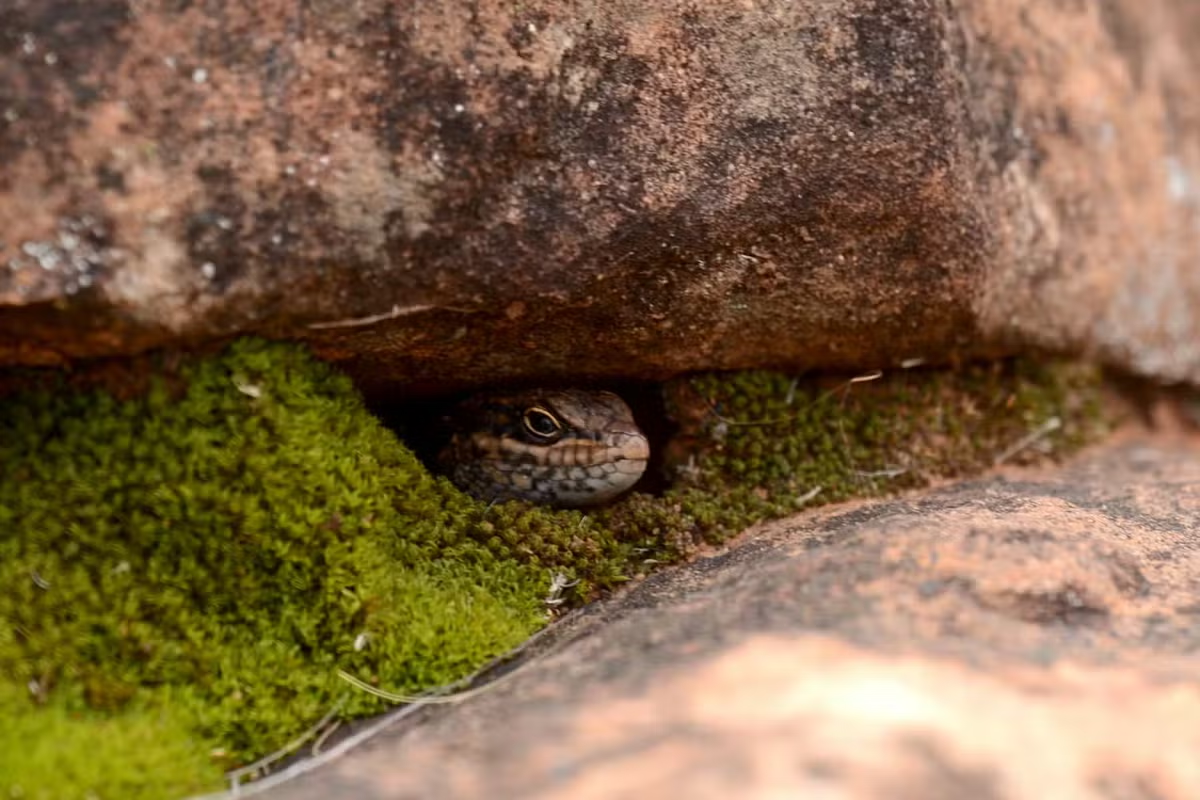
The recent identification of a rare new species, confined to a singular, isolated habitat, is less a triumph of nature and more a desperate race against the clock. While the discovery of an organism found nowhere else on Earth typically triggers a wave of scientific celebration, the reality on the ground is far grimmer. We are finding these species just as the conditions required for their survival are being dismantled by industrial encroachment and rapid climate shifts. This isn't just about cataloging a new beetle or a unique orchid. It is about the failure of our current conservation models to protect the "micro-habitats" that house the planet's most specialized genetic data.
The Myth of the Pristine Wilderness
The common narrative suggests that new species are found in vast, untouched jungles where no human has ever set foot. This is largely a fantasy. Most modern discoveries of highly localized species occur in "remnant patches"—tiny slivers of land that have survived agriculture or urban sprawl. These are not robust ecosystems. They are fragile biological islands. Recently making news in this space: The Great Himalayan Standoff and the Illusion of Normalcy.
When a species is described as "endemic" to a specific mountain ridge or a single underwater cave, it means that organism has evolved over millions of years to fit a hyper-specific niche. If you change the temperature by two degrees or introduce a single invasive competitor, that species vanishes. Scientists aren't just finding new life; they are documenting the "living dead"—species whose populations are already below the threshold for long-term viability.
The High Tech Hunt for Genetic Ghost Ships
The methodology behind these discoveries has shifted from the Victorian era of butterfly nets to the cold precision of environmental DNA (eDNA) and satellite-guided thermal mapping. Researchers now scan water samples for microscopic traces of skin, scales, or waste to identify life that remains invisible to the naked eye. Further insights on this are detailed by Reuters.
This technological leap has revealed a startling truth. Many "new" species have actually been hiding in plain sight, misclassified for decades because they look identical to common relatives. It is only through genomic sequencing that we realize we are looking at a completely different evolutionary lineage. The cost of this equipment is plummeting, allowing field teams in developing nations to conduct high-level analysis without shipping samples to Western labs. However, the speed of our data collection still lags behind the speed of habitat loss. We are essentially scanning a library while the building is on fire.
The Economic Value of Hyper Local Life
Why should anyone outside of academia care about a slug that lives on one specific rock in the Balkans? The answer is purely utilitarian.
Highly specialized species often possess unique biochemical properties. Because they have evolved to survive in extreme or isolated conditions, their bodies produce enzymes and compounds that more common species do not. These are the foundations for the next generation of antibiotics, drought-resistant crops, and synthetic materials.
- Micro-organisms found in isolated volcanic vents have already provided the enzymes used in PCR testing.
- Rare amphibians often carry skin secretions that can lead to new pain management medications.
- Isolated flora can contain genetic sequences that allow plants to thrive in high-salinity soil.
When we allow a newly discovered species to go extinct because protecting its ten-acre habitat is "economically unfeasible," we are burning a blueprint for a technology we haven't even invented yet. It is the height of short-sightedness.
The Failure of Protected Areas
Our current global strategy for conservation relies on "Protected Areas." The problem is that these parks are often designed for large, charismatic megafauna like tigers or elephants. They require massive corridors of land.
Micro-endemic species—the ones found "nowhere else on Earth"—frequently exist outside these boundaries. A new species of lizard might live only in a specific limestone quarry that isn't part of a national park. A rare flower might grow only on the edge of a highway. Because these sites lack "scenic beauty" or tourist appeal, they are rarely granted legal protection.
The investigative reality is that many governments prioritize large-scale "green" projects, like hydroelectric dams or massive solar farms, over the preservation of these tiny, ugly, but vital pockets of biodiversity. We are sacrificing the specific for the general, and in doing so, we are losing the most unique branches of the tree of life.
The Counter Argument of Natural Selection
There is a cold, Darwinian perspective that argues if a species is so specialized that it cannot survive a minor shift in its environment, it was already on the path to extinction. Proponents of this view suggest that focusing resources on "evolutionary dead ends" is a waste of capital. They argue we should focus on "generalist" species that can adapt to the human-dominated world.
This argument falls apart when you look at the speed of current changes. Evolution happens over millennia. The destruction of a mountain top for a nickel mine happens in months. We aren't seeing natural selection; we are seeing a mechanical erasure. The "dead end" isn't the species; it's the environment we've boxed them into.
The Problem with Naming Rights
There is an overlooked ego-driven element in this field. Scientists gain prestige by naming new species. There is a rush to publish, to be the first to describe the "rare find." This creates a fragmented landscape of data. One team might identify a "new" species in the morning, while another team across the border classifies the same creature differently in the afternoon.
This lack of coordination hinders conservation. If we can't agree on what a species is, we can't pass laws to protect it. International treaties like CITES (Convention on International Trade in Endangered Species) move at a glacial pace. By the time a new species is officially recognized and added to a protected list, the illegal pet trade or local industry has often already wiped it out.
Rethinking the Recovery
The solution isn't more national parks. We need a decentralized, aggressive approach to "micro-conservation." This involves:
- Direct Land Acquisition: Small-scale trusts buying the specific ten or twenty acres where these species live, bypassing the bureaucratic nightmare of state-run parks.
- Citizen Science Integration: Using local populations as paid stewards of their unique local fauna. If a village knows that a specific bird exists only in their backyard, and that bird brings in research funding or eco-tourism, they will protect it more fiercely than any distant government agency.
- Real-Time Monitoring: Using AI-linked camera traps and acoustic sensors to detect poaching or habitat encroachment the moment it happens.
The discovery of a species found nowhere else is not a sign that the world is still full of mystery. It is a final warning. These organisms are the last survivors of ancient lineages, clinging to the edges of a world that is rapidly becoming too uniform to support them. If we continue to treat these discoveries as feel-good headlines rather than emergency alerts, the next species we find will likely be the last of its kind before it's even been named.
The map of the world's unique life is shrinking to a series of dots. It is time to protect the dots.