The wind in the High Atlas Mountains does not just blow; it screams. It carries the scent of juniper, dry earth, and the terrifying realization that a human being is incredibly small when measured against a limestone cliff. When the sun dips behind the jagged peaks of central Morocco, the temperature doesn't just drop. It crashes. One moment you are sweating under a North African sun; the next, the marrow in your bones feels like it is turning to ice.
This is the backdrop for a desperate, ticking clock.
Two American soldiers, part of a joint training exercise, have vanished into this vertical labyrinth. On a map, the search area might look like a manageable grid of coordinates. On the ground, it is a nightmare of shifting scree, hidden crevices, and canyons so deep they haven't seen direct sunlight in centuries. To find them, the scale of the response has ballooned into something massive. Six hundred military personnel—a mix of American grit and Moroccan local knowledge—are now scouring the terrain.
But numbers are deceptive.
You can put six hundred boots on a mountain, but the mountain still has the home-field advantage. To understand the stakes, you have to look past the troop counts and the logistics reports. You have to imagine the individual soldier standing on a ridgeline at 3:00 AM, the beam of their flashlight swallowed by a darkness so thick it feels tactical.
The Anatomy of a Disappearance
In the military, there is a term for the chaos that follows an unexpected event: the fog of war. In a search and rescue operation in the Atlas range, that fog is literal. Dust storms can wipe out visibility in minutes, turning a routine trek into a blind scramble for survival.
Consider the physical toll on those six hundred searchers.
The High Atlas isn't like the rolling hills of the Appalachians or the groomed trails of the Rockies. It is raw. Every step upward requires three times the energy because of the thinning oxygen. Every step downward is a gamble with gravity. The searchers are carrying gear, water, and the crushing psychological weight of knowing that with every hour that passes, the "search" risks becoming a "recovery."
The Moroccan Royal Armed Forces are the backbone of this effort. They know these peaks the way a sailor knows the currents. They understand that a soldier missing in this heat during the day and this cold at night faces a brutal physiological gauntlet. Dehydration hits first, blurring the vision and slowing the reflexes. Then comes the disorientation. By the time the second night falls, the body begins to cannibalize its own resources just to keep the core warm.
The Logistics of Hope
Six hundred people require an immense infrastructure. You don't just send six hundred soldiers into the wilderness; you send a city. There are communication relays being perched on high outcrops to ensure that a radio signal can jump from one canyon to the next. There are medical teams on standby, their rotors turning, waiting for the one burst of static that confirms a sighting.
The search is a symphony of mismatched parts working in a sudden, desperate harmony.
American technology—thermal imaging, high-altitude drones, and satellite reconnaissance—is being paired with the Moroccan soldiers' intuitive understanding of the land. A drone might see a heat signature, but it takes a local mountain guide to know that the signature is likely just a sun-warmed rock or a stray mountain goat, rather than a human huddling in a thermal blanket.
The invisible stakes here aren't just about the two lives hanging in the balance, though those are the only lives that matter right now. There is also the quiet, heavy pressure of international cooperation. When soldiers from two different nations train together, they form a pact. They are saying: We will fight together, and we will not leave you behind. To fail in this search would be a fracture in that unspoken promise.
The Silence of the Peaks
If you have ever been truly lost, you know that the most terrifying part isn't the danger. It's the silence. It’s the realization that you could scream until your lungs fail and the only thing that will answer is the echo of your own fear.
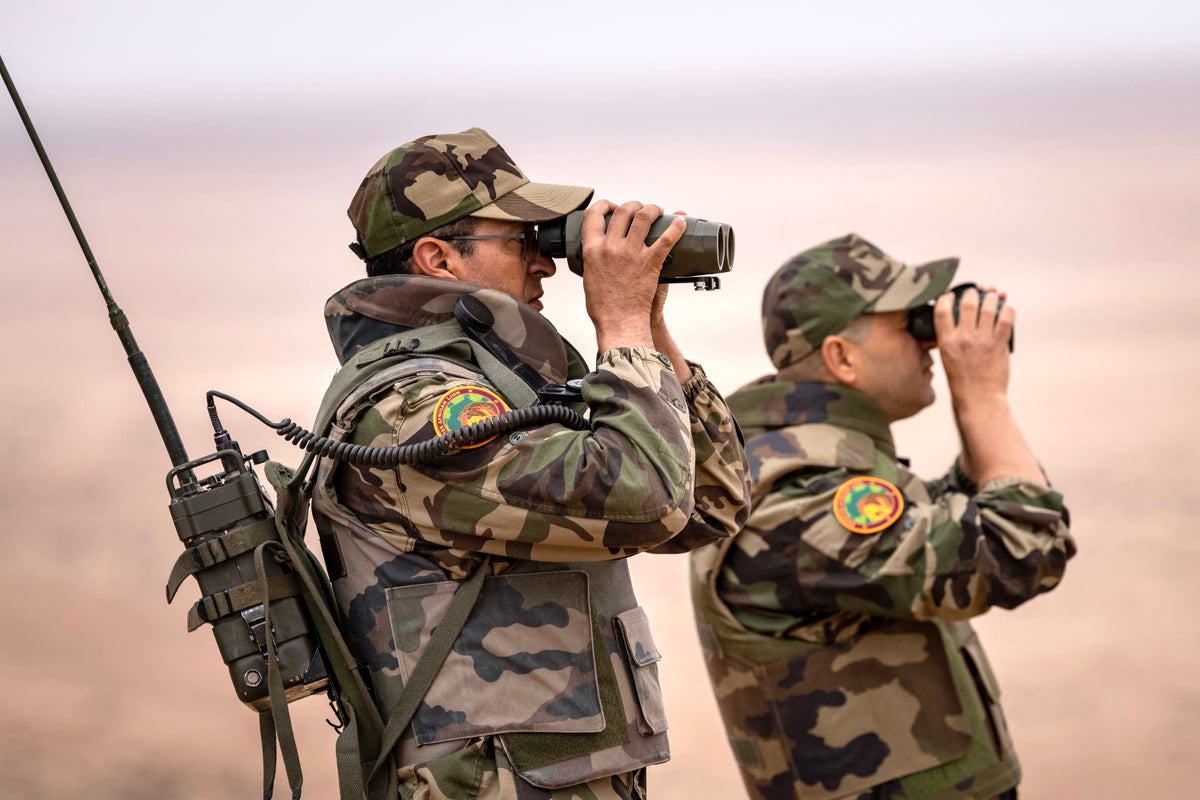
The searchers feel this too. They move in lines, spaced out just enough to cover ground but close enough to maintain a visual on their partner. They poke into caves. They glass the distant slopes with binoculars until their eyes ache. They are looking for a flash of tan uniform against the grey rock, a wisp of smoke, or the glint of a signal mirror.
Six hundred people.
It sounds like a lot until you stand at the base of Toubkal or look out across the vast, arid stretches of the south. Then, six hundred people look like a handful of ants trying to find two grains of sugar in a desert.
The operation has moved into a phase where the adrenaline has worn off, replaced by a grim, methodical determination. The initial "golden hour" of rescue is long gone. Now, it is a test of endurance. The searchers are rotating in shifts, sleeping in snatches on the hard ground, their faces caked in the fine, red dust of the Maghreb.
Why We Watch
We track these stories not because we love the drama of the military machine, but because we recognize the universal horror of being lost. We see ourselves in those two missing soldiers. We imagine the moment they realized they had taken a wrong turn, the moment the sun began to set, and the moment they realized they were no longer the hunters, but the hunted—hunted by the elements, by hunger, and by time.
The six hundred soldiers are the physical manifestation of a society’s refusal to accept a loss. They are the "no" we scream back at the void.
As the sun begins to set again over the High Atlas, the shadows lengthen, stretching out like long, dark fingers across the valleys. The temperature begins its inevitable slide toward freezing. Somewhere out there, in a fold of the earth we haven't found yet, two people are waiting. They are listening for the sound of a boot hitting a rock, the thrum of a helicopter, or a human voice calling their names.
The mountain is vast, indifferent, and ancient. But it is currently being climbed by six hundred people who refuse to let it have the last word.
The boots keep moving. The flashlights keep cutting through the dust. The search continues because the alternative is a silence that none of us is willing to hear.