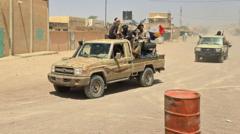
The desert sand around Tinzaouaten has long been a graveyard for empires and rebels alike, but the recent defeat of Russian private military contractors—formerly known as the Wagner Group—marks a tectonic shift in the Sahel. For years, the narrative of Russian intervention in Africa was one of ruthless efficiency. They arrived where the West failed, traded security for mineral rights, and propped up military juntas with a "no questions asked" policy on human rights. That myth of invincibility died in a July ambush near the Algerian border.
Russian fighters have now confirmed a tactical withdrawal from northern Mali after suffering their most significant battlefield loss on the continent to date. This wasn't just a minor skirmish or a hit-and-run incident. It was a coordinated massacre that saw dozens of Russian operatives and Malian government soldiers killed or captured by a coalition of Tuareg separatists and jihadist militants.
The implications for the Kremlin’s influence in the region are massive. When a regime trades its sovereignty for a foreign security guarantee, that guarantee has to be absolute. The moment the protector bleeds, the price of the contract becomes a liability.
The Mirage of Security in the Sahel
The Malian military junta, which seized power in a series of coups starting in 2020, kicked out French forces and UN peacekeepers in favor of Moscow’s mercenaries. The promise was simple: Russia would do what the West couldn't—crush the rebellion in the north.
Instead, the conflict has widened. The Permanent Strategic Framework for Peace, Security, and Development (CSP-PSD), a coalition of Tuareg-led rebels, managed to lure a combined Malian and Russian convoy into a geographic trap during a sandstorm. The rugged terrain of the Tigharghar mountains became a kill zone.
This defeat highlights a fundamental misunderstanding of the Sahelian theater. Russian strategy relies heavily on brute force, air superiority, and psychological warfare. However, in the vast, ungovernable spaces of northern Mali, these assets are easily negated by local knowledge and mobile tactics. The Tuareg rebels didn't just win a battle; they proved that the Russian model of "expeditionary security" has a breaking point.
Following the Money and the Mineral Rights
Security isn't a gift; it’s a commodity. In Mali, the payment often comes in the form of gold. The Russian presence, now rebranded under the "Africa Corps" umbrella and integrated more closely with the Russian Ministry of Defense, has focused its efforts on securing lucrative mining sites.
By securing these assets, the Kremlin offsets the costs of its war in Ukraine. This creates a perverse incentive structure. The mercenaries are more motivated to guard a gold mine in the south than to patrol the hostile, empty deserts of the north. When they do venture into rebel-held territory, they are often flying blind, lacking the deep human intelligence networks that the French military spent decades building—and still failed to master.
The Mercenary Rebrand
Since the death of Yevgeny Prigozhin, the Kremlin has attempted to bring these irregular forces under tighter state control. The transition from the Wagner "brand" to the Africa Corps was supposed to provide more stability and professionalize the operation.
It has done the opposite. By stripping away the semi-autonomous nature of the group, Moscow has slowed down the decision-making process. The fighters at Tinzaouaten lacked the rapid air support and logistical backup that characterized earlier Wagner successes. They were hung out to dry by a bureaucracy more concerned with loyalty than tactical flexibility.
The Geopolitical Fallout for Bamako
For the Malian junta led by Colonel Assimi Goïta, the Russian retreat is a PR nightmare. Their entire claim to legitimacy rests on the idea that they are the only ones capable of restoring territorial integrity. If the Russians cannot hold the north, the junta’s reason for existing begins to evaporate.
Neighbors are watching closely. Burkina Faso and Niger, both of which have followed Mali’s lead by pivoting toward Moscow, are now forced to calculate the risk of a similar failure. If Russia cannot protect the strongest military government in the region, what hope do the others have?
The vacuum created by this retreat is already being filled. Extremist groups linked to al-Qaeda (JNIM) and the Islamic State are capitalizing on the chaos, often finding common cause with local separatists when it comes to expelling foreign "invaders." This creates an environment where the very forces Russia was hired to stop are instead becoming more emboldened and better equipped, often using captured Russian gear.
The Ukraine Connection
An overlooked factor in the Tinzaouaten disaster is the potential involvement of external intelligence. Reports have surfaced suggesting that Ukrainian intelligence services provided training or information to the Tuareg rebels. While these claims are difficult to verify independently, they align with Kyiv's stated goal of striking Russian interests wherever they exist globally.
If Mali becomes a secondary front in the Russo-Ukrainian war, the complexity of the conflict triples. The Sahel becomes a playground for proxy battles, where local grievances are subsumed by global power struggles. This is the worst-case scenario for the civilian population, which is already caught between the hammer of military operations and the anvil of insurgent reprisals.
Tactical Failures on the Ground
The retreat was not a clean break. It was a panicked withdrawal after a prolonged engagement that saw the loss of high-value assets, including several Mi-24 Hind helicopters. These aircraft are the backbone of Russian power projection in Africa. Losing them in a remote border region isn't just a loss of hardware; it’s a loss of the "fear factor."
- Intelligence Failure: The convoy moved into a bottleneck without adequate drone reconnaissance.
- Weather Underestimation: The seasonal sandstorms (the Harmattan) neutralized the Russian advantage in night vision and thermal optics.
- Overextension: Attempting to plant a flag on the Algerian border, hundreds of miles from reliable supply lines, was a vanity project rather than a strategic necessity.
The fighters who survived the ambush are now regrouping in safer zones, but the psychological damage is done. For the first time, the "white devils"—as some local groups refer to the mercenaries—have been shown to be mortal.
The Cost of the Russian Gamble
Moscow’s "Africa strategy" was always a high-stakes gamble. It was a low-cost, high-reward method of irritating Western powers while securing natural resources. But the "low-cost" part of that equation only works if your men don't get slaughtered in the desert.
Replacing dozens of seasoned, specialized fighters is expensive. Replacing the lost reputation is impossible. The Russian Ministry of Defense now faces a choice: double down by sending in regular army units, which they can ill afford given the meat grinder in Ukraine, or accept a diminished role as a glorified bodyguard service for the junta’s elite in Bamako.
The withdrawal from the north suggests they are choosing the latter, at least for now. This leaves a massive swath of Mali effectively independent, governed by a shifting mosaic of rebel commanders and religious hardliners.
The Myth of the "Clean" Intervention
The Western world often criticized French "Françafrique" for its paternalism and meddling. However, the Russian alternative has proven to be far more violent and significantly less stable. The massacre at Tinzaouaten is the logical conclusion of a security policy built on "disposable" men and resource extraction.
When you fight for a paycheck and a gold mine, there is no "last stand." There is only a calculation of when the risk outweighs the reward. For the Russian fighters in northern Mali, that moment arrived in a hail of gunfire and a blinding sandstorm. They confirmed their withdrawal because, in the cold logic of the mercenary, there is no profit in a grave.
The juntas in the Sahel must now reckon with a hard reality: they have traded one master for another, only to find the new one is just as vulnerable and far more indifferent to their survival. The sand is already shifting again.