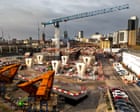
High Speed 2 was already the most expensive railway on earth before the latest round of trade barriers hit the ledger. Now, the government's decision to extend steel safeguards and slap new tariffs on imports has turned a manageable budget gap into a systemic failure. By prioritizing the survival of a shrinking domestic steel industry over the delivery of national infrastructure, the UK has effectively taxed its own tax-funded projects.
The math is brutal. Construction firms tied to HS2 and other major regional builds are reporting that steel costs now represent a volatile, uncontrollable variable that could push project overheads up by another 10% to 15% this year. It is a feedback loop of economic protectionism where the state pays more for a bridge to "protect" the factory making the girders, even when that factory cannot meet the specific technical demands of the project.
The Illusion of Domestic Self Sufficiency
The core of the problem lies in a fundamental mismatch between what British steel mills produce and what modern high-speed rail requires. You cannot simply swap a specialized structural beam from a European or Asian mill for a domestic alternative if the domestic version does not exist.
Britain's steel industry has spent decades pivoting toward higher-margin, specialized niches or, conversely, struggling to keep aging blast furnaces operational. When the government imposes tariffs on the types of heavy-duty, high-grade steel that HS2 demands, it isn't forcing contractors to "buy British." It is forcing them to pay a premium for the same imports they were already using. There is no domestic substitute to pivot to.
This is not a theoretical supply chain hiccup. It is a direct transfer of wealth from the Department for Transport’s infrastructure budget into the pockets of global steel conglomerates and the Treasury’s customs coffers. The construction industry is caught in the middle, holding fixed-price contracts signed in a pre-tariff world that no longer exists.
How Trade Safeguards Become Construction Taxes
Trade safeguards are designed to prevent "dumping"—the practice of foreign state-subsidized firms flooding a market with cheap product to kill off local competition. However, in the current UK context, these safeguards act as a ceiling on national growth.
When the Trade Remedies Authority recommends extending these measures, they are looking at the health of a few specific plants in Port Talbot or Scunthorpe. They are rarely looking at the 2.5 million people employed in the broader UK construction and engineering sectors.
For a firm working on an HS2 viaduct, the procurement process involves years of planning. They specify exact grades of steel. If a new 25% tariff is suddenly applied to that specific grade because of a trade dispute that has nothing to do with the railway, the contractor has two choices. They can eat the cost and risk insolvency, or they can trigger "force majeure" or "change in law" clauses that pass the bill straight back to the taxpayer.
The taxpayer loses twice. First, they pay for the tariff at the border. Second, they pay the inflated price of the railway.
The Quality Gap and the Technical Reality
The debate often ignores the technical reality of modern engineering. Infrastructure of this scale requires specific metallurgical properties—fatigue resistance, seismic flexibility, and exact carbon compositions.
Much of the steel required for the specialized rolling stock and the high-tension track systems for HS2 isn't even made in the UK. By applying blanket tariffs across broad categories of steel, the government is penalizing innovation. Engineering firms are being told to build the future of British transport using a procurement strategy that belongs in the 1950s.
Smaller contractors are the first to feel the snap. While the "Tier 1" giants have enough balance sheet weight to negotiate, the specialized subcontractors—the people actually bending the rebar and welding the frames—are seeing their margins vanish. When these firms go under, the expertise disappears with them. This creates a secondary crisis: a lack of skilled labor that will haunt the industry long after the steel prices stabilize.
Comparison of Steel Pricing Pressures
| Factor | Impact on Infrastructure Cost | Root Cause |
|---|---|---|
| Import Tariffs | High (Direct) | Government protectionist policy |
| Energy Costs | Medium (Indirect) | Industrial electricity price disparity |
| Logistics | Low | Port congestion and driver shortages |
| Currency Fluctuation | High | Weakness of the Pound vs Euro/USD |
The Hidden Cost of Policy Contradiction
There is a glaring lack of synchronization between the Department for Business and Trade and the Department for Transport. One department is tasked with lowering the cost of living and improving national connectivity. The other is tasked with shielding a legacy industry from the realities of the global market.
These two goals are currently in a head-on collision.
The "exacerbation" mentioned by industry leaders is an understatement. We are witnessing the slow-motion cannibalization of the UK's capital investment program. If the cost of steel continues to be artificially inflated by trade barriers, the government will eventually have to choose between finishing the projects it started or keeping the remaining steel mills on life support. You cannot have both in a high-inflation environment.
Consider the ripple effect on housing. While HS2 is the most visible victim, the same steel goes into the frames of apartment blocks and the reinforcement of hospitals. Every pound added to the cost of a tonne of steel is a pound taken away from the number of affordable units a developer can justify. The crisis is not confined to a single railway line in the Midlands; it is a weight tied to the ankles of the entire British economy.
Breaking the Cycle of Protectionist Decay
The solution is not a simple removal of all tariffs, which would likely lead to the immediate collapse of what remains of domestic primary steelmaking. Instead, there must be a move toward "Project-Specific Exemptions."
If a piece of national infrastructure is deemed "nationally significant," the materials required for its completion should be exempt from trade safeguards if domestic industry cannot meet the volume or technical specification within a reasonable timeframe. This would protect the taxpayer from paying an internal tax on their own investment.
The construction industry does not need more "robust" dialogues or "holistic" reviews. It needs a predictable pricing environment. Currently, bidding on a major UK project is less like engineering and more like gambling on the mood of trade negotiators in London and Brussels.
Stop treating steel as a political football and start treating it as the foundational requirement for a modern state. Until the government recognizes that its trade policy is actively sabotaging its infrastructure policy, the costs of building anything in Britain will continue to be the highest in the world.
The bill is coming due. The Treasury can either stop taxing its own builders or watch as the cranes across the country's biggest sites slowly grind to a halt.
Inventory the steel sitting in the yards of every major UK project today. You will find it is increasingly stamped with the marks of foreign mills, now carrying a price tag inflated by a government that claims to be on the side of the builder. This is the reality of the British construction crisis: a self-inflicted wound that is being dressed in the flag of industrial protectionism.