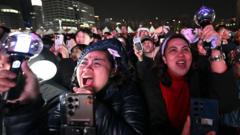
The long-awaited reunion of BTS was supposed to be the financial "all-clear" signal for HYBE. After three years of military-induced hiatus, the septet finally took the stage at Gwanghwamun Square on March 21, 2026, for their "Arirang" comeback show. Instead of a triumphant market rally, HYBE shares cratered by 14.5% on the Monday following the event, wiping out nearly $1 trillion won in market value.
While surface-level reports point to a "weak turnout" as the culprit, the reality is far more complex. The disconnect between the 260,000 attendees predicted by police and the roughly 40,000-60,000 estimated by city data trackers has exposed deep-seated anxieties about HYBE's valuation in a post-hiatus world. Investors aren't just reacting to empty seats; they are reacting to the realization that the "BTS premium" may no longer be an infinite resource.
The Math of Expectations vs Reality
For years, analysts have modeled HYBE’s 2026 recovery on the assumption of a flawless, record-shattering return. Institutional bulls had pushed target prices as high as 550,000 won, betting on a "BTS effect" that would dwarf even the Olympics in economic impact. When the Gwanghwamun show drew an estimated 42,000 to 100,000 people—depending on whether you trust Seoul City data or HYBE’s internal carrier-based metrics—the narrative of an unstoppable global juggernaut hit a wall of cold, hard numbers.
The problem isn't a lack of fans. It’s the friction of the modern "superfandom" economy. Strict crowd-control measures, implemented with a heavy hand by Seoul authorities wary of past tragedies, physically prevented the kind of organic, sprawling street festival that investors use to gauge cultural momentum. When police spend the entire set shouting at non-ticket holders to "keep moving," the atmospheric data points—the "buzz" that justifies a 37x price-to-earnings ratio—simply vanish.
Insider Selling and the Confidence Gap
Smart money was already backing toward the exit before the first note of "Arirang" was played. In January, HYBE disclosed a sale of 24,500 shares at a staggering 36% discount to market price. This wasn't a routine liquidation; it was a signal. When the company’s own leadership cashes out $3.5 million worth of stock during a rally, they are essentially telling the market that the current price has peaked.
Institutional investors hate being the last ones holding the bag. The weekend’s turnout discrepancy provided the perfect excuse for a broader sell-off. If the "biggest comeback in history" can't fill a city square to its projected capacity, the secondary revenue streams—the $1.2 trillion won projected from the upcoming 79-show world tour—suddenly look like they might be based on aggressive, best-case-scenario accounting.
The Margin Trap
HYBE spent 2024 and 2025 diversifying. They expanded into Latin America, India, and the U.S. through massive acquisitions and the launch of global acts like KATSEYE. These were expensive bets intended to prove the company could survive without its seven core stars.
The results have been bruising. Operating profits for 2025 plunged 73% compared to the previous year, with operating margins thinning to a razor-sharp 1.9%. HYBE is no longer a lean K-pop label; it is a sprawling, high-overhead global media conglomerate. This transformation means the company now requires BTS to not just be "successful," but to perform at a level of profitability that compensates for the losses of its international subsidiaries.
Why the Gwanghwamun Show was a Warning Shot
- Crowd Friction: The discrepancy in attendance figures suggests that "demand" is being throttled by logistics and regulation, limiting the "spillover" economic impact that once fueled local merchant support and positive press.
- Merchandise Saturation: While album sales for the new "Arirang" project remain strong at nearly 4 million units, the growth is linear, not exponential. The market had priced in an explosion that didn't happen.
- The Valuation Ceiling: At a 344,000 won share price, HYBE was priced for perfection. Any deviation from a "national festival" atmosphere is interpreted by the algorithmic trading desks as a failure of the brand’s core IP.
The New Reality of the Global Tour
The upcoming world tour is still projected to be a massive earner, with 44% of shows situated in high-margin regions like North America and Europe. However, the Gwanghwamun "shortfall" raises a terrifying question for the C-suite in Yongsan: Has the three-year hiatus allowed the global audience to diversify their attention?
The K-pop landscape of 2026 is significantly more crowded than it was in 2022. Competitors have filled the void, and HYBE’s own internal labels are cannibalizing each other for the same limited pool of "stan" dollars. When you factor in the rising costs of global logistics and the premium pricing of tickets (averaging 270,000 won), the risk of "fan fatigue" becomes a tangible metric that analysts can no longer ignore.
The stock's 14.5% plunge is a correction of sentiment, not necessarily a reflection of the group's talent or popularity. It is the sound of the market realizing that the "BTS recovery" is a marathon, not a sprint. If HYBE cannot translate the "Arirang" era into consistent, high-margin growth across its entire ecosystem, the era of the K-pop agency as a blue-chip stock market darling may be coming to a close.
Watch the ticket resale data for the Chicago and London dates; that is where the true health of this comeback will be revealed.