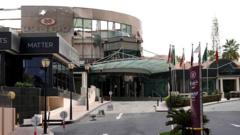
The notification arrives with a sterile, rhythmic ping. It is a sound usually reserved for grocery deliveries or calendar reminders. But for a British family currently sitting in a darkened apartment in Beirut, that tiny electronic pulse represents the only tether to a home that feels a thousand miles further away than it did yesterday. They aren't just tourists anymore. They are data points in a massive, invisible ledger of anxiety.
More than 100,000 British nationals have now signaled to their government that they are standing by the door.
This isn't a simple list. It is a digital manifestation of a collective breath being held. When the Foreign, Commonwealth & Development Office (FCDO) opened its registration portal, the numbers didn't just trickle in; they surged. To look at that figure—100,000—is to see a stadium filled to capacity, every single person looking toward the same exit.
The Weight of a Registration
Registering your presence in a conflict zone is a peculiar psychological act. It is a confession of vulnerability. For many of the Britons in Lebanon and the wider Middle East, the decision to click "submit" on a government form is the moment the theoretical becomes visceral.
Consider a hypothetical, yet representative, case: Sarah, a teacher who has lived in the region for a decade. Her life is there. Her books, her cat, her friends, and her history are all woven into the fabric of a city that currently vibrates with the low hum of distant uncertainty. For years, she ignored the "travel advice" emails. They were background noise. But this week, she filled out the form.
When Sarah enters her passport number into the system, she is effectively saying, I can no longer guarantee my own safety. This surge in registrations is the largest of its kind in recent memory. It dwarfs the numbers seen during the initial shocks of the pandemic or the sudden collapses of other regional stabilities. It suggests that the British public abroad has reached a tipping point of pragmatism. They are no longer waiting to see what happens next. They are preparing for what happens when "what happens next" is no longer manageable.
The Logistics of the Invisible
What does the government actually do with a list of 100,000 names?
It is a common misconception that registration guarantees a seat on a plane. It doesn't. Instead, it creates a heat map of human need. The FCDO uses this data to understand where the clusters are, which airports are still viable, and how many children might need specialized care if a mass departure becomes necessary. It is a logistical blueprint for a nightmare scenario.
The sheer scale of this list presents a terrifying math problem. If you have 100,000 people and a standard charter flight carries 200, you need 500 flights. That is an armada. It is a feat of coordination that requires not just planes, but clear skies, open runways, and the diplomatic permission to move through contested airspace.
The government’s messaging has shifted from "stay alert" to a much more pointed directive: Leave now while commercial options are available.
There is a cold logic to this. A commercial flight is a choice made in relative comfort. An evacuation flight is a necessity born of chaos. The 100,000 people on that list are currently balanced on the knife-edge between those two realities. They are checking flight prices every hour, watching the blue bars on travel websites move slowly across the screen, hoping the "Book Now" button still works.
The Silence Between the Lines
Behind the raw statistics lies a profound sense of isolation. For those living through this, the news isn't a headline; it’s the sound of the street outside. It’s the way the local baker looks at you when you buy three times the usual amount of bread. It’s the "What if?" that sits at the dinner table.
The 100,000 Britons registered are not a monolith. They are dual nationals with deep roots, business travelers caught in a bad calendar window, and young families who moved for adventure only to find themselves in an epic they didn't sign up for.
Some are refusing to leave. For them, registering is a "just in case" measure, a security blanket they hope never to unfold. They are the ones who look at their apartments—the art on the walls, the plants they’ve watered for years—and cannot fathom walking away with only what they can carry in a backpack.
What do you pack when you are one of 100,000?
You pack the irreplaceable. Documents. Hard drives. A child’s favorite stuffed animal. The rest—the furniture, the cars, the careers—becomes secondary to the primary directive of biology: survival.
The Friction of Choice
The government is currently operating in a state of high-tension readiness. Border Force officials, consular staff, and military planners are staring at the same screens we are, but they are looking at the infrastructure of the exit. They are measuring the distance between a port and a safe haven. They are calculating fuel loads and crew rotations.
But the friction isn't just logistical. It's emotional.
There is a specific kind of guilt that comes with being a citizen of a country that has the power to come and get you. As Sarah (our hypothetical teacher) stands in line at a local market, she knows that her British passport is a golden ticket that her neighbors do not possess. That little burgundy or blue booklet represents a promise of extraction.
This creates a haunting tension. The 100,000 are not just worried about getting out; they are worried about what they are leaving behind. They are worried about the friends who don't have a portal to register on, and the communities that will remain long after the charter flights have vanished into the clouds.
The Reality of the "Last Flight"
History is littered with the ghosts of "last flights." We have seen the grainy footage of people running across tarmacs, the desperate scramble for the final seats, the closing of hangar doors. The British government is trying desperately to prevent that footage from being filmed again.
The registration of 100,000 people is a preventative strike against chaos. It is an attempt to turn a potential stampede into a calculated withdrawal.
But the window is narrowing.
Every time an airline cancels a route, the pressure on the remaining exits increases. The price of a one-way ticket to London or Manchester spikes. The digital lifeboat gets a little more crowded.
People ask: "Why don't they just leave today?"
The answer is rarely simple. It’s a job that hasn't officially ended. It’s a spouse who is waiting for their own paperwork. It’s the hope—the stubborn, human hope—that tomorrow the news will be better. That the registration was just a formality. That the "stay" will outweigh the "go."
The Invisible Ledger
As the sun sets over the Mediterranean, 100,000 phones are plugged into chargers. 100,000 people are checking their inboxes for an update from the FCDO.
The number is more than a statistic. It is a testament to the fragility of our global lives. We live in a world where we can be in a vibrant, bustling city on Tuesday and a data point on an emergency evacuation list by Wednesday.
The government portal remains open. The count will likely climb. Each new entry is a story of a life interrupted, a suitcase being pulled from the back of a closet, and a family sitting around a laptop, debating whether today is the day they finally walk away.
The digital ledger is full. The planes are fueled. All that remains is the wait.
The apartment in Beirut is quiet now, save for the hum of the refrigerator and the occasional notification on a phone. Sarah looks at her packed bag by the door. She isn't a teacher today. She isn't a resident. She is simply a name on a list, waiting for the signal to become a passenger.