The sky over the Kuwaiti desert is rarely just blue. It is a heavy, pressurized expanse of sapphire and dust, a ceiling that feels close enough to touch but vast enough to drown in. On a Tuesday that should have been defined by nothing more than the routine hum of regional security, that sky suddenly tore open.
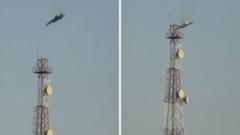
Grainy cell phone footage began to circulate, the kind of digital debris that defines our modern era of instant witness. In the frame, a dark shape—unmistakably the twin-tail silhouette of an F-15—plummets. There is no Hollywood explosion, no cinematic trail of fire. There is only the sickening, inexorable pull of gravity. The jet, a marvel of aerospace engineering worth roughly $30 million, becomes a dead weight. It hits the sand, and for a split second, the world seems to hold its breath before the black plume of smoke signals the earth has claimed its prize.
The Anatomy of a Falling Star
To understand what happened in that patch of desert, you have to look past the hardware. We talk about the F-15 Eagle as if it is an invincible titan. Since its inception, it has been the gold standard of air superiority, boasting a combat record that looks more like a tall tale than a military ledger. But inside that cockpit, tucked behind the glass canopy and the glowing heads-up display, is a human being.
When a fighter jet goes down, we usually rush to the technicalities. Was it a bird strike? Did the Pratt & Whitney engines suffer a catastrophic compressor stall? Was it a flight control malfunction that turned the pilot’s joystick into a useless piece of plastic? These are the questions investigators from the Air Force Safety Center will spend months answering. They will sift through charred carbon fiber and twisted titanium, looking for the "black box" that holds the final heartbeat of the aircraft’s systems.
But the real story isn't in the metal. It's in the silence that follows the ejection.
The Invisible Stakes of the Ejection Seat
Think about the physical toll of leaving a crippled aircraft. In the video, if you look closely at the moments before impact, there is a flicker—the split-second sequence of the canopy blowing away and the rocket motors under the seat firing.
An ejection is not a graceful exit. It is a controlled explosion. In less than a second, a human body is subjected to forces of up to 20Gs. It is enough to compress spinal discs, to bruise the soul, to leave a pilot gasping for air as they dangle from a parachute while their multi-million dollar office disintegrates on the dunes below.
The pilot in this incident survived. That is the only fact that truly matters in the ledger of the day. The Pentagon confirmed the recovery, a brief statement that hides a whirlwind of frantic radio chatter, SAR (Search and Rescue) scrambled helicopters, and the crushing weight of relief felt by a family thousands of miles away.
Why the Desert Smells of High Stakes
Why was an F-15 over Kuwait in the first place? This isn't just about a training exercise.
The presence of U.S. airpower in the Persian Gulf is a constant, rhythmic pulse. Kuwait serves as a critical node in a network of bases that keep the region from tipping into chaos. Every time a jet takeoffs from Ahmad al-Jaber Air Base, it carries the weight of international diplomacy on its wings. These flights are a message. They are a deterrent.
When a jet crashes, that message flickers. For a moment, the invincibility of the machine is stripped away. Adversaries watch the smoke on the horizon and take notes. Allies look at the wreckage and wonder about maintenance cycles and the aging fleet of an Air Force stretched thin across multiple continents.
The F-15 is a legacy platform. Some of the airframes currently screaming through the sky are older than the pilots flying them. While the newer "EX" models are rolling off the lines, many of the jets in the Middle East have spent decades enduring the brutal heat and abrasive sand of the desert. Sand isn't just dirt; it’s an abrasive that finds its way into the smallest tolerances of a jet engine, acting like sandpaper on the turbines that keep the beast aloft.
The Human Cost of Readiness
We often treat military technology as a series of statistics. We see "100% survival rate" or "Class A Mishap" and we move on to the next headline. But consider the pilot who walked away from that wreckage.
That individual woke up, had coffee, perhaps checked an app on their phone, and then climbed into a machine designed to defy the laws of physics. They spent their morning balancing at the edge of a stall, managing fuel flow, and monitoring radar sweeps. Then, in a heartbeat, they were a pedestrian in the middle of a wasteland, watching their career's primary tool burn into the sand.
There is a psychological shadow that follows a crash. It stays in the flight brief rooms. It lingers in the hangars where the maintainers—the 19 and 20-year-old airmen who turn the wrenches—now wonder if they missed a hairline fracture or a loose bolt.
The investigation will eventually produce a report hundreds of pages long. It will cite "Angle of Attack" and "Hydraulic Pressure." It will use sterile language to describe a terrifying event.
But the footage on social media tells a different story. It reminds us that for all our sensors, all our stealth coatings, and all our geopolitical posturing, we are still small. We are still fragile. We are still building machines that the earth occasionally decides to take back.
As the sun sets over the Kuwaiti border, the recovery teams will finish their work. They will haul away the jagged pieces of the Eagle. The sand will eventually shift, blown by the northern winds, covering the scorched earth where the jet met its end. But for the pilot who felt the jolt of the rockets and the snap of the silk parachute, the desert will never look the same again. It is no longer just a landscape. It is the place where they learned, with visceral clarity, exactly what it costs to touch the sun.
The smoke clears, but the gravity remains.