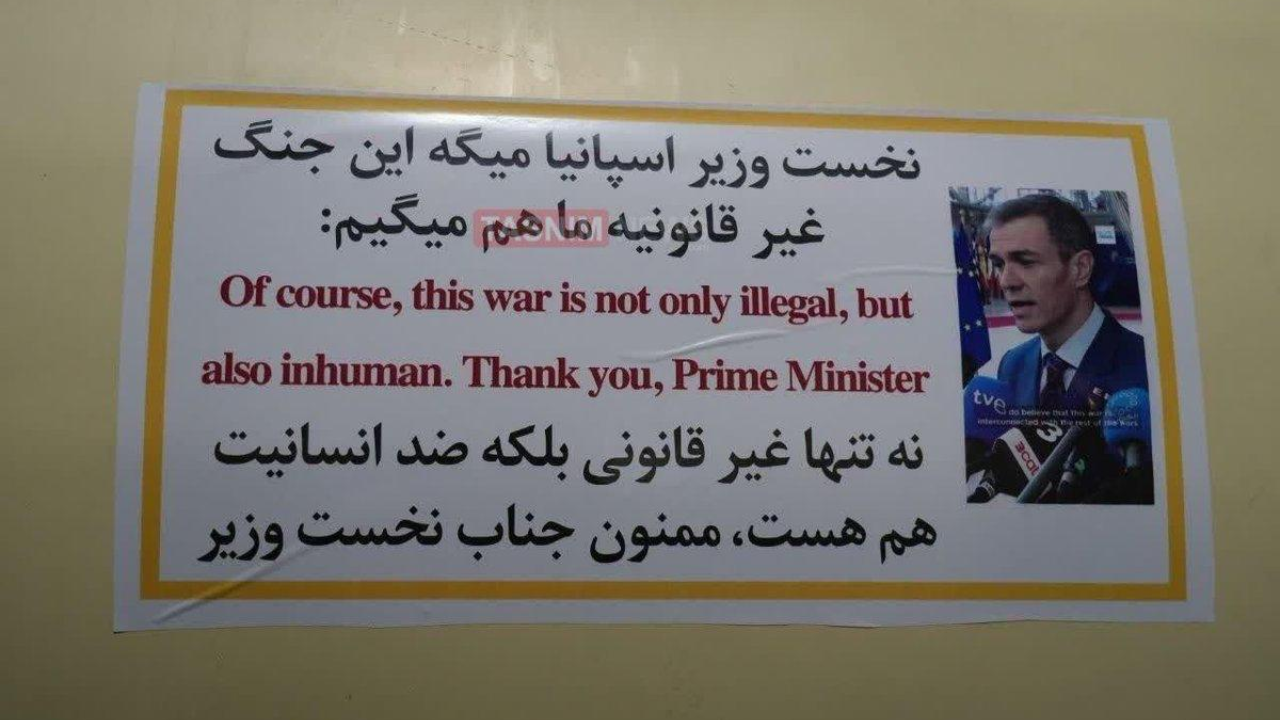
The image is jarring and intentionally surreal. A massive ballistic missile, a machine designed for singular destruction, sits on a launcher draped in a message of peace. Specifically, it bears the words of Spanish Prime Minister Pedro Sánchez. "Illegal, inhuman," the text reads, echoing Sánchez’s own condemnation of the violence in Gaza. It’s a masterclass in dark irony. Iran isn’t just firing metal and explosives anymore. They’re weaponizing Western rhetoric to justify their own regional escalations.
This isn't just a PR stunt. It’s a calculated move to flip the script on international law. By literally sticking a "no war" message onto a weapon of war, Tehran is telling the world that their strikes against Israel are the actual path to peace. It’s a bold, cynical attempt to claim the moral high ground while the Middle East teeters on the edge of a much larger conflagration.
The Weaponization of Western Diplomacy
Tehran has a long history of using billboards and murals to send messages, but this latest tactic is different. It targets the internal divisions within Europe and the West. When Pedro Sánchez spoke out against the humanitarian crisis in Gaza, he was speaking to his domestic base and the European Union. He wasn't providing a tagline for an Iranian missile battery.
By using his words, Iran attempts to create a false equivalence. They want to suggest that if a Western leader calls the situation in Gaza "inhuman," then any military action Iran takes against Israel is a legitimate enforcement of that sentiment. It’s a brilliant, if terrifying, bit of psychological editing. They take a plea for de-escalation and turn it into a justification for a barrage.
The missiles in question are part of Iran's increasingly sophisticated arsenal. We aren't looking at old Soviet leftovers. These are precision-guided instruments. When you see a "no war" sticker on a Haj Qasem or a Kheibar Shekan missile, you're looking at a message meant for the cameras as much as the target. It’s designed to go viral on social media, blurring the lines between humanitarian activism and state-sponsored militancy.
Why the Spanish Connection Matters
Spain has taken one of the most critical stances toward Israel within the European Union. Sánchez has been vocal about recognizing Palestinian statehood and has frequently clashed with the Netanyahu government. This makes his rhetoric the perfect raw material for Iranian propagandists.
Iran isn't picking quotes from leaders who are staunchly pro-Israel. They're cherry-picking from those who are already critical. This serves two purposes. First, it creates friction between Western allies. Imagine the diplomatic headache in Madrid when the Prime Minister’s words are literally plastered on the side of a rocket heading toward Tel Aviv. Second, it signals to the "Global South" that Iran is the only power actually "acting" on the words that Western leaders only say.
The irony is thick. Spain is a NATO member. It’s part of the very security architecture that Iran often decries as imperialist. Yet, in this specific instance, the Islamic Revolutionary Guard Corps (IRGC) finds it useful to play the role of the reluctant enforcer of Spanish "morality."
Beyond the Stickers
We have to look at the hardware. The propaganda works because the threat is real. In the recent exchanges between Iran and Israel, the sheer volume of projectiles has changed the math of Middle Eastern warfare. We saw hundreds of drones and missiles launched in single waves.
These aren't just "protest" launches. They are tests of the world’s most advanced air defense systems. Every time an Iron Dome interceptor hits a "peace-labeled" Iranian missile, Iran gathers data. They learn about saturation points. They learn about response times. The stickers are for the public, but the flight paths are for the generals.
The Iranian strategy is to make the cost of defending Israel's airspace unsustainable. By framing this as a moral crusade backed by Western "admissions" of illegality, they hope to soften the international community's resolve to keep funding those defenses. It's a long game. They’re betting that eventually, the Western public will get tired of the contradiction between their leaders' words and their military support.
The New Era of Kinetic Propaganda
We used to think of propaganda as posters or radio broadcasts. Today, propaganda is kinetic. It’s an object that flies. The "no war" missile is the ultimate symbol of this era. It forces the viewer to hold two opposing ideas at once. It’s a weapon, but it says "peace." It’s an attack, but it claims to be a defense of the "inhumanly" treated.
This tactic also targets the anti-war movements within Western countries. It attempts to co-opt their language, making it harder for activists to distance themselves from the actions of a regime like Iran’s. If you use the same words as the missile, does that mean you support the missile? That’s the wedge Iran is trying to drive into the heart of Western political discourse.
It’s also a direct challenge to the concept of international law. By labeling their actions with the Prime Minister's words, Iran is essentially saying that the current international order is a sham. They are claiming the right to interpret "legality" through the lens of their own strategic interests.
What Happens When the Rhetoric Fails
Propaganda has its limits. A sticker doesn't change the trajectory of a missile, and it doesn't change the geopolitical reality of a direct state-on-state conflict. While the IRGC might enjoy the cleverness of their messaging, the reality on the ground is far more grim.
The escalatory ladder in the Middle East has fewer rungs than it used to. We've moved past the era of proxy-only wars. Now, it's direct. When missiles start flying from Iranian soil toward Israel, the time for clever wordplay is mostly over. The "no war" message becomes a dark joke in the face of actual explosions.
If you're following these developments, don't get distracted by the surface-level irony. Look at the logistics. Watch the shipping lanes in the Persian Gulf and the movements of the IRGC's missile divisions. The labels might be Spanish, but the intent is purely Iranian.
The most effective way to counter this kind of psychological warfare is to see it for what it is. It's an attempt to paralyze decision-making by creating moral confusion. When the news shows a missile with a "peace" quote, remember that the quote was stolen and the missile is real. The goal isn't to start a conversation about human rights; it's to end one.
Stay informed by looking at the source of the quotes and the context of the launches. Don't let a viral photo obscure the strategic reality of regional destabilization. The best response to kinetic propaganda is a clear-eyed understanding of the motives behind the theater.