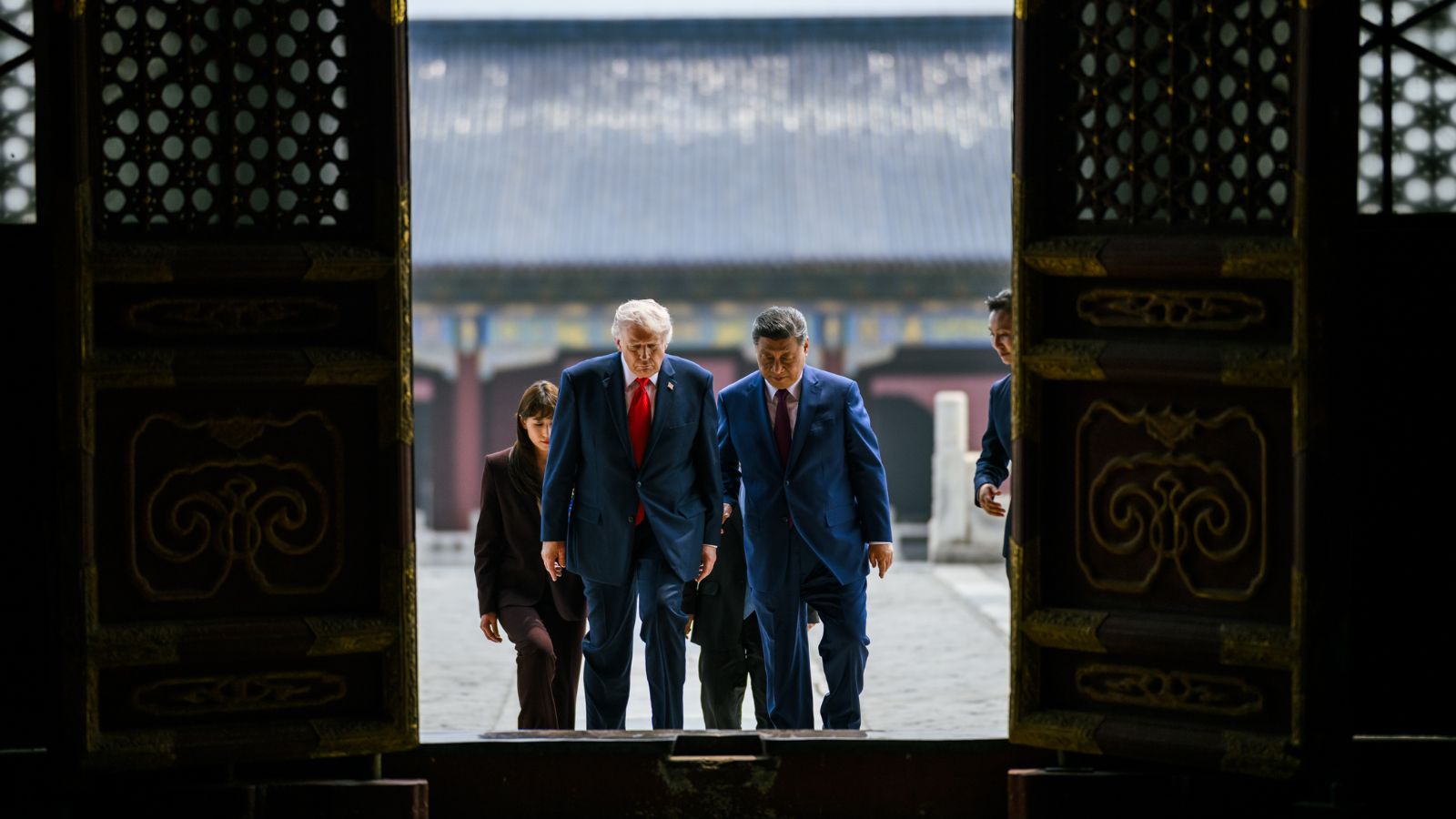
The foreign policy establishment is running its favorite play again, and it is completely missing the field.
Mainstream analysts look at Donald Trump walking the manicured grounds of Zhongnanhai with Xi Jinping, dropping the tariff rate from 57% to 47%, and bringing a tail of American CEOs to Beijing, and they declare a "learning curve" has ended in conciliation. They see a chastened American president, boxed in by domestic inflation and a grinding conflict involving Iran, finally bending to the realities of global macroeconomic codependency.
They are dead wrong. This isn't conciliation. It is a terrifyingly transactional shift that replaces long-term strategic positioning with short-term corporate asset preservation.
The lazy consensus insists that by focusing on corporate deliverables—getting Beijing to buy Boeing aircraft, clearing Nvidia's artificial intelligence hardware for export, and setting up a bilateral "Board of Trade"—Washington is stabilizing the relationship. It isn't stabilization; it is financial capitulation disguised as a diplomatic win. I have spent decades watching executive teams mistake a temporary truce for structural victory. When you trade core geopolitical leverage for a bump in next quarter’s corporate earnings, you haven't won a negotiation. You’ve surrendered your position for a line item.
The Illusion of the Tariff Truce
Let’s dismantle the economic fantasy holding this summit together. The standard narrative claims that dropping the tariff headline rate to 47% is a pragmatic move to cool the domestic inflationary fires stoked by the Middle East crisis.
This ignores the actual mechanics of modern trade infrastructure. A 10% drop in tariffs does not suddenly make American supply chains resilient. It merely signals to global markets that the United States lacks the industrial stamina to finish what it started.
Imagine a scenario where an automotive company spends hundreds of millions of dollars to diversify its component sourcing away from Shenzhen, moving assembly lines to Vietnam or Mexico to hedge against geopolitical risk. Suddenly, Washington reverses course because the political pain of inflation becomes unpalatable. The tariff drops, the economic incentive to decouple evaporates, and American capital flows right back into the state-subsidized manufacturing engine of the mainland.
This policy whiplash destroys corporate planning. It punishes the companies that actually invested in supply chain resilience and rewards the laggards who stayed addicted to cheap Chinese manufacturing. By treating trade policy like an adjustable thermostat rather than a permanent structural wall, Washington has ensured that American industry remains fundamentally dependent on a systemic adversary.
The Real Cost of the Tech Compromise
The most dangerous element of this Beijing summit isn't the agricultural purchase commitments or the Boeing orders. It is the quiet capitulation on advanced computing infrastructure.
The corporate delegation traveling with the White House has a transparent agenda: reopen the pipeline for high-performance silicon. Silicon Valley executives want restrictions eased on specialized processors designed for artificial intelligence workloads. They argue that blocking these sales simply starves American tech giants of revenue while forcing Beijing to accelerate its domestic chip fabrication capabilities.
This argument is a self-serving trap. The reality of technological competition is that dual-use technology cannot be compartmentalized into "safe" commercial buckets. A GPU sold to optimize consumer software in Shanghai can be reallocated to optimize hypersonic flight paths or cryptographic decryption protocols tomorrow morning.
[US High-Tech Silicon Export] ──> [Chinese Corporate Entity] ──> [Dual-Use Military Application]
By floating communication channels and regulatory exceptions for AI hardware under the banner of a "Board of Trade," the administration is trading away the only real bottleneck the West has over eastern technological parity. The assumption that we can manage tech competition through dialogue while actively feeding their compute infrastructure is pure corporate delusion.
The Taiwan Transaction
The establishment press is terrified by Xi Jinping’s explicit warnings about the "Thucydides Trap" and potential military conflict over Taiwan. They parse Trump's hesitation over delivering the pre-approved $11 billion arms package as a sign of diplomatic pragmatism—an effort to prevent an accidental war while the U.S. military is stretched thin by peripheral conflicts.
Let's call this what it is: the financialization of a sovereign security guarantee.
When a superpower signals that a defense package approved by its own legislature is open to negotiation during a trade summit, it tells the world that its alliances are not strategic anchor points, but bargaining chips. This destroys the core element of strategic deterrence: credibility.
If Beijing believes that American defense commitments can be bought off with a massive purchase of liquified natural gas or a promise to stabilize rare earth export quotas, then the risk of miscalculation skyrockets. Deterrence does not fail because one side lacks weapons; it fails because one side calculates that the opposition lacks the stomach to enforce its red lines. The current diplomatic posturing makes that calculation look cheaper by the day.
The Strategic Bankruptcy of the CEO Delegation
Look at who is celebrating the outcomes of this summit. It isn't the defense planners or the industrial strategists; it is the multi-national executives who view global geopolitics through the lens of a quarterly earnings call.
We are told that bringing corporate titans into the diplomatic tent creates a stabilizing layer of shared economic interest. This is a profound misunderstanding of the Chinese economic model. A Western CEO answers to an independent board and public shareholders hungry for short-term returns. A Chinese enterprise leader answers to the state apparatus.
When American executives sit across the table in Beijing negotiating market access for aviation or tech, they are not operating as ambassadors of Western values. They are operating as structural hostages. They will gladly trade away IP security, long-term technological dominance, and supply chain sovereignty if it means maintaining access to a consumer base or keeping their manufacturing plants running without disruption.
The administration’s transactional approach turns these corporate vulnerabilities into official state policy. It assumes that if the trade numbers look green, the strategic ledger is balanced. It is a fundamental misdiagnosis of a multi-dimensional competition that cannot be settled by a purchase order.
The summit in Beijing didn't show a leader who has mastered the learning curve of global statecraft. It showed a system that has forgotten how to play the long game, trading its structural leverage for the illusion of a corporate peace.
The strategic reality of the US-China relationship requires a deeper analysis of how trade and technology interlock, a dynamic examined closely in this discussion on the strategic competition between Washington and Beijing, which provides critical context on why treating geopolitical rivalry as a series of simple business deals ultimately undermines long-term American leverage.